




For the adjacency matrix of a directed graph the row sum is the ___________ degree and the column sum is the ___________ degree.
A.In , out
B.Out , in
C. In , total
D.Total , out
Answer
 Verified
548.1k+ views
Hint: In the adjacency matrix of a directed graph the in degree of a vertex is given by the sum of the entries of the respective column and the out degree of a particular vertex is given by the sum of the entries of the row of the respective column.
Complete step-by-step answer:
Adjacency matrix of a directed graph
An adjacency matrix is a matrix which describes a graph by representing which vertices are adjacent to which other vertices.
If G is a graph of order n , then its adjacency matrix is a square matrix of order n, where each row and column correspond to a vertex of G
The element ${a_{ij}}$of such a matrix specifies the number of edges from vertex i to vertex j.
An example of a directed graph is given
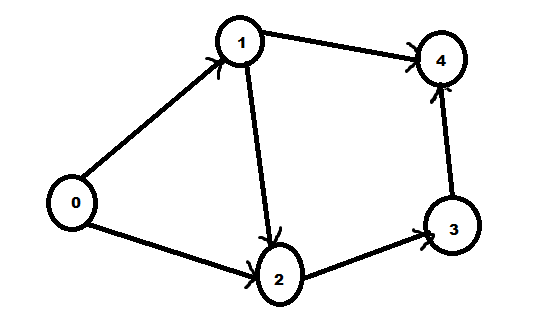
Its adjacency matrix can be given by
$\begin{gathered}
{\text{ }}\begin{array}{*{20}{c}}
0&1&2&3
\end{array}{\text{ 4}} \\
\begin{array}{*{20}{c}}
0 \\
1 \\
2 \\
\begin{gathered}
3 \\
4 \\
\end{gathered}
\end{array}\left[ {{\text{ }}\begin{array}{*{20}{c}}
0 \\
0 \\
0 \\
\begin{gathered}
0 \\
0 \\
\end{gathered}
\end{array}{\text{ }}\begin{array}{*{20}{c}}
1 \\
0 \\
0 \\
\begin{gathered}
0 \\
0 \\
\end{gathered}
\end{array}{\text{ }}\begin{array}{*{20}{c}}
1 \\
1 \\
0 \\
\begin{gathered}
0 \\
0 \\
\end{gathered}
\end{array}{\text{ }}\begin{array}{*{20}{c}}
0 \\
0 \\
1 \\
\begin{gathered}
0 \\
0 \\
\end{gathered}
\end{array}{\text{ }}\begin{array}{*{20}{c}}
0 \\
1 \\
0 \\
\begin{gathered}
1 \\
0 \\
\end{gathered}
\end{array}{\text{ }}} \right] \\
\end{gathered} $
In degree of an adjacency matrix
The sum of entries in the column j of the adjacency matrix equals to the in degree of the vertex ${v_j}$
Now with the given graph
We can see the in degree of ${v_0}$ = sum of entries in column 0 = 0
We can see the in degree of ${v_1}$ = sum of entries in column 1 = 1
We can see the in degree of ${v_2}$ = sum of entries in column 2 = 2
We can see the in degree of ${v_3}$ = sum of entries in column 3 = 1
We can see the in degree of ${v_4}$ = sum of entries in column 4 = 2
Out degree of an adjacency matrix
The sum of entries in the row i of the adjacency matrix equals to the out degree of the vertex ${v_i}$
From the above definitions we get that , for the adjacency matrix of a directed graph the row sum is the out degree and the column sum is the in degree.
Now with the given graph
We can see the out degree of ${v_0}$ = sum of entries in row 0 = 2
We can see the out degree of ${v_1}$ = sum of entries in row 1 = 2
We can see the out degree of ${v_2}$ = sum of entries in row 2 = 1
We can see the out degree of ${v_3}$ = sum of entries in row 3 = 1
We can see the out degree of ${v_4}$ = sum of entries in row 4 = 0
The correct option is B.
Note: The adjacency matrix of a directed graph can be asymmetric. One can define the adjacency matrix of a directed graph either such that
a non-zero element ${A_{ij}}$ indicates an edge from i to j or
it indicates an edge from j to i.
Complete step-by-step answer:
Adjacency matrix of a directed graph
An adjacency matrix is a matrix which describes a graph by representing which vertices are adjacent to which other vertices.
If G is a graph of order n , then its adjacency matrix is a square matrix of order n, where each row and column correspond to a vertex of G
The element ${a_{ij}}$of such a matrix specifies the number of edges from vertex i to vertex j.
An example of a directed graph is given
Its adjacency matrix can be given by
$\begin{gathered}
{\text{ }}\begin{array}{*{20}{c}}
0&1&2&3
\end{array}{\text{ 4}} \\
\begin{array}{*{20}{c}}
0 \\
1 \\
2 \\
\begin{gathered}
3 \\
4 \\
\end{gathered}
\end{array}\left[ {{\text{ }}\begin{array}{*{20}{c}}
0 \\
0 \\
0 \\
\begin{gathered}
0 \\
0 \\
\end{gathered}
\end{array}{\text{ }}\begin{array}{*{20}{c}}
1 \\
0 \\
0 \\
\begin{gathered}
0 \\
0 \\
\end{gathered}
\end{array}{\text{ }}\begin{array}{*{20}{c}}
1 \\
1 \\
0 \\
\begin{gathered}
0 \\
0 \\
\end{gathered}
\end{array}{\text{ }}\begin{array}{*{20}{c}}
0 \\
0 \\
1 \\
\begin{gathered}
0 \\
0 \\
\end{gathered}
\end{array}{\text{ }}\begin{array}{*{20}{c}}
0 \\
1 \\
0 \\
\begin{gathered}
1 \\
0 \\
\end{gathered}
\end{array}{\text{ }}} \right] \\
\end{gathered} $
In degree of an adjacency matrix
The sum of entries in the column j of the adjacency matrix equals to the in degree of the vertex ${v_j}$
Now with the given graph
We can see the in degree of ${v_0}$ = sum of entries in column 0 = 0
We can see the in degree of ${v_1}$ = sum of entries in column 1 = 1
We can see the in degree of ${v_2}$ = sum of entries in column 2 = 2
We can see the in degree of ${v_3}$ = sum of entries in column 3 = 1
We can see the in degree of ${v_4}$ = sum of entries in column 4 = 2
Out degree of an adjacency matrix
The sum of entries in the row i of the adjacency matrix equals to the out degree of the vertex ${v_i}$
From the above definitions we get that , for the adjacency matrix of a directed graph the row sum is the out degree and the column sum is the in degree.
Now with the given graph
We can see the out degree of ${v_0}$ = sum of entries in row 0 = 2
We can see the out degree of ${v_1}$ = sum of entries in row 1 = 2
We can see the out degree of ${v_2}$ = sum of entries in row 2 = 1
We can see the out degree of ${v_3}$ = sum of entries in row 3 = 1
We can see the out degree of ${v_4}$ = sum of entries in row 4 = 0
The correct option is B.
Note: The adjacency matrix of a directed graph can be asymmetric. One can define the adjacency matrix of a directed graph either such that
a non-zero element ${A_{ij}}$ indicates an edge from i to j or
it indicates an edge from j to i.
Recently Updated Pages
Master Class 11 Social Science: Engaging Questions & Answers for Success

Master Class 11 English: Engaging Questions & Answers for Success
Master Class 11 Maths: Engaging Questions & Answers for Success
Master Class 11 Chemistry: Engaging Questions & Answers for Success
Master Class 11 Biology: Engaging Questions & Answers for Success
Master Class 11 Physics: Engaging Questions & Answers for Success
Trending doubts
Differentiate between an exothermic and an endothermic class 11 chemistry CBSE
There are 720 permutations of the digits 1 2 3 4 5 class 11 maths CBSE
Draw a diagram of a plant cell and label at least eight class 11 biology CBSE
1 Quintal is equal to a 110 kg b 10 kg c 100kg d 1000 class 11 physics CBSE
Which chemical is known as king of chemicals A H 2 class 11 chemistry CBSE
Draw a diagram of nephron and explain its structur class 11 biology CBSE