




For Manganese atom, assuming the Hund’s rule is not valid for $l = 2$ subshell predict the unpaired electrons and electron pairs in that subshell of atom:
A) $5,1$
B) $5,0$
C) $1,2$
D) $1,3$
Answer
 Verified
575.1k+ views
Hint: Hund’s rule of maximum multiplicity states that in a subshell all the orbitals are singly occupied by the electrons first and only after all the orbitals of that subshell are singly occupied, the pairing of electrons takes place.
Complete step by step answer:
The azimuthal quantum number $(l)$ has the values $0,1,2$ and $3$ for the subshells $s, p, d$ and $f$ respectively. So, $l = 2$ corresponds to $d$ subshell.
As the $d$ subshell has five orbitals and assuming that the Hund’s rule is not valid, the filling of orbitals will occur such that each orbital will accommodate two electrons first and then the next orbital will be filled.
For manganese atom, the electronic configuration is,
${}^{25}Mn = [Ar]3{d^5}4{s^2}$
As per the condition, the five electrons in $d$ subshell will be filled as follows,
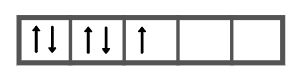
We can see that the number of unpaired electrons in manganese is $1$ and the number of electron pairs is $2$.
Therefore, the answer is option (C).
Note:
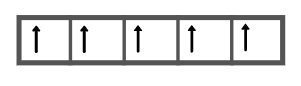
If the Hund’s rule was applicable then for $l = 2$ subshell, that is, for d subshell the filling of orbitals would have been such that each of the orbitals would be singly occupied and only then the pairing of electrons will take place. In that case, the five ‘d’ electrons would have been filled as:
Complete step by step answer:
The azimuthal quantum number $(l)$ has the values $0,1,2$ and $3$ for the subshells $s, p, d$ and $f$ respectively. So, $l = 2$ corresponds to $d$ subshell.
As the $d$ subshell has five orbitals and assuming that the Hund’s rule is not valid, the filling of orbitals will occur such that each orbital will accommodate two electrons first and then the next orbital will be filled.
For manganese atom, the electronic configuration is,
${}^{25}Mn = [Ar]3{d^5}4{s^2}$
As per the condition, the five electrons in $d$ subshell will be filled as follows,
We can see that the number of unpaired electrons in manganese is $1$ and the number of electron pairs is $2$.
Therefore, the answer is option (C).
Note:
If the Hund’s rule was applicable then for $l = 2$ subshell, that is, for d subshell the filling of orbitals would have been such that each of the orbitals would be singly occupied and only then the pairing of electrons will take place. In that case, the five ‘d’ electrons would have been filled as:
Recently Updated Pages
Master Class 11 English: Engaging Questions & Answers for Success

Master Class 11 Social Science: Engaging Questions & Answers for Success
Master Class 11 Maths: Engaging Questions & Answers for Success
Master Class 11 Biology: Engaging Questions & Answers for Success
Master Class 11 Physics: Engaging Questions & Answers for Success
Master Class 11 Chemistry: Engaging Questions & Answers for Success
Trending doubts
One Metric ton is equal to kg A 10000 B 1000 C 100 class 11 physics CBSE
What is cell theory Who formulated it class 11 biology CBSE
Phyllotaxy is the arrangement of ALeaflets BLeaves class 11 biology CBSE
Difference Between Prokaryotic Cells and Eukaryotic Cells
The symbiotic association of fungi and algae is called class 11 biology CBSE
Cell theory was formulated by A Schleiden and Schwann class 11 biology CBSE