




For any two sets A and B, prove that:
1. \[A\cup B=B\cup A\] [Commutative law for the union of sets]
2. \[A\cap B=B\cap A\] [Commutative law for the intersection of sets]
Answer
 Verified
639k+ views
Hint:First of all take an element \[x\in A\cup B\] and \[x\in A\cap B\] in each of the proofs respectively. Now, by the definition of intersection and union of sets, prove that \[x\in B\cup A\] and \[x\in B\cap A\]. From this, prove that \[A\cap B\subset B\cap A\] and vice versa. From this and its converse, prove the desired result. Similarly, do for the other one as well.
Complete step-by-step answer:
Here, for any two sets A and B, prove that
1. \[A\cup B=B\cup A\] [Commutative law for the union of sets]
2. \[A\cap B=B\cap A\] [Commutative law for the intersection of sets]
Let us prove that \[A\cup B=B\cup A\]. Let x be an element in the set \[A\cup B\]. So, we can write
\[x\in A\cup B\]
We know that \[A\cup B\] constitute elements in A or B or in both. So, if \[x\in A\cup B\], then \[x\in A\] or \[x\in B\]. We can also say that as \[x\in B\] or \[x\in A\], so, \[x\in B\cup A\].
So, from \[x\in A\cup B\], we get, \[x\in B\cup A\]. From this, we can say that \[A\cup B\] is a subset of \[B\cup A\]
So, we get,
\[A\cup B\subset B\cup A.....\left( i \right)\]
Let us consider the reverse of the commutative law of union of two sets that is \[B\cup A=A\cup B\]
Let \[x\in B\cup A\]. If \[x\in B\cup A\], then \[x\in B\] or \[x\in A\]. We can also say that \[x\in A\] or \[x\in B\]. So, \[x\in A\cup B\].
So, from \[x\in B\cup A\], we get, \[x\in A\cup B\]. From this, we can say that \[B\cup A\] is a subset of \[A\cup B\]. So, we get,
\[B\cup A\subset A\cup B.....\left( ii \right)\]
We know that when x is a subset of y and y is a subset of x, then x = y. So, from equation (i) and (ii), we get,
\[A\cup B=B\cup A\]
Hence, we have proved the commutative law from the union of sets.
Now let us prove that \[A\cap B=B\cap A\]. Let x be an element in \[A\cap B\]. So, we can write \[x\in A\cap B\]. We know that \[A\cap B\] constitute elements that are in set A as well as B.
So if, \[x\in A\cap B\], then \[x\in A\] and \[x\in B\]. Also, we can say that \[x\in B\] and \[x\in A\]. So, we get, \[x\in B\cap A\]. From \[x\in A\cap B\], we get \[x\in B\cap A\]. So, we can say that \[A\cap B\] is a subset of \[B\cap A\]. Therefore, we get,
\[A\cap B\subset B\cap A....\left( iii \right)\]
Now, let us consider the reverse of commutative law for the intersection of two sets that is
\[B\cap A=A\cap B\]
Let \[x\in B\cap A\], then \[x\in B\] , and \[x\in A\]. We can say that \[x\in A\] and \[x\in B\]. So, we get, \[x\in A\cap B\]. From \[x\in B\cap A\], we get, \[x\in A\cap B\]. So, we can say that \[B\cap A\] is a subset of \[A\cap B\]. Therefore, we get,
\[B\cap A\subset A\cap B....\left( iv \right)\]
We know that when x is a subset of y and y is a subset of x, then x = y.
So, from equation (iii) and (iv), we get,
\[A\cap B=B\cap A\]
Hence, we have proved that the commutative law for the intersection of two sets.
Note: Students can also verify their relationship by Venn Diagram as follows:
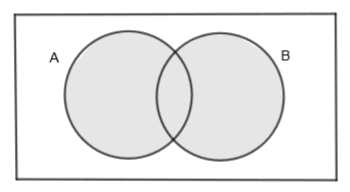
In the above diagram, we can write the shaded portion as \[A\cup B\] or \[B\cup A\]. So, we get, \[A\cup B=B\cup A\].

In the above diagram, we can write the shaded portion as \[A\cap B\] or \[B\cap A\]. So, we get, \[A\cap B=B\cap A\]
Complete step-by-step answer:
Here, for any two sets A and B, prove that
1. \[A\cup B=B\cup A\] [Commutative law for the union of sets]
2. \[A\cap B=B\cap A\] [Commutative law for the intersection of sets]
Let us prove that \[A\cup B=B\cup A\]. Let x be an element in the set \[A\cup B\]. So, we can write
\[x\in A\cup B\]
We know that \[A\cup B\] constitute elements in A or B or in both. So, if \[x\in A\cup B\], then \[x\in A\] or \[x\in B\]. We can also say that as \[x\in B\] or \[x\in A\], so, \[x\in B\cup A\].
So, from \[x\in A\cup B\], we get, \[x\in B\cup A\]. From this, we can say that \[A\cup B\] is a subset of \[B\cup A\]
So, we get,
\[A\cup B\subset B\cup A.....\left( i \right)\]
Let us consider the reverse of the commutative law of union of two sets that is \[B\cup A=A\cup B\]
Let \[x\in B\cup A\]. If \[x\in B\cup A\], then \[x\in B\] or \[x\in A\]. We can also say that \[x\in A\] or \[x\in B\]. So, \[x\in A\cup B\].
So, from \[x\in B\cup A\], we get, \[x\in A\cup B\]. From this, we can say that \[B\cup A\] is a subset of \[A\cup B\]. So, we get,
\[B\cup A\subset A\cup B.....\left( ii \right)\]
We know that when x is a subset of y and y is a subset of x, then x = y. So, from equation (i) and (ii), we get,
\[A\cup B=B\cup A\]
Hence, we have proved the commutative law from the union of sets.
Now let us prove that \[A\cap B=B\cap A\]. Let x be an element in \[A\cap B\]. So, we can write \[x\in A\cap B\]. We know that \[A\cap B\] constitute elements that are in set A as well as B.
So if, \[x\in A\cap B\], then \[x\in A\] and \[x\in B\]. Also, we can say that \[x\in B\] and \[x\in A\]. So, we get, \[x\in B\cap A\]. From \[x\in A\cap B\], we get \[x\in B\cap A\]. So, we can say that \[A\cap B\] is a subset of \[B\cap A\]. Therefore, we get,
\[A\cap B\subset B\cap A....\left( iii \right)\]
Now, let us consider the reverse of commutative law for the intersection of two sets that is
\[B\cap A=A\cap B\]
Let \[x\in B\cap A\], then \[x\in B\] , and \[x\in A\]. We can say that \[x\in A\] and \[x\in B\]. So, we get, \[x\in A\cap B\]. From \[x\in B\cap A\], we get, \[x\in A\cap B\]. So, we can say that \[B\cap A\] is a subset of \[A\cap B\]. Therefore, we get,
\[B\cap A\subset A\cap B....\left( iv \right)\]
We know that when x is a subset of y and y is a subset of x, then x = y.
So, from equation (iii) and (iv), we get,
\[A\cap B=B\cap A\]
Hence, we have proved that the commutative law for the intersection of two sets.
Note: Students can also verify their relationship by Venn Diagram as follows:
In the above diagram, we can write the shaded portion as \[A\cup B\] or \[B\cup A\]. So, we get, \[A\cup B=B\cup A\].
In the above diagram, we can write the shaded portion as \[A\cap B\] or \[B\cap A\]. So, we get, \[A\cap B=B\cap A\]
Recently Updated Pages
Master Class 11 Social Science: Engaging Questions & Answers for Success

Master Class 11 Chemistry: Engaging Questions & Answers for Success
Master Class 12 Business Studies: Engaging Questions & Answers for Success
Master Class 12 Chemistry: Engaging Questions & Answers for Success
Master Class 12 Biology: Engaging Questions & Answers for Success
Class 12 Question and Answer - Your Ultimate Solutions Guide
Trending doubts
One Metric ton is equal to kg A 10000 B 1000 C 100 class 11 physics CBSE
Difference Between Prokaryotic Cells and Eukaryotic Cells
How many of the following diseases can be studied with class 11 biology CBSE
Two of the body parts which do not appear in MRI are class 11 biology CBSE
Which of the following enzymes is used for carboxylation class 11 biology CBSE
Explain zero factorial class 11 maths CBSE