




For any curve \[xy = {c^2}\] the subnormal at any point varies as
1) \[{x^2}\]
2) \[{x^3}\]
3) \[{y^2}\]
4) \[{y^3}\]
Answer
 Verified
511.2k+ views
Hint: Here in this question we have to determine the subnormal, so first we have to find the derivative of the given curve with respect to x and then by using the formula \[y \times \dfrac{{dy}}{{dx}}\] we determining the subnormal variation. Then we choose an appropriate option in the question.
Complete step by step answer:
We usually know about the tangent and normal. So first we know about the subtangent and subnormal
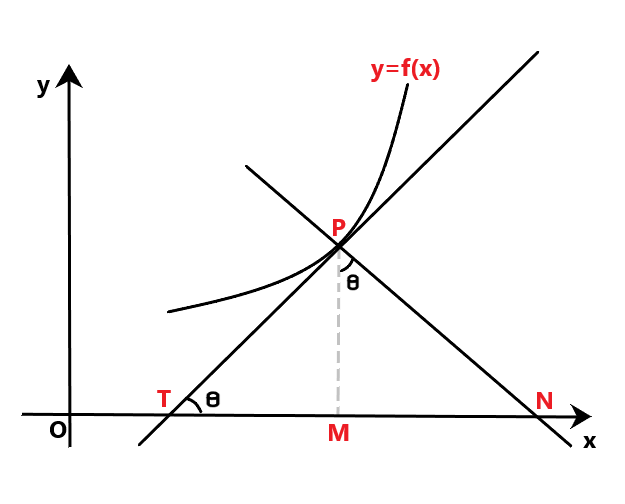
Let y = f (x) be the curve that is differentiable at a point P. Let the tangent and normal at P(x, y) to the curve meet at the x-axis at points T and N. M is the projection of P on the x-axis. In the figure below,
PT is the length of the tangent
PN is the length of the normal
TM is the length of subtangent
MN is the length of the subnormal
Now consider the given question, the curve is \[xy = {c^2}\]---- (1)
The equation can be written as
\[ \Rightarrow y = \dfrac{{{c^2}}}{x}\] ----(2)
On differentiating the equation (2) with respect to x we have
\[ \Rightarrow \dfrac{{dy}}{{dx}} = - \dfrac{{{c^2}}}{{{x^2}}}\]
The formula to determine the subnormal is \[y \times \dfrac{{dy}}{{dx}}\], so we have
\[ \Rightarrow y \times - \dfrac{{{c^2}}}{{{x^2}}}\]-------(3)
Consider the equation (2) \[y = \dfrac{{{c^2}}}{x}\], this can be written as \[x = \dfrac{{{c^2}}}{y}\]----- (4)
On substituting the equation (4) in the equation (3) we have
\[ \Rightarrow y \times - \dfrac{{{c^2}}}{{{{\left( {\dfrac{{{c^2}}}{y}} \right)}^2}}}\]
On squaring the denominator term we have
\[ \Rightarrow y \times - \dfrac{{{c^2}}}{{\dfrac{{{c^4}}}{{{y^2}}}}}\]
Taking the reciprocal we have
\[ \Rightarrow y \times {c^2} \times \dfrac{{{y^2}}}{{{c^4}}}\]
On simplifying we have
\[ \Rightarrow \dfrac{{{y^3}}}{{{c^2}}}\]
where c represents the constant. Therefore for any curve \[xy = {c^2}\] the subnormal at any point varies as \[{y^3}\]
So, the correct answer is “Option 4”.
Note: To determine the length of tangent, normal, subtangent and subnormal of a curve we have to know the formula and it is given as follows
1. The length of tangent = \[|y|\sqrt {1 + {{\left( {\dfrac{{dx}}{{dy}}} \right)}^2}} \]
2. The length of normal = \[\left| {y \times \dfrac{{dx}}{{dy}}} \right|\]
3. The length of subtangent = \[|y|\sqrt {1 + {{\left( {\dfrac{{dy}}{{dx}}} \right)}^2}} \]
4.The length of subnormal = \[\left| {y \times \dfrac{{dy}}{{dx}}} \right|\]
Complete step by step answer:
We usually know about the tangent and normal. So first we know about the subtangent and subnormal
Let y = f (x) be the curve that is differentiable at a point P. Let the tangent and normal at P(x, y) to the curve meet at the x-axis at points T and N. M is the projection of P on the x-axis. In the figure below,
PT is the length of the tangent
PN is the length of the normal
TM is the length of subtangent
MN is the length of the subnormal
Now consider the given question, the curve is \[xy = {c^2}\]---- (1)
The equation can be written as
\[ \Rightarrow y = \dfrac{{{c^2}}}{x}\] ----(2)
On differentiating the equation (2) with respect to x we have
\[ \Rightarrow \dfrac{{dy}}{{dx}} = - \dfrac{{{c^2}}}{{{x^2}}}\]
The formula to determine the subnormal is \[y \times \dfrac{{dy}}{{dx}}\], so we have
\[ \Rightarrow y \times - \dfrac{{{c^2}}}{{{x^2}}}\]-------(3)
Consider the equation (2) \[y = \dfrac{{{c^2}}}{x}\], this can be written as \[x = \dfrac{{{c^2}}}{y}\]----- (4)
On substituting the equation (4) in the equation (3) we have
\[ \Rightarrow y \times - \dfrac{{{c^2}}}{{{{\left( {\dfrac{{{c^2}}}{y}} \right)}^2}}}\]
On squaring the denominator term we have
\[ \Rightarrow y \times - \dfrac{{{c^2}}}{{\dfrac{{{c^4}}}{{{y^2}}}}}\]
Taking the reciprocal we have
\[ \Rightarrow y \times {c^2} \times \dfrac{{{y^2}}}{{{c^4}}}\]
On simplifying we have
\[ \Rightarrow \dfrac{{{y^3}}}{{{c^2}}}\]
where c represents the constant. Therefore for any curve \[xy = {c^2}\] the subnormal at any point varies as \[{y^3}\]
So, the correct answer is “Option 4”.
Note: To determine the length of tangent, normal, subtangent and subnormal of a curve we have to know the formula and it is given as follows
1. The length of tangent = \[|y|\sqrt {1 + {{\left( {\dfrac{{dx}}{{dy}}} \right)}^2}} \]
2. The length of normal = \[\left| {y \times \dfrac{{dx}}{{dy}}} \right|\]
3. The length of subtangent = \[|y|\sqrt {1 + {{\left( {\dfrac{{dy}}{{dx}}} \right)}^2}} \]
4.The length of subnormal = \[\left| {y \times \dfrac{{dy}}{{dx}}} \right|\]
Recently Updated Pages
Master Class 11 Computer Science: Engaging Questions & Answers for Success

Master Class 11 Business Studies: Engaging Questions & Answers for Success
Master Class 11 Economics: Engaging Questions & Answers for Success
Master Class 11 English: Engaging Questions & Answers for Success
Master Class 11 Maths: Engaging Questions & Answers for Success
Master Class 11 Biology: Engaging Questions & Answers for Success
Trending doubts
One Metric ton is equal to kg A 10000 B 1000 C 100 class 11 physics CBSE
There are 720 permutations of the digits 1 2 3 4 5 class 11 maths CBSE
Discuss the various forms of bacteria class 11 biology CBSE
Draw a diagram of a plant cell and label at least eight class 11 biology CBSE
State the laws of reflection of light
Explain zero factorial class 11 maths CBSE