




For all values of $ A\& B $ ,Prove that $ \cos (A - B) = \cos A.\cos B - \operatorname{Sin} A.\operatorname{Sin} B $
Answer
 Verified
566.7k+ views
Hint: To calculate the value we first construct a circle and mark the points with respect to sine and cosine. Then, we will compare the two chords which subtend equal angles. Then we will be able to prove the equation by solving the equation.
Complete step by step solution:
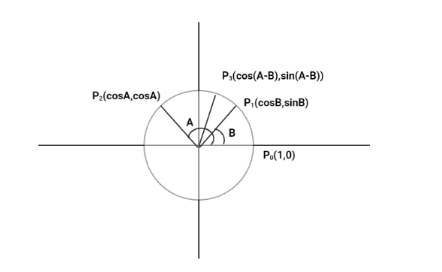
Equal chords of a circle subtends equal angle at the centre.
Hence, $ {P_1}{P_2} $ chord and $ {P_0}{P_3} $ chord are equal as they both angles are the same at centre that is $ A - B $ .
$
{P_0}{P_3} = {P_1}{P_2} \\
\Rightarrow \sqrt {{{(cos(A - B) - 1)}^2} + {{(sin(A - B) - 0)}^2}} = \sqrt {{{(\cos A - \cos B)}^2} + {{(\sin A - \sin B)}^2}} \;
$
(Using the distance formula)
Now, squaring both sides we will get,
$
{(cos(A - B) - 1)^2} + {(sin(A - B) - 0)^2} = {(\cos A - \cos B)^2} + {(\sin A - \sin B)^2} \\
{\operatorname{Cos} ^2}(A - B) + 1 - 2\cos (A - B) + {\sin ^2}(A - B) = {\cos ^2}A + {\cos ^2}B - 2\cos A\cos B + {\sin ^2}A + {\sin ^2}B + 2\sin A\sin B \;
$
We know that $ {\sin ^2}\theta + {\cos ^2}\theta = 1 $
$
\{ {\operatorname{Cos} ^2}(A - B) + {\sin ^2}(A - B)\} + 1 - 2\cos (A - B) = \{ {\cos ^2}A + {\sin ^2}A\} + \{ {\cos ^2}B + {\sin ^2}B\} - 2\cos A\cos B + 2\sin A\sin B \\
\Rightarrow 1 + 1 - 2\cos (A - B) = 1 + 1 - 2\cos A\cos B + 2\sin A\sin B \\
\Rightarrow {2} - 2\cos (A - B) ={2} - 2\cos A\cos B + 2\sin A\sin B \\
\Rightarrow -{2}\cos (A - B) = -{2}(\cos A\cos B - \sin A\sin B) \;
$
Hence, $ cos(A - B) = \cos A.\cos B - \sin A.\sin B $
Therefore, for all values of $ A\& B $ $ \cos (A - B) = \cos A.\cos B - \operatorname{Sin} A.\operatorname{Sin} B $
Note: Using $ \cos (A - B) $ and $ \cos (A + B) $ we can further derive many other formulas like $ \cos 2x $, $ \cos 3x $, $\sin 2x$ and $\sin 3x$. All these identities can be derived in the same manner as we did in the above question.
Complete step by step solution:
Equal chords of a circle subtends equal angle at the centre.
Hence, $ {P_1}{P_2} $ chord and $ {P_0}{P_3} $ chord are equal as they both angles are the same at centre that is $ A - B $ .
$
{P_0}{P_3} = {P_1}{P_2} \\
\Rightarrow \sqrt {{{(cos(A - B) - 1)}^2} + {{(sin(A - B) - 0)}^2}} = \sqrt {{{(\cos A - \cos B)}^2} + {{(\sin A - \sin B)}^2}} \;
$
(Using the distance formula)
Now, squaring both sides we will get,
$
{(cos(A - B) - 1)^2} + {(sin(A - B) - 0)^2} = {(\cos A - \cos B)^2} + {(\sin A - \sin B)^2} \\
{\operatorname{Cos} ^2}(A - B) + 1 - 2\cos (A - B) + {\sin ^2}(A - B) = {\cos ^2}A + {\cos ^2}B - 2\cos A\cos B + {\sin ^2}A + {\sin ^2}B + 2\sin A\sin B \;
$
We know that $ {\sin ^2}\theta + {\cos ^2}\theta = 1 $
$
\{ {\operatorname{Cos} ^2}(A - B) + {\sin ^2}(A - B)\} + 1 - 2\cos (A - B) = \{ {\cos ^2}A + {\sin ^2}A\} + \{ {\cos ^2}B + {\sin ^2}B\} - 2\cos A\cos B + 2\sin A\sin B \\
\Rightarrow 1 + 1 - 2\cos (A - B) = 1 + 1 - 2\cos A\cos B + 2\sin A\sin B \\
\Rightarrow {2} - 2\cos (A - B) ={2} - 2\cos A\cos B + 2\sin A\sin B \\
\Rightarrow -{2}\cos (A - B) = -{2}(\cos A\cos B - \sin A\sin B) \;
$
Hence, $ cos(A - B) = \cos A.\cos B - \sin A.\sin B $
Therefore, for all values of $ A\& B $ $ \cos (A - B) = \cos A.\cos B - \operatorname{Sin} A.\operatorname{Sin} B $
Note: Using $ \cos (A - B) $ and $ \cos (A + B) $ we can further derive many other formulas like $ \cos 2x $, $ \cos 3x $, $\sin 2x$ and $\sin 3x$. All these identities can be derived in the same manner as we did in the above question.
Recently Updated Pages
Master Class 11 English: Engaging Questions & Answers for Success

Master Class 11 Social Science: Engaging Questions & Answers for Success
Master Class 11 Maths: Engaging Questions & Answers for Success
Master Class 11 Biology: Engaging Questions & Answers for Success
Master Class 11 Physics: Engaging Questions & Answers for Success
Master Class 11 Chemistry: Engaging Questions & Answers for Success
Trending doubts
One Metric ton is equal to kg A 10000 B 1000 C 100 class 11 physics CBSE
Difference Between Prokaryotic Cells and Eukaryotic Cells
Two of the body parts which do not appear in MRI are class 11 biology CBSE
Find the value of the expression given below sin 30circ class 11 maths CBSE
Draw a diagram of a plant cell and label at least eight class 11 biology CBSE
10 examples of friction in our daily life