



For a quadrilateral, answer the following question:
(i) How many pairs of adjacent sides does it have?
(ii) How many pairs of opposite sides does it have?
(iii) How many pairs of adjacent angles does it have?
(iv) How many pairs of opposite angles does it have?
(v) How many diagonals does it have?
Answer
 Verified
615.6k+ views
Hint: In a quadrilateral, two sides are adjacent if they have an angle in common while if two sides don’t have any common angle then they are opposite sides. Similarly two angles are adjacent if they have a side in common while if two angles don’t have any common side then they are opposite angles. Also, a line joining opposite angles is diagonal. Use these results for counting in each case.
Complete step-by-step solution:
According to the question, we have to find the number of adjacent sides, opposite sides, adjacent angles, opposite angles and diagonals in a quadrilateral.
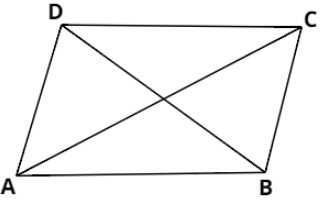
For all the counting, consider the quadrilateral \[ABCD\] shown in the above figure as an example.
(i) We know that in a quadrilateral, two sides are adjacent if they have an angle in common. So if we consider all the four angles in the above figure, we have:
A). For $\angle A$, $DA$ and $AB$ are adjacent sides.
B). For $\angle B$, $AB$ and $BC$ are adjacent sides.
C). For $\angle C$, $BC$ and $CD$ are adjacent sides.
D). And for $\angle D$, $CD$ and $DA$ are adjacent sides.
Thus there are four pairs of adjacent sides.
(ii) We also know that in a quadrilateral if two sides don’t have any common angle then they are opposite sides. Based on this information, we have $AB$ and $CD$ as opposite sides and $BC$ and $DA$ as opposite sides. Thus there are two pairs of opposite sides.
(iii) Further we know that in a quadrilateral two angles are adjacent if they have a side in common. So for the above quadrilateral, we have:
A). For side $AB$, $\angle A$ and $\angle B$ are adjacent angles.
B). For side $BC$, $\angle B$ and $\angle C$ are adjacent angles.
C). For side $CD$, $\angle C$ and $\angle D$ are adjacent angles.
D). And for side $DA$, $\angle D$ and $\angle A$ are adjacent angles.
Thus there are four pairs of adjacent angles.
(iv) Similarly, in a quadrilateral if two angles don’t have any side in common, they are opposite angles. From this we have $\angle A$ and $\angle C$ as opposite angles and $\angle B$ and $\angle D$ as opposite angles. Thus there are two pairs of opposite angles.
(v) And finally, we can see in the figure that opposite angles $\angle A$ and $\angle C$ are joined to form a diagonal $AC$ and $\angle B$ and $\angle D$ are joined to form another diagonal $BD$. Thus a quadrilateral has two diagonals.
Note: The sum of all the angles of a quadrilateral is ${360^ \circ }$. If all the angles measure ${90^ \circ }$ then the quadrilateral is rectangle and if all the sides are equal along with it then the quadrilateral is square. In a rectangle and parallelogram, opposite sides are parallel and equal. And in square and rhombus, opposite sides are parallel and all the sides are equal in length.
Complete step-by-step solution:
According to the question, we have to find the number of adjacent sides, opposite sides, adjacent angles, opposite angles and diagonals in a quadrilateral.
For all the counting, consider the quadrilateral \[ABCD\] shown in the above figure as an example.
(i) We know that in a quadrilateral, two sides are adjacent if they have an angle in common. So if we consider all the four angles in the above figure, we have:
A). For $\angle A$, $DA$ and $AB$ are adjacent sides.
B). For $\angle B$, $AB$ and $BC$ are adjacent sides.
C). For $\angle C$, $BC$ and $CD$ are adjacent sides.
D). And for $\angle D$, $CD$ and $DA$ are adjacent sides.
Thus there are four pairs of adjacent sides.
(ii) We also know that in a quadrilateral if two sides don’t have any common angle then they are opposite sides. Based on this information, we have $AB$ and $CD$ as opposite sides and $BC$ and $DA$ as opposite sides. Thus there are two pairs of opposite sides.
(iii) Further we know that in a quadrilateral two angles are adjacent if they have a side in common. So for the above quadrilateral, we have:
A). For side $AB$, $\angle A$ and $\angle B$ are adjacent angles.
B). For side $BC$, $\angle B$ and $\angle C$ are adjacent angles.
C). For side $CD$, $\angle C$ and $\angle D$ are adjacent angles.
D). And for side $DA$, $\angle D$ and $\angle A$ are adjacent angles.
Thus there are four pairs of adjacent angles.
(iv) Similarly, in a quadrilateral if two angles don’t have any side in common, they are opposite angles. From this we have $\angle A$ and $\angle C$ as opposite angles and $\angle B$ and $\angle D$ as opposite angles. Thus there are two pairs of opposite angles.
(v) And finally, we can see in the figure that opposite angles $\angle A$ and $\angle C$ are joined to form a diagonal $AC$ and $\angle B$ and $\angle D$ are joined to form another diagonal $BD$. Thus a quadrilateral has two diagonals.
Note: The sum of all the angles of a quadrilateral is ${360^ \circ }$. If all the angles measure ${90^ \circ }$ then the quadrilateral is rectangle and if all the sides are equal along with it then the quadrilateral is square. In a rectangle and parallelogram, opposite sides are parallel and equal. And in square and rhombus, opposite sides are parallel and all the sides are equal in length.
Recently Updated Pages
What are the two major island groups in India class 9 social science CBSE

What is Jhum cultivation class 9 biology CBSE
Write an Article on Save Earth Save Life
Silk is obtained from of the silk moth APupa BLarva class 9 chemistry CBSE
Write chemical formulas of the following compounds class 9 chemistry CBSE
The Indo Gangetic Plains of India are fertile due to class 9 social science CBSE
Trending doubts
Fill the blanks with the suitable prepositions 1 The class 9 english CBSE
Who was referred to as Amitraghata by the Greeks AChandragupta class 9 social science CBSE
Difference Between Plant Cell and Animal Cell
Name 10 Living and Non living things class 9 biology CBSE
What is the full form of pH?
On an outline map of India show its neighbouring c class 9 social science CBSE