




For a particle moving in vertical circle, the total energy at different positions along the path
A) is conserved
B) increases
C) decreases
D) may increase or decrease
Answer
 Verified
621.3k+ views
Hint
For any isolated system, when non-conservative forces are absent the mechanical energy is conserved. Here the work done is zero at every point and the remaining forces due to weight and centrifugal are conservative forces. Hence, total energy is conserved.
Complete step-by-step answer
Conservative forces, its work does not depend on the path, and work done in a loop is zero. As work done is zero, the force and torque cannot convert the total energy into non mechanical forms.
Only non conservative forces convert mechanical energy into other forms. Kinetic energy may be changed by work of both forces, so conservative forces should change potential energy to make sure mechanical energy is conserved.
Consider a particle moving in a circular path. At point A, the forces acting on the body are the weight of the particle mg downwards, normal force in terms of work done in the upward direction and the centrifugal force outwards. Kinetic energy is the same at initial and final state and potential energy depends on height which is symmetrical over a circular path.
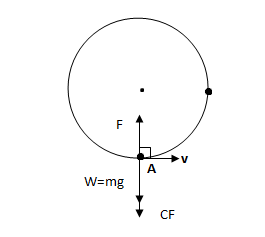
The work done by the particle is given by,
$W = Fs\cos \theta $
The angle between the direction of motion and the force acting is ${90^0}$. It remains perpendicular throughout the motion so the work done is zero at every point.
Since, work done is zero and the weight is due to gravitational force, all the forces acting on the particle are conservative.
Hence, it can be concluded that, when only conservative forces are acting, total energy is conserved.
The correct option is (A).
Note
In conservative fields, the work done by the force over a round path is zero so the change in kinetic energy is zero which means that initial kinetic energy and final kinetic energy are equal.
One should note that gravitational force is conservative. Electrostatic, elastic, magnetic forces are also conservative forces.
For any isolated system, when non-conservative forces are absent the mechanical energy is conserved. Here the work done is zero at every point and the remaining forces due to weight and centrifugal are conservative forces. Hence, total energy is conserved.
Complete step-by-step answer
Conservative forces, its work does not depend on the path, and work done in a loop is zero. As work done is zero, the force and torque cannot convert the total energy into non mechanical forms.
Only non conservative forces convert mechanical energy into other forms. Kinetic energy may be changed by work of both forces, so conservative forces should change potential energy to make sure mechanical energy is conserved.
Consider a particle moving in a circular path. At point A, the forces acting on the body are the weight of the particle mg downwards, normal force in terms of work done in the upward direction and the centrifugal force outwards. Kinetic energy is the same at initial and final state and potential energy depends on height which is symmetrical over a circular path.
The work done by the particle is given by,
$W = Fs\cos \theta $
The angle between the direction of motion and the force acting is ${90^0}$. It remains perpendicular throughout the motion so the work done is zero at every point.
Since, work done is zero and the weight is due to gravitational force, all the forces acting on the particle are conservative.
Hence, it can be concluded that, when only conservative forces are acting, total energy is conserved.
The correct option is (A).
Note
In conservative fields, the work done by the force over a round path is zero so the change in kinetic energy is zero which means that initial kinetic energy and final kinetic energy are equal.
One should note that gravitational force is conservative. Electrostatic, elastic, magnetic forces are also conservative forces.
Recently Updated Pages
Master Class 12 Economics: Engaging Questions & Answers for Success

Master Class 12 English: Engaging Questions & Answers for Success
Master Class 12 Social Science: Engaging Questions & Answers for Success
Master Class 12 Maths: Engaging Questions & Answers for Success
Master Class 12 Physics: Engaging Questions & Answers for Success
Master Class 9 General Knowledge: Engaging Questions & Answers for Success
Trending doubts
One Metric ton is equal to kg A 10000 B 1000 C 100 class 11 physics CBSE
Difference Between Prokaryotic Cells and Eukaryotic Cells
Two of the body parts which do not appear in MRI are class 11 biology CBSE
Find the value of the expression given below sin 30circ class 11 maths CBSE
1 ton equals to A 100 kg B 1000 kg C 10 kg D 10000 class 11 physics CBSE
Draw a diagram of nephron and explain its structur class 11 biology CBSE