




Food plant of the Antheraea assama is
A. Terminalia arjuna
B. Machilus bombycina
C. Ricinus communis
D. Euphorbia pulcherrima
Answer
 Verified
603.3k+ views
Hint: Antheraea assama is known with the common name Assam silk moth and feeds on the plant which is abundantly grown in North-East India.
Complete answer:
The silk moth Antheraea assama is found in the Brahmaputra valley of Assam and the foothills of East Garo Hills of Meghalaya in India. As it is confined to the places mentioned, it is an endemic species of North-East India. This silkworm is famous for producing a lustrous golden yellow silk with a high economic value. It is a phytophagous insect and feeds on specific host plants like Machilus bombycina and Litsea polyantha. Its larva thrives well on the aromatic leaves of these plants and these are considered to be the primary food plants for this silkworm.
Additional information
- It is a common fact that most of the lepidopteran larvae tend to have a wide range of host plants for feeding. The same applies to the larva of Antheraea assama. Though Machilus bombycina and Litsea polyantha are the primary food plants for this insect, it also feeds on certain secondary food plants like Symplocos grandiflora, Michelia champaca, Litsea citrate, Cinnamomum obtusifolium, etc.
- Som and Soalu are the common names of the plants Machilus bombycina and Litsea polyantha respectively. These food plants are considered to be the best food plants for the rearing of the Assam silk moth or Muga silkworm, and for this purpose, the fresh and nutritive leaves of these plants are chosen.
So, the correct answer is “Machilus bombycina”.
Note: Terminalia arjuna is known as Arjun tree and its bark is used for medicinal purposes in hypertension, anginal pain, dyslipidemia, and congestive heart failure like conditions. Ricinus communis is the castor oil plant or castor bean that gives non-volatile fatty oil and is used in the production of paints, resins, plastics, synthetic fibers, etc.
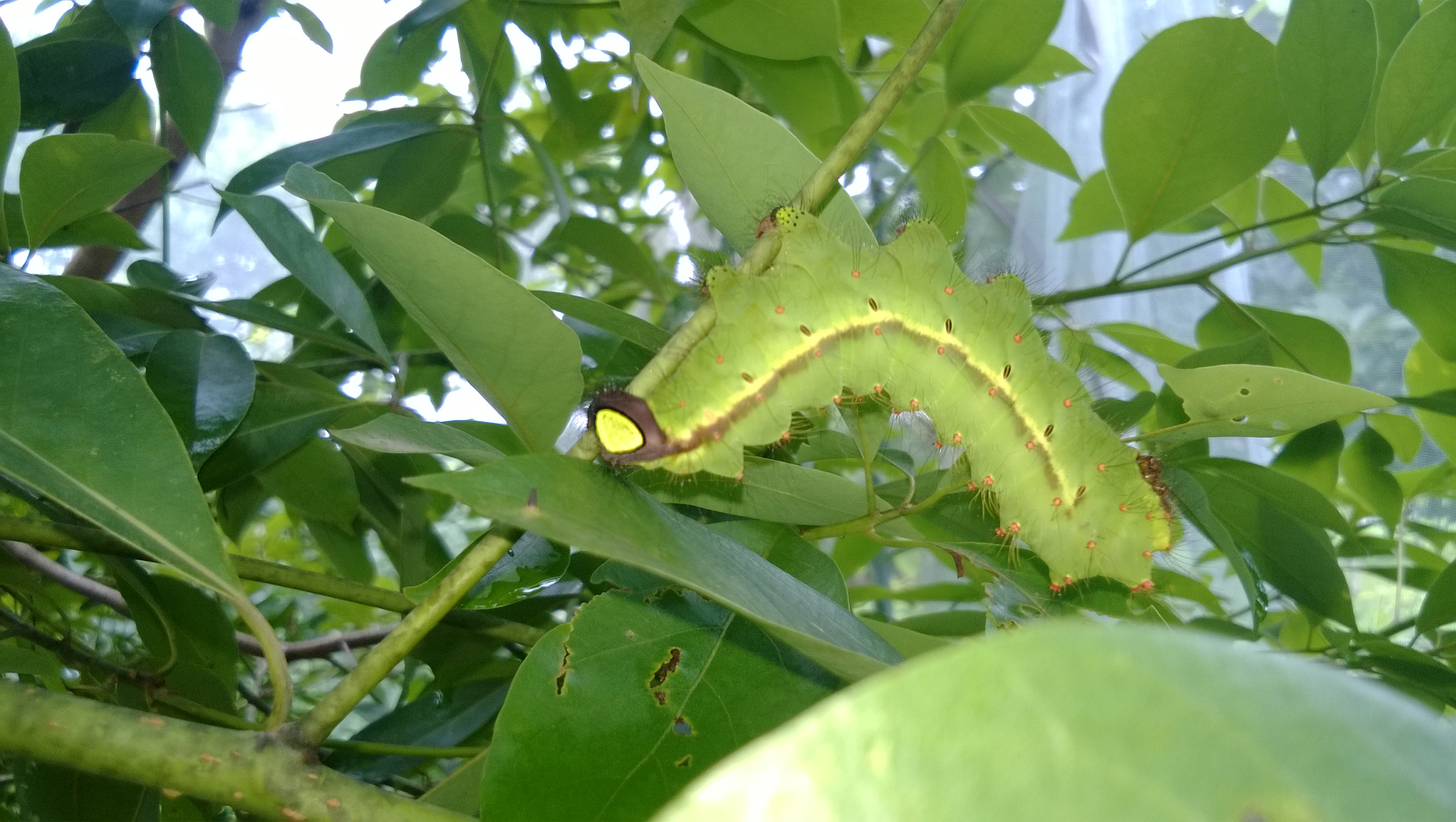
Figure: Antheraea assama
Complete answer:
The silk moth Antheraea assama is found in the Brahmaputra valley of Assam and the foothills of East Garo Hills of Meghalaya in India. As it is confined to the places mentioned, it is an endemic species of North-East India. This silkworm is famous for producing a lustrous golden yellow silk with a high economic value. It is a phytophagous insect and feeds on specific host plants like Machilus bombycina and Litsea polyantha. Its larva thrives well on the aromatic leaves of these plants and these are considered to be the primary food plants for this silkworm.
Additional information
- It is a common fact that most of the lepidopteran larvae tend to have a wide range of host plants for feeding. The same applies to the larva of Antheraea assama. Though Machilus bombycina and Litsea polyantha are the primary food plants for this insect, it also feeds on certain secondary food plants like Symplocos grandiflora, Michelia champaca, Litsea citrate, Cinnamomum obtusifolium, etc.
- Som and Soalu are the common names of the plants Machilus bombycina and Litsea polyantha respectively. These food plants are considered to be the best food plants for the rearing of the Assam silk moth or Muga silkworm, and for this purpose, the fresh and nutritive leaves of these plants are chosen.
So, the correct answer is “Machilus bombycina”.
Note: Terminalia arjuna is known as Arjun tree and its bark is used for medicinal purposes in hypertension, anginal pain, dyslipidemia, and congestive heart failure like conditions. Ricinus communis is the castor oil plant or castor bean that gives non-volatile fatty oil and is used in the production of paints, resins, plastics, synthetic fibers, etc.
Figure: Antheraea assama
Recently Updated Pages
Master Class 11 Computer Science: Engaging Questions & Answers for Success

Master Class 11 Business Studies: Engaging Questions & Answers for Success
Master Class 11 Economics: Engaging Questions & Answers for Success
Master Class 11 English: Engaging Questions & Answers for Success
Master Class 11 Maths: Engaging Questions & Answers for Success
Master Class 11 Biology: Engaging Questions & Answers for Success
Trending doubts
One Metric ton is equal to kg A 10000 B 1000 C 100 class 11 physics CBSE
There are 720 permutations of the digits 1 2 3 4 5 class 11 maths CBSE
Discuss the various forms of bacteria class 11 biology CBSE
Draw a diagram of a plant cell and label at least eight class 11 biology CBSE
State the laws of reflection of light
Explain zero factorial class 11 maths CBSE