




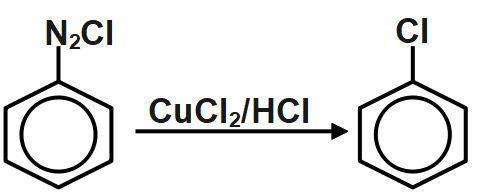
Following reaction is:
(A) $ {{S}_{N}} $
(B) $ {{S}_{E}} $
(C) $ E1 $
(D) $ E1-CB $
Answer
 Verified
510.6k+ views
Hint: We know that this reaction involves the formation of a diazonium salt. The second step of the reaction is commonly known as Sandmeyer reaction. Sandmeyer reaction is a radical nucleophilic aromatic substitution. The Sandmeyer Reaction is a significant change in sweet-smelling science, since it can bring about some substitution patterns that are not feasible by direct substitution.
Complete answer:
The reactions mentioned are basically named reactions; these reactions are named after their discoverer or developer. Many reactions have scientific names but these on contrary are named after some person. The above mentioned reactions are organic chemical reactions in which halides have a significant role. Sandmeyer reaction is a kind of radical-nucleophilic fragrant substitution reaction. It is a helpful device by which an amino group on a sweet-smelling ring is supplanted with various substituents. During the Sandmeyer reaction, the amino group is changed over into a diazonium salt that can be changed into different functional groups utilizing a catalyst. The system includes a few stages, including the generation of intermediary compounds.
There are various types of Sandmeyer reaction in which benzene diazonium chloride reacts with $ CuCl,\text{ }CuBr,\text{ }CuCN $ to form chlorobenzene, bromobenzene and benzonitrile respectively. The Sandmeyer reaction is a chemical reaction used for synthesis of aryl halides from aryl diazonium salts using copper salts as catalysts or reagents. It is an example of a radical-nucleophilic aromatic substitution. This reaction is named after Traugott Sandmeyer. When a primary aromatic amine is dissolved or suspended in cold aqueous mineral acid, and is treated with sodium nitrite, a diazonium salt is formed.
Therefore, the correct answer is option A.
Note:
Remember that the reaction mechanism is based on Substitution Reaction. The Sandmeyer reaction provide us a method through which one can perform unique transformations on benzene, such as halogenation, cyanation, trifluoromethylation and hydroxylation Replacement of the diazonium group by iodine does not require the presence of cuprous halide and is done simply by shaking the diazonium salt with potassium iodide.
Complete answer:
The reactions mentioned are basically named reactions; these reactions are named after their discoverer or developer. Many reactions have scientific names but these on contrary are named after some person. The above mentioned reactions are organic chemical reactions in which halides have a significant role. Sandmeyer reaction is a kind of radical-nucleophilic fragrant substitution reaction. It is a helpful device by which an amino group on a sweet-smelling ring is supplanted with various substituents. During the Sandmeyer reaction, the amino group is changed over into a diazonium salt that can be changed into different functional groups utilizing a catalyst. The system includes a few stages, including the generation of intermediary compounds.
There are various types of Sandmeyer reaction in which benzene diazonium chloride reacts with $ CuCl,\text{ }CuBr,\text{ }CuCN $ to form chlorobenzene, bromobenzene and benzonitrile respectively. The Sandmeyer reaction is a chemical reaction used for synthesis of aryl halides from aryl diazonium salts using copper salts as catalysts or reagents. It is an example of a radical-nucleophilic aromatic substitution. This reaction is named after Traugott Sandmeyer. When a primary aromatic amine is dissolved or suspended in cold aqueous mineral acid, and is treated with sodium nitrite, a diazonium salt is formed.
Therefore, the correct answer is option A.
Note:
Remember that the reaction mechanism is based on Substitution Reaction. The Sandmeyer reaction provide us a method through which one can perform unique transformations on benzene, such as halogenation, cyanation, trifluoromethylation and hydroxylation Replacement of the diazonium group by iodine does not require the presence of cuprous halide and is done simply by shaking the diazonium salt with potassium iodide.
Recently Updated Pages
Master Class 11 Computer Science: Engaging Questions & Answers for Success

Master Class 11 Business Studies: Engaging Questions & Answers for Success
Master Class 11 Economics: Engaging Questions & Answers for Success
Master Class 11 English: Engaging Questions & Answers for Success
Master Class 11 Maths: Engaging Questions & Answers for Success
Master Class 11 Biology: Engaging Questions & Answers for Success
Trending doubts
One Metric ton is equal to kg A 10000 B 1000 C 100 class 11 physics CBSE
There are 720 permutations of the digits 1 2 3 4 5 class 11 maths CBSE
Discuss the various forms of bacteria class 11 biology CBSE
Draw a diagram of a plant cell and label at least eight class 11 biology CBSE
State the laws of reflection of light
Explain zero factorial class 11 maths CBSE