




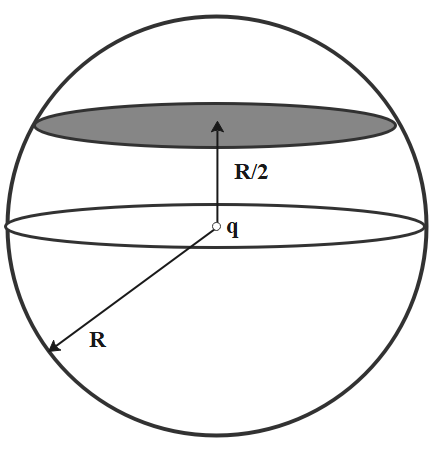
Flux passing through the shaded surface of a sphere when a point charge q is placed at the centre is (Radius of the sphere is R):
(A)$\dfrac{q}{{{\varepsilon }_{0}}}$
(B)$\dfrac{q}{2{{\varepsilon }_{0}}}$
(C)$\dfrac{q}{4{{\varepsilon }_{0}}}$
(D)Zero
Answer
 Verified
626.4k+ views
Hint: The flux flowing through both the regions that are marked will be the same since the charge is placed at the centre of the sphere and electric field lines from the charge spread out in the radial direction. Applying this concept, we try to solve this problem.
Formula Used:
The electric flux is given by, $\phi $ =E.dA
Complete answer:
Since the charge is placed at the centre of the sphere, the electric field directs all over the sphere in radial direction. The property of electric field lines that they do not intersect with each other explains the fact that the two regions that are marked have the same flux flowing through them, that is the flux in the top and bottom regions are the same.
Let us consider a small surface element on the surface that subtends an angle $d\theta $and$d\phi $.
The area is given in spherical coordinates as follows:
dA = ${{R}^{2}}\sin \theta d\theta d\phi \text{ }\hat{r}$
The flux is given by d$\phi $ = E. dA
$\Rightarrow d\phi =\dfrac{q}{4\pi {{\varepsilon }_{0}}{{R}^{2}}}{{R}^{2}}\sin \theta d\theta d\phi $
The value $\theta $ from 0 to $\dfrac{\pi }{3}$ and $\phi $ varies from 0 to 2$\pi $ .
Therefore, the flux is given as
$\phi =\iint{\dfrac{q}{4\pi {{\varepsilon }_{0}}}}\sin \theta d\theta d\phi $
Taking the limit over the integral, we have
$\phi =\dfrac{q}{4{{\varepsilon }_{0}}}$
Thus the value of flux for the shaded region given in the figure below is $\dfrac{q}{4{{\varepsilon }_{0}}}$.
Hence the correct option is (C) $\dfrac{q}{4{{\varepsilon }_{0}}}$.
Additional Information:
Electric flux is the rate of flow of electric field through a given area. Electric flux can be said to be directly proportional to the number of lines entering the surface. In fact flux gives us a description of electric field strength at any distance from the charge causing the field.
Note:
The charge is placed at the centre of the sphere so we must consider the radial direction of the electric field while calculating the flux. Also we need to properly define the integration limits as any slight mistake will create errors in the entire problem at hand.
Formula Used:
The electric flux is given by, $\phi $ =E.dA
Complete answer:
Since the charge is placed at the centre of the sphere, the electric field directs all over the sphere in radial direction. The property of electric field lines that they do not intersect with each other explains the fact that the two regions that are marked have the same flux flowing through them, that is the flux in the top and bottom regions are the same.
Let us consider a small surface element on the surface that subtends an angle $d\theta $and$d\phi $.
The area is given in spherical coordinates as follows:
dA = ${{R}^{2}}\sin \theta d\theta d\phi \text{ }\hat{r}$
The flux is given by d$\phi $ = E. dA
$\Rightarrow d\phi =\dfrac{q}{4\pi {{\varepsilon }_{0}}{{R}^{2}}}{{R}^{2}}\sin \theta d\theta d\phi $
The value $\theta $ from 0 to $\dfrac{\pi }{3}$ and $\phi $ varies from 0 to 2$\pi $ .
Therefore, the flux is given as
$\phi =\iint{\dfrac{q}{4\pi {{\varepsilon }_{0}}}}\sin \theta d\theta d\phi $
Taking the limit over the integral, we have
$\phi =\dfrac{q}{4{{\varepsilon }_{0}}}$
Thus the value of flux for the shaded region given in the figure below is $\dfrac{q}{4{{\varepsilon }_{0}}}$.
Hence the correct option is (C) $\dfrac{q}{4{{\varepsilon }_{0}}}$.
Additional Information:
Electric flux is the rate of flow of electric field through a given area. Electric flux can be said to be directly proportional to the number of lines entering the surface. In fact flux gives us a description of electric field strength at any distance from the charge causing the field.
Note:
The charge is placed at the centre of the sphere so we must consider the radial direction of the electric field while calculating the flux. Also we need to properly define the integration limits as any slight mistake will create errors in the entire problem at hand.
Recently Updated Pages
Which will be the least stable resonating structure class 11 chemistry CBSE

How many 5 digit telephone numbers can be construc-class-11-maths-CBSE
How do you find the angle of the resultant vector class 11 physics CBSE
Draw labelled diagram of the following i Gram seed class 11 biology CBSE
1 Quintal is equal to a 110 kg b 10 kg c 100kg d 1000 class 11 physics CBSE
What is the need and importance of classification class 11 biology CBSE
Trending doubts
One Metric ton is equal to kg A 10000 B 1000 C 100 class 11 physics CBSE
Find the value of the expression given below sin 30circ class 11 maths CBSE
Draw a diagram of nephron and explain its structur class 11 biology CBSE
10 examples of friction in our daily life
Proton was discovered by A Thomson B Rutherford C Chadwick class 11 chemistry CBSE
The teeth used for biting and cutting food are called class 11 biology CBSE