




Fluid is flowing with velocity 4m/s in a cylinder of diameter 8 cm. It is connected to a pipe with its end tip of diameter 2 cm. Calculate the velocity of the fluid at this free end.
A. 4m/s
B. 8m/s
C. 32m/s
D. 64m/s
Answer
 Verified
651.6k+ views
Hint: When fluid is flowing through a pipe, the volume has to be conserved per unit time. This means the rate of volume entering must be equal to the rate of exiting. This result is called the equation of continuity which is a very important result of a principle known as Bernoulli’s principle.
Formula used: $\dfrac{dV}{dt} = A_1 v_1 = A_2 v_2$
Complete step-by-step solution
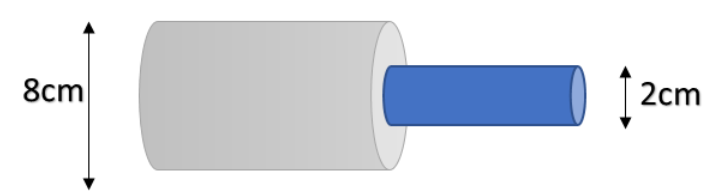
As shown in the above diagram, we have the fluid getting enter in the thicker tube and getting exit from the narrow tube. Now, according to the equation of continuity, $A_1v_1 = A_2v_2$
Given: $d_1 = 8cm \implies A_1 = \dfrac{\pi}{4}(8)^2$
And $d_2 = 2cm \implies A_2 = \dfrac{\pi}{4}(2)^2$
Also $v_1 = 4 m/s$
Hence putting these values in equation $A_1v_1 = A_2v_2$, we get;
$\dfrac{\pi}{4} \times 8^2 \times 4 = \dfrac{\pi}{4} \times 2^2 \times v_2$
$\implies v_2 = 8^2 = 64 m/s$.
Thus, option D. is correct.
Additional information: The term$\dfrac{dV}{dt}$represents the rate of flow of fluid. It means the total volume of fluid flow per unit time. Hence we can calculate this term if we know the variation of volume with time. Equation of continuity plays a very important role in fluid mechanics. Even in the case of varying cross-sectional areas, we could get the point to point relation between area and velocity of the fluid molecule at that point. The measuring area of cross-section is an easier task, compared to the velocity. Hence using this equation, we can analyze the complex situation of the velocity behavior of the fluid.
Note: There are certain assumptions that Bernoulli assumed while deriving this theorem. This includes that fluid must be incompressible and the flow of fluid must be laminar flow. This type of fluid is called an ideal fluid. But practically, it’s very difficult for fluid to behave like an ideal fluid.
Formula used: $\dfrac{dV}{dt} = A_1 v_1 = A_2 v_2$
Complete step-by-step solution
As shown in the above diagram, we have the fluid getting enter in the thicker tube and getting exit from the narrow tube. Now, according to the equation of continuity, $A_1v_1 = A_2v_2$
Given: $d_1 = 8cm \implies A_1 = \dfrac{\pi}{4}(8)^2$
And $d_2 = 2cm \implies A_2 = \dfrac{\pi}{4}(2)^2$
Also $v_1 = 4 m/s$
Hence putting these values in equation $A_1v_1 = A_2v_2$, we get;
$\dfrac{\pi}{4} \times 8^2 \times 4 = \dfrac{\pi}{4} \times 2^2 \times v_2$
$\implies v_2 = 8^2 = 64 m/s$.
Thus, option D. is correct.
Additional information: The term$\dfrac{dV}{dt}$represents the rate of flow of fluid. It means the total volume of fluid flow per unit time. Hence we can calculate this term if we know the variation of volume with time. Equation of continuity plays a very important role in fluid mechanics. Even in the case of varying cross-sectional areas, we could get the point to point relation between area and velocity of the fluid molecule at that point. The measuring area of cross-section is an easier task, compared to the velocity. Hence using this equation, we can analyze the complex situation of the velocity behavior of the fluid.
Note: There are certain assumptions that Bernoulli assumed while deriving this theorem. This includes that fluid must be incompressible and the flow of fluid must be laminar flow. This type of fluid is called an ideal fluid. But practically, it’s very difficult for fluid to behave like an ideal fluid.
Recently Updated Pages
If x a + bt + ct2 where x is in meters and t is in class 11 physics CBSE

A car covers the first half distance between two places class 11 physics CBSE
The resultant of two vectors overrightarrow P and overrightarrow class 11 physics CBSE
Find the value of cos 135 class 11 maths CBSE
A mass M is held in place by an applied force F and class 11 physics CBSE
A solution of glucose in water is labelled as 10 dfracwv class 11 chemistry CBSE
Trending doubts
One Metric ton is equal to kg A 10000 B 1000 C 100 class 11 physics CBSE
Find the value of the expression given below sin 30circ class 11 maths CBSE
What do you mean by retardation What is its SI uni class 11 physics CBSE
Draw a diagram of nephron and explain its structur class 11 biology CBSE
10 examples of friction in our daily life
Difference between physical and chemical change class 11 chemistry CBSE