




When flowers are unisexual then emasculation is done by
(a). Female
(b). Male
(c). Both A and B
(d). None of the above
Answer
 Verified
626.7k+ views
Hint: It is the process in which the removal of both the penis and the testicles, the external male sex organs. It differs from castration, which is the removal of the testicles only, in spite of the fact that the terms are in some cases utilized reciprocally.
Complete answer:
In unisexual flowers, a flower that possesses either stamens or carpels but not both. A plant could likewise be unisexually having just male blossoms or female blossoms, or it will be monoecious with male and ladylike regenerative organs borne inside a similar bloom or in various unisexual blossoms yet on a comparable plant. Removal of stamens or anthers or killing the pollen of a flower without the feminine sex organ is understood as emasculation. In bisexual flowers, emasculation is important to stop self-pollination. But in an unsexual flower already there is only one either male or female then there is no need to emasculate the flower.
Additional information
Emasculation procedures happen both inside and out of doors medical facilities.
In the cultural emasculations, like those performed by the Skoptsy, the Hijra, and on Chinese eunuchs conventionally incorporate separating the penis and gonads during a solitary movement, with a pointed instrument such as a knife or razor.
Alternatively, the process may be explained by consecutively tightening a string around the genitalia over a prolonged period of time.
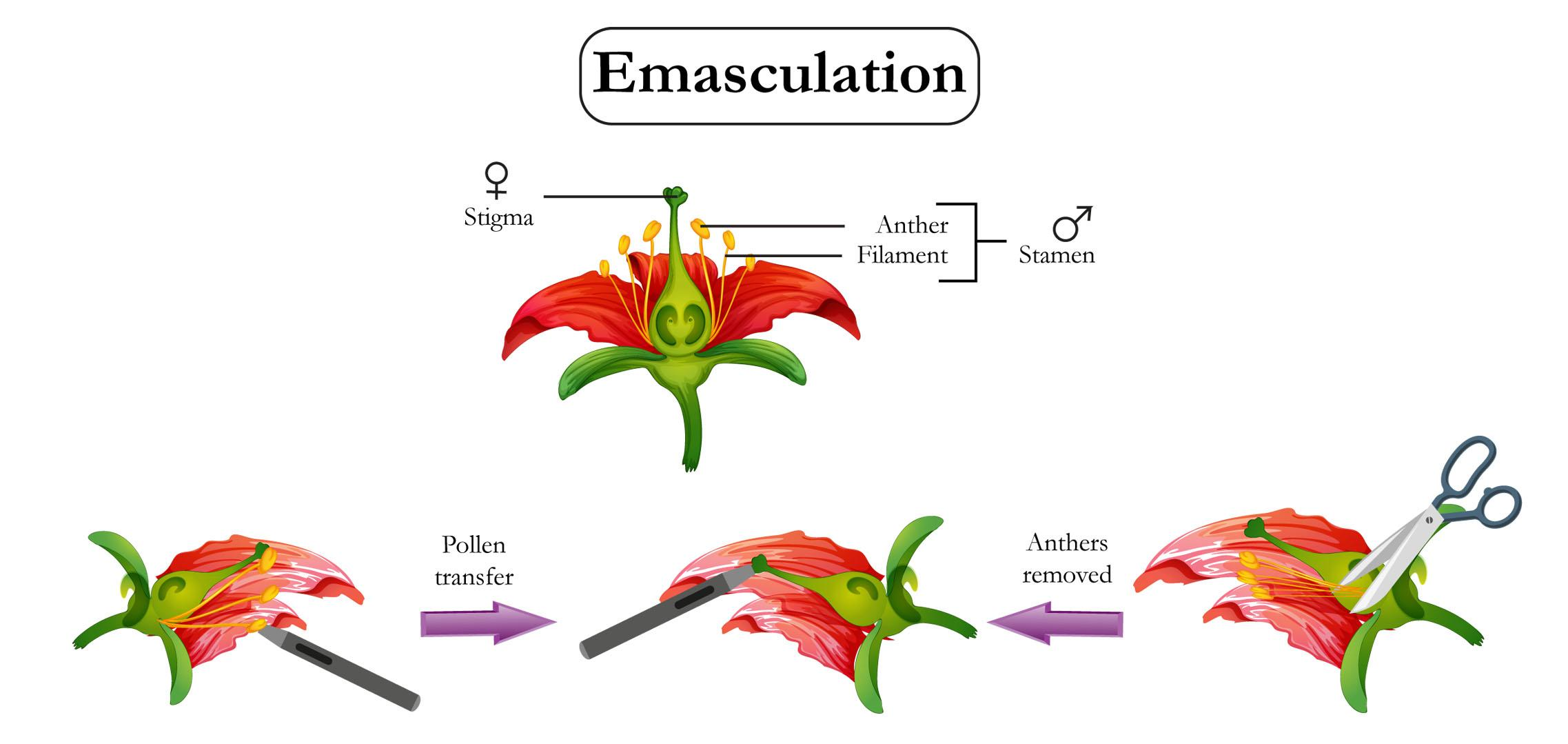
So the correct answer to the above question is ‘None of the above’.
Note: Emasculation may cause physiological changes to a recipient. A few investigations of the actual attributes of the Skoptsy, Chinese eunuchs, and Byzantine eunuchs, weakened went to have abbreviated middles, augmented stomachs and hips, expanded tallness, bowed legs, a prolonged skull. Emasculates also tend to possess less or no facial and hair, increased adipose tissue, and female fat pattern distributions.
Complete answer:
In unisexual flowers, a flower that possesses either stamens or carpels but not both. A plant could likewise be unisexually having just male blossoms or female blossoms, or it will be monoecious with male and ladylike regenerative organs borne inside a similar bloom or in various unisexual blossoms yet on a comparable plant. Removal of stamens or anthers or killing the pollen of a flower without the feminine sex organ is understood as emasculation. In bisexual flowers, emasculation is important to stop self-pollination. But in an unsexual flower already there is only one either male or female then there is no need to emasculate the flower.
Additional information
Emasculation procedures happen both inside and out of doors medical facilities.
In the cultural emasculations, like those performed by the Skoptsy, the Hijra, and on Chinese eunuchs conventionally incorporate separating the penis and gonads during a solitary movement, with a pointed instrument such as a knife or razor.
Alternatively, the process may be explained by consecutively tightening a string around the genitalia over a prolonged period of time.
So the correct answer to the above question is ‘None of the above’.
Note: Emasculation may cause physiological changes to a recipient. A few investigations of the actual attributes of the Skoptsy, Chinese eunuchs, and Byzantine eunuchs, weakened went to have abbreviated middles, augmented stomachs and hips, expanded tallness, bowed legs, a prolonged skull. Emasculates also tend to possess less or no facial and hair, increased adipose tissue, and female fat pattern distributions.
Recently Updated Pages
Master Class 12 Economics: Engaging Questions & Answers for Success

Master Class 12 Social Science: Engaging Questions & Answers for Success
Master Class 12 English: Engaging Questions & Answers for Success
Master Class 12 Maths: Engaging Questions & Answers for Success
Master Class 12 Physics: Engaging Questions & Answers for Success
Master Class 12 Biology: Engaging Questions & Answers for Success
Trending doubts
Draw a labelled sketch of the human eye class 12 physics CBSE
Which are the Top 10 Largest Countries of the World?
Draw ray diagrams each showing i myopic eye and ii class 12 physics CBSE
Which is the correct genotypic ratio of mendel dihybrid class 12 biology CBSE
Differentiate between homogeneous and heterogeneous class 12 chemistry CBSE
Which animal never drinks water in its entire life class 12 biology CBSE