




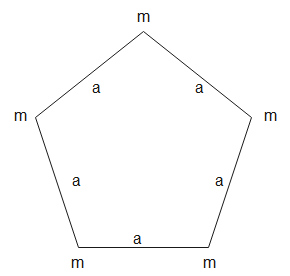
Five particles are situated on the corner of a regular pentagon as shown in figure. If one of the mass m will be replaced by 2m then what will be the shift in centre of mass?
Answer
 Verified
599.4k+ views
Hint: Centre of mass of a distributed mass system is an imaginary point where the whole mass of the system seems to be concentrated. Centre of mass is a unique point for a system. For regular shaped objects with uniform mass density, the centre of mass lies at centroid. When a mass is replaced by ‘2m’ the shift in centre of mass can be calculated using the formula of COM.
Formula used:
Coordinates of centre of mass, ${{R}_{COM}}=\dfrac{1}{M}\sum\limits_{i=1}^{n}{{{m}_{i}}{{r}_{i}}}$
Complete step by step answer:
Centre of mass of a system is defined as an imaginary point where the whole mass of the system seems to be concentrated. It is the balance point of the system. At this point, weighted position vectors of all the masses of a system adds to zero.
Mathematically, centre of mass for a system of particles is written as
${{R}_{COM}}=\dfrac{1}{M}\sum\limits_{i=1}^{n}{{{m}_{i}}{{r}_{i}}}$
Where ${{m}_{i}}$ and ${{r}_{i}}$ are the mass and co-ordinates of particle $i$ respectively. $M$ is the total mass of the whole system.
Initially, the situation is as shown in figure. As the system is regularly shaped with uniform distribution of masses, therefore, the centroid of pentagon coincides with the centre of mass of the system. Let us assume that the centroid of the system coincides with the origin of the coordinate system. Now, the system can be imagined to be concentrated at origin having mass ‘5m’.
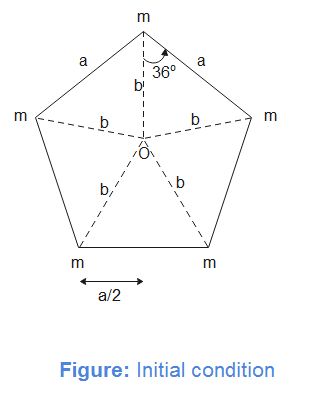
When one mass ‘m’ is replaced with ‘2m’, the mass at one of the vertices increases by ‘m’ or more precisely one extra mass ‘m’ is placed at the vertex. Therefore, the new centre of mass is
${{R}_{COM}}=\dfrac{5m\times 0+m\times b}{6m}=\dfrac{b}{6}$
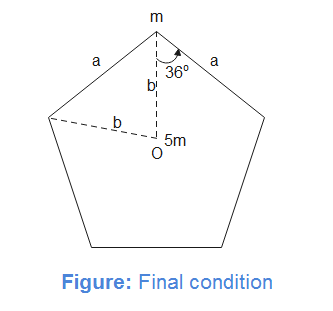
Centroid of a regular pentagon of edge length ‘a’ is at distance $a\cos {{36}^{{}^\circ }}$ from its vertices. Therefore, $b=a\cos {{36}^{{}^\circ }}=0.809a$
The new centre of mass is at distance $\dfrac{b}{6}$ from the centroid. Therefore, the shift in centre of mass is
$\Delta {{R}_{COM}}=\dfrac{b}{6}=\dfrac{0.809a}{6}=0.135a$
Note:
For regular shaped objects with uniform mass density, the centre of mass lies at centroid. This statement may not be true for objects with non-uniform density. For objects whose dimensions are much smaller than the radius of earth, the centre of mass and centre of gravity coincide. Centre of mass lies near the heavier portion of a system.
Formula used:
Coordinates of centre of mass, ${{R}_{COM}}=\dfrac{1}{M}\sum\limits_{i=1}^{n}{{{m}_{i}}{{r}_{i}}}$
Complete step by step answer:
Centre of mass of a system is defined as an imaginary point where the whole mass of the system seems to be concentrated. It is the balance point of the system. At this point, weighted position vectors of all the masses of a system adds to zero.
Mathematically, centre of mass for a system of particles is written as
${{R}_{COM}}=\dfrac{1}{M}\sum\limits_{i=1}^{n}{{{m}_{i}}{{r}_{i}}}$
Where ${{m}_{i}}$ and ${{r}_{i}}$ are the mass and co-ordinates of particle $i$ respectively. $M$ is the total mass of the whole system.
Initially, the situation is as shown in figure. As the system is regularly shaped with uniform distribution of masses, therefore, the centroid of pentagon coincides with the centre of mass of the system. Let us assume that the centroid of the system coincides with the origin of the coordinate system. Now, the system can be imagined to be concentrated at origin having mass ‘5m’.
When one mass ‘m’ is replaced with ‘2m’, the mass at one of the vertices increases by ‘m’ or more precisely one extra mass ‘m’ is placed at the vertex. Therefore, the new centre of mass is
${{R}_{COM}}=\dfrac{5m\times 0+m\times b}{6m}=\dfrac{b}{6}$
Centroid of a regular pentagon of edge length ‘a’ is at distance $a\cos {{36}^{{}^\circ }}$ from its vertices. Therefore, $b=a\cos {{36}^{{}^\circ }}=0.809a$
The new centre of mass is at distance $\dfrac{b}{6}$ from the centroid. Therefore, the shift in centre of mass is
$\Delta {{R}_{COM}}=\dfrac{b}{6}=\dfrac{0.809a}{6}=0.135a$
Note:
For regular shaped objects with uniform mass density, the centre of mass lies at centroid. This statement may not be true for objects with non-uniform density. For objects whose dimensions are much smaller than the radius of earth, the centre of mass and centre of gravity coincide. Centre of mass lies near the heavier portion of a system.
Recently Updated Pages
Master Class 11 Social Science: Engaging Questions & Answers for Success

Master Class 11 English: Engaging Questions & Answers for Success
Master Class 11 Maths: Engaging Questions & Answers for Success
Master Class 11 Chemistry: Engaging Questions & Answers for Success
Master Class 11 Biology: Engaging Questions & Answers for Success
Master Class 11 Physics: Engaging Questions & Answers for Success
Trending doubts
Differentiate between an exothermic and an endothermic class 11 chemistry CBSE
One Metric ton is equal to kg A 10000 B 1000 C 100 class 11 physics CBSE
Difference Between Prokaryotic Cells and Eukaryotic Cells
There are 720 permutations of the digits 1 2 3 4 5 class 11 maths CBSE
Two of the body parts which do not appear in MRI are class 11 biology CBSE
Which gas is abundant in air class 11 chemistry CBSE