




Five identical strings are used in the following three configurations. The time periods of vertical oscillations in the following configuration are in ratio:
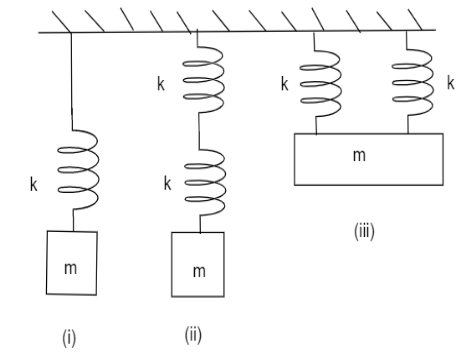
A. \[{\text{ 1 : }}\sqrt 2 {\text{ : }}\dfrac{1}{{\sqrt 2 }}\]
B. \[{\text{ 2 : }}\sqrt 2 {\text{ : }}\dfrac{1}{{\sqrt 2 }}\]
C. \[{\text{ }}\dfrac{1}{{\sqrt 2 }}{\text{ : }}2{\text{ : 1}}\]
D. \[{\text{ }}2{\text{ : }}\dfrac{1}{{\sqrt 2 }}{\text{ : 1}}\]
Answer
 Verified
560.7k+ views
Hint: We will find the time period of oscillation of the spring in each case. Also when two springs are attached in parallel or series combination then we have to calculate the equivalent spring constant. Thus we will find an equivalent spring constant before finding the time period of oscillations.
Formula Used:
\[(i){\text{ T = 2}}\pi \sqrt {\dfrac{m}{k}} \]
\[(ii)\] For parallel combination of springs:
\[{k_{eq.}}{\text{ = }}{k_1}{\text{ + }}{k_2}{\text{ + }}...............{k_n}\]
\[(iii)\] For series combination of springs:
\[\dfrac{1}{{{k_{eq.}}}}{\text{ = }}\dfrac{1}{{{k_1}}}{\text{ + }}\dfrac{1}{{{k_2}}}{\text{ + }}...............\dfrac{1}{{{k_n}}}\]
Complete step by step answer:
The time taken by the spring to complete one vertical oscillation is known as the time period of vertical oscillations. It depends on the spring constant \[k\] and mass of the body \[(m)\] attached to it. The time period to complete one vertical oscillation is given by:
\[{\text{ T = 2}}\pi \sqrt {\dfrac{m}{k}} \]
When two or more springs are attached to each other in series combination or parallel combination then we have to calculate the equivalent spring constant of the system and the formula reduced as,
\[{\text{ T = 2}}\pi \sqrt {\dfrac{m}{{{k_{eq.}}}}} \]
Time period for figure \[(i)\]:
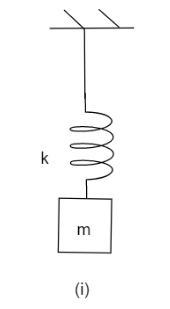
The time period for above system can be written as:
\[{\text{ }}{{\text{T}}_{(i)}}{\text{ = 2}}\pi \sqrt {\dfrac{m}{k}} \]
Time period for figure \[(ii)\]
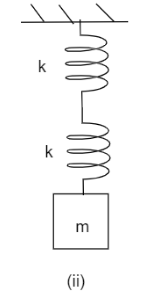
Here two ideal springs of spring constant \[k\] each are attached in series combination with mass \[(m)\]. Therefore we will find the equivalent spring constant for above system as,
For series combination:
\[\dfrac{1}{{{k_{eq.}}}}{\text{ = }}\dfrac{1}{{{k_1}}}{\text{ + }}\dfrac{1}{{{k_2}}}{\text{ + }}...............\dfrac{1}{{{k_n}}}\]
Here \[{k_1}\] and \[{k_2}\] both are equal to \[k\]. Thus on substituting values we get \[{k_{eq.}}\] as:
\[\dfrac{1}{{{k_{eq.}}}}{\text{ = }}\dfrac{1}{{{k_1}}}{\text{ + }}\dfrac{1}{{{k_2}}}{\text{ }}\]
\[\Rightarrow \dfrac{1}{{{k_{eq.}}}}{\text{ = }}\dfrac{1}{k}{\text{ + }}\dfrac{1}{k}{\text{ }}\]
\[\Rightarrow \dfrac{1}{{{k_{eq.}}}}{\text{ = }}\dfrac{2}{k}\]
\[\Rightarrow {k_{eq.}}{\text{ = }}\dfrac{k}{2}\]
Now the time period for the given system will be calculated as:
\[{\text{ }}{{\text{T}}_{(ii)}}{\text{ = 2}}\pi \sqrt {\dfrac{m}{{{k_{eq.}}}}} \]
\[\Rightarrow {\text{ }}{{\text{T}}_{(ii)}}{\text{ = 2}}\pi \sqrt {\dfrac{m}{{\dfrac{k}{2}}}} \]
\[\Rightarrow {\text{ }}{{\text{T}}_{(ii)}}{\text{ = 2}}\pi \sqrt {\dfrac{{2m}}{k}} \]
Time period for figure \[(iii)\]
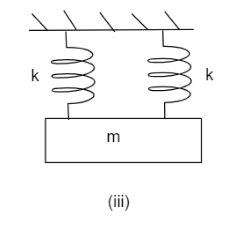
Here two identical springs of spring constant \[k\] are joined in a parallel combination. Therefore the equivalent spring constant can be calculated as:
For parallel combination:
\[{k_{eq.}}{\text{ = }}{k_1}{\text{ + }}{k_2}{\text{ + }}...............{k_n}\]
Here \[{k_1}\] and \[{k_2}\] both are equal to \[k\]. Thus on substituting values we get \[{k_{eq.}}\] as:
\[\Rightarrow {k_{eq.}}{\text{ = }}{k_1}{\text{ + }}{k_2}{\text{ }}\]
\[\Rightarrow {k_{eq.}}{\text{ = }}k{\text{ + }}k{\text{ }}\]
\[\Rightarrow {k_{eq.}}{\text{ = 2}}k\]
Time period of vertical oscillation will be equal to:
\[{\text{ }}{{\text{T}}_{(iii)}}{\text{ = 2}}\pi \sqrt {\dfrac{m}{{{k_{eq.}}}}} \]
\[\Rightarrow {\text{ }}{{\text{T}}_{(iii)}}{\text{ = 2}}\pi \sqrt {\dfrac{m}{{2k}}} \]
Now we will find the ratio of \[{T_{(i)}}{\text{ : }}{T_{(ii)}}{\text{ : }}{T_{(iii)}}\] and get the result as:
\[{T_{(i)}}{\text{ : }}{T_{(ii)}}{\text{ : }}{T_{(iii)}}{\text{ = 2}}\pi \sqrt {\dfrac{m}{k}{\text{ }}} {\text{ }}:{\text{ 2}}\pi \sqrt {\dfrac{{2m}}{k}} {\text{ : 2}}\pi \sqrt {\dfrac{m}{{2k}}} \]
\[\therefore {T_{(i)}}{\text{ : }}{T_{(ii)}}{\text{ : }}{T_{(iii)}}{\text{ = 1}}:{\text{ }}\sqrt 2 {\text{ : }}\dfrac{1}{{\sqrt 2 }}\]
Hence the correct option is A.
Note: Before finding the time period of oscillation we must ensure to find the equivalent spring constant of the system. The concept used for finding equivalent spring constant is the reverse of that of equivalent combination of resistance. Also the mass we used is reduced mass.
Formula Used:
\[(i){\text{ T = 2}}\pi \sqrt {\dfrac{m}{k}} \]
\[(ii)\] For parallel combination of springs:
\[{k_{eq.}}{\text{ = }}{k_1}{\text{ + }}{k_2}{\text{ + }}...............{k_n}\]
\[(iii)\] For series combination of springs:
\[\dfrac{1}{{{k_{eq.}}}}{\text{ = }}\dfrac{1}{{{k_1}}}{\text{ + }}\dfrac{1}{{{k_2}}}{\text{ + }}...............\dfrac{1}{{{k_n}}}\]
Complete step by step answer:
The time taken by the spring to complete one vertical oscillation is known as the time period of vertical oscillations. It depends on the spring constant \[k\] and mass of the body \[(m)\] attached to it. The time period to complete one vertical oscillation is given by:
\[{\text{ T = 2}}\pi \sqrt {\dfrac{m}{k}} \]
When two or more springs are attached to each other in series combination or parallel combination then we have to calculate the equivalent spring constant of the system and the formula reduced as,
\[{\text{ T = 2}}\pi \sqrt {\dfrac{m}{{{k_{eq.}}}}} \]
Time period for figure \[(i)\]:
The time period for above system can be written as:
\[{\text{ }}{{\text{T}}_{(i)}}{\text{ = 2}}\pi \sqrt {\dfrac{m}{k}} \]
Time period for figure \[(ii)\]
Here two ideal springs of spring constant \[k\] each are attached in series combination with mass \[(m)\]. Therefore we will find the equivalent spring constant for above system as,
For series combination:
\[\dfrac{1}{{{k_{eq.}}}}{\text{ = }}\dfrac{1}{{{k_1}}}{\text{ + }}\dfrac{1}{{{k_2}}}{\text{ + }}...............\dfrac{1}{{{k_n}}}\]
Here \[{k_1}\] and \[{k_2}\] both are equal to \[k\]. Thus on substituting values we get \[{k_{eq.}}\] as:
\[\dfrac{1}{{{k_{eq.}}}}{\text{ = }}\dfrac{1}{{{k_1}}}{\text{ + }}\dfrac{1}{{{k_2}}}{\text{ }}\]
\[\Rightarrow \dfrac{1}{{{k_{eq.}}}}{\text{ = }}\dfrac{1}{k}{\text{ + }}\dfrac{1}{k}{\text{ }}\]
\[\Rightarrow \dfrac{1}{{{k_{eq.}}}}{\text{ = }}\dfrac{2}{k}\]
\[\Rightarrow {k_{eq.}}{\text{ = }}\dfrac{k}{2}\]
Now the time period for the given system will be calculated as:
\[{\text{ }}{{\text{T}}_{(ii)}}{\text{ = 2}}\pi \sqrt {\dfrac{m}{{{k_{eq.}}}}} \]
\[\Rightarrow {\text{ }}{{\text{T}}_{(ii)}}{\text{ = 2}}\pi \sqrt {\dfrac{m}{{\dfrac{k}{2}}}} \]
\[\Rightarrow {\text{ }}{{\text{T}}_{(ii)}}{\text{ = 2}}\pi \sqrt {\dfrac{{2m}}{k}} \]
Time period for figure \[(iii)\]
Here two identical springs of spring constant \[k\] are joined in a parallel combination. Therefore the equivalent spring constant can be calculated as:
For parallel combination:
\[{k_{eq.}}{\text{ = }}{k_1}{\text{ + }}{k_2}{\text{ + }}...............{k_n}\]
Here \[{k_1}\] and \[{k_2}\] both are equal to \[k\]. Thus on substituting values we get \[{k_{eq.}}\] as:
\[\Rightarrow {k_{eq.}}{\text{ = }}{k_1}{\text{ + }}{k_2}{\text{ }}\]
\[\Rightarrow {k_{eq.}}{\text{ = }}k{\text{ + }}k{\text{ }}\]
\[\Rightarrow {k_{eq.}}{\text{ = 2}}k\]
Time period of vertical oscillation will be equal to:
\[{\text{ }}{{\text{T}}_{(iii)}}{\text{ = 2}}\pi \sqrt {\dfrac{m}{{{k_{eq.}}}}} \]
\[\Rightarrow {\text{ }}{{\text{T}}_{(iii)}}{\text{ = 2}}\pi \sqrt {\dfrac{m}{{2k}}} \]
Now we will find the ratio of \[{T_{(i)}}{\text{ : }}{T_{(ii)}}{\text{ : }}{T_{(iii)}}\] and get the result as:
\[{T_{(i)}}{\text{ : }}{T_{(ii)}}{\text{ : }}{T_{(iii)}}{\text{ = 2}}\pi \sqrt {\dfrac{m}{k}{\text{ }}} {\text{ }}:{\text{ 2}}\pi \sqrt {\dfrac{{2m}}{k}} {\text{ : 2}}\pi \sqrt {\dfrac{m}{{2k}}} \]
\[\therefore {T_{(i)}}{\text{ : }}{T_{(ii)}}{\text{ : }}{T_{(iii)}}{\text{ = 1}}:{\text{ }}\sqrt 2 {\text{ : }}\dfrac{1}{{\sqrt 2 }}\]
Hence the correct option is A.
Note: Before finding the time period of oscillation we must ensure to find the equivalent spring constant of the system. The concept used for finding equivalent spring constant is the reverse of that of equivalent combination of resistance. Also the mass we used is reduced mass.
Recently Updated Pages
If x a + bt + ct2 where x is in meters and t is in class 11 physics CBSE

A car covers the first half distance between two places class 11 physics CBSE
The resultant of two vectors overrightarrow P and overrightarrow class 11 physics CBSE
Find the value of cos 135 class 11 maths CBSE
A mass M is held in place by an applied force F and class 11 physics CBSE
A solution of glucose in water is labelled as 10 dfracwv class 11 chemistry CBSE
Trending doubts
Find the value of the expression given below sin 30circ class 11 maths CBSE
What is the maximum height of a projectile class 11 physics CBSE
Derive an expression for maximum height and range of class 11 physics CBSE
Describe various types of epithelial tissues with the class 11 biology CBSE
Lysosomes are known as suicidal bags of cell why class 11 biology CBSE
State and derive law of conservation of momentum class 11 physics CBSE