




Five groups of extremely reduced male flowers, each group consisting of a single anther on a stem is found in which inflorescence?
(a)Cyathium
(b)Dichasial cyme
(c)Panicle
(d)Verticillaster
Answer
 Verified
599.4k+ views
Hint: The inflorescence bearing such flowers is one of the specialized pseudanthium forming or “false flowers” forming inflorescence seen in the genus Euphorbia. This kind of inflorescence also has five bracteoles and one extremely reduced female flower.
Complete answer:
Cyathium inflorescence is an inflorescence with unisexual, apetalous male and female flowers.
A cyathium inflorescence consists of:
- Five sometimes four bracteoles which are small, united bracts forming a cup-like involucre. Their tips are free and they cover the opening of the involucre.
- These bracteoles alternate with five nectar glands, which may be present singly or may be fused.
- One extremely reduced female flower in the center and consists of an ovary on a short stem with a pistil.
- These female flowers are surrounded by five groups of extremely reduced male flowers (one group at the base of each bracteole), each consisting of a single anther present on a stem.
So, the correct answer is, “Cyathium”
Note: - Though cyathia are said to be one of the types of inflorescence producing false flowers, the flower-like characteristics are underlined by brightly colored nectar glands and often also through the petal-like appendages to the nectar glands.
- Sometimes the cyathia may be present solitarily but is usually present as a second-order inflorescence in cymes, pseudumbels, etc.
- Most cyathia have cyathophyllum surrounding them that are upright and provide protection but rendering the nectar glands inaccessible.
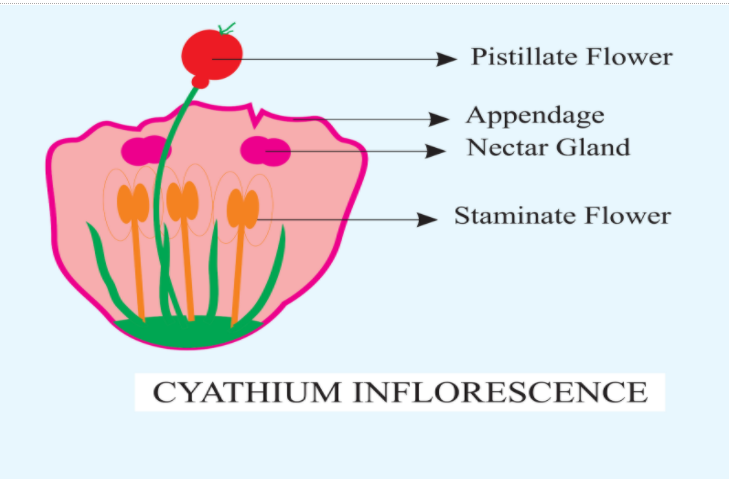
Complete answer:
Cyathium inflorescence is an inflorescence with unisexual, apetalous male and female flowers.
A cyathium inflorescence consists of:
- Five sometimes four bracteoles which are small, united bracts forming a cup-like involucre. Their tips are free and they cover the opening of the involucre.
- These bracteoles alternate with five nectar glands, which may be present singly or may be fused.
- One extremely reduced female flower in the center and consists of an ovary on a short stem with a pistil.
- These female flowers are surrounded by five groups of extremely reduced male flowers (one group at the base of each bracteole), each consisting of a single anther present on a stem.
So, the correct answer is, “Cyathium”
Note: - Though cyathia are said to be one of the types of inflorescence producing false flowers, the flower-like characteristics are underlined by brightly colored nectar glands and often also through the petal-like appendages to the nectar glands.
- Sometimes the cyathia may be present solitarily but is usually present as a second-order inflorescence in cymes, pseudumbels, etc.
- Most cyathia have cyathophyllum surrounding them that are upright and provide protection but rendering the nectar glands inaccessible.
Recently Updated Pages
Master Class 11 Social Science: Engaging Questions & Answers for Success

Master Class 11 Chemistry: Engaging Questions & Answers for Success
Master Class 12 Business Studies: Engaging Questions & Answers for Success
Master Class 12 Chemistry: Engaging Questions & Answers for Success
Master Class 12 Biology: Engaging Questions & Answers for Success
Class 12 Question and Answer - Your Ultimate Solutions Guide
Trending doubts
One Metric ton is equal to kg A 10000 B 1000 C 100 class 11 physics CBSE
Difference Between Prokaryotic Cells and Eukaryotic Cells
How many of the following diseases can be studied with class 11 biology CBSE
Two of the body parts which do not appear in MRI are class 11 biology CBSE
Which of the following enzymes is used for carboxylation class 11 biology CBSE
Explain zero factorial class 11 maths CBSE