



Five dry cells each of 1.5 volt have internal resistance of 0.2, 0.3, 0.4, 0.5 and 12ohms. When connected in series, what current will these five cells furnish through 10ohm resistance?
Answer
 Verified
558k+ views
Hint: Since all the cells are connected in series in the above-mentioned configuration, therefore they will collectively act as one battery, whose net voltage output is the sum of voltage output of all the cells and whose resistance is the net resistance, that is the sum of all the cell resistances. We shall proceed with this analysis.
Complete answer:
Let us first try to understand this series connection of cells with the help of the following diagram:
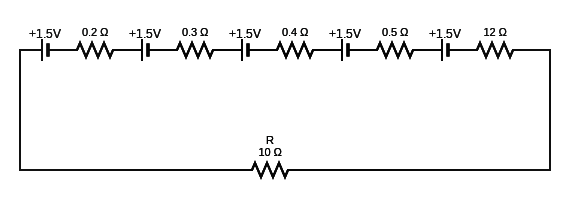
Here, we can see all the cells being connected in parallel along with their respective internal resistances.
Let the collective voltage output of all the cells be denoted by V. Then, since we have 5 cell of 1.5 volts each, therefore this collective voltage V can be calculated as follows:
$\Rightarrow V=1.5\times 5V$
$\Rightarrow V=7.5V$ [Let this expression be equation number (1)]
Now, let the total cell resistance be denoted by R. Then, it can be calculated as follows:
$\Rightarrow R=(0.2+0.3+0.4+0.5+12)\Omega $
$\Rightarrow R=13.4\Omega $
Thus, the total resistance offered by the circuit will be equal to:
$\begin{align}
& \Rightarrow {{R}_{net}}=(13.4+10)\Omega \\
& \Rightarrow {{R}_{net}}=23.4\Omega \\
\end{align}$ [Let this expression be equation number (2)]
Now, the net current that these five cells together furnish (say I) through 10ohm resistance will be equal to:
$\begin{align}
& \Rightarrow I=\dfrac{7.5}{23.4}A \\
& \therefore I=0.32A \\
\end{align}$
Hence, when connected in series, the net current that these five cells will furnish through the 10ohm resistance is 0.32 Amperes.
Note:
It is important to know how cells work when connected in series or parallel. In our problem, there was no mention of how in series the cells were joined together, that is, parallel or antiparallel. So, under such conditions we will assume that the cells are joined parallel to one another. That is, their net voltage output will be a sum of their individual voltage outputs. These basic assumptions should be applied when there is insufficient data in the question.
Complete answer:
Let us first try to understand this series connection of cells with the help of the following diagram:
Here, we can see all the cells being connected in parallel along with their respective internal resistances.
Let the collective voltage output of all the cells be denoted by V. Then, since we have 5 cell of 1.5 volts each, therefore this collective voltage V can be calculated as follows:
$\Rightarrow V=1.5\times 5V$
$\Rightarrow V=7.5V$ [Let this expression be equation number (1)]
Now, let the total cell resistance be denoted by R. Then, it can be calculated as follows:
$\Rightarrow R=(0.2+0.3+0.4+0.5+12)\Omega $
$\Rightarrow R=13.4\Omega $
Thus, the total resistance offered by the circuit will be equal to:
$\begin{align}
& \Rightarrow {{R}_{net}}=(13.4+10)\Omega \\
& \Rightarrow {{R}_{net}}=23.4\Omega \\
\end{align}$ [Let this expression be equation number (2)]
Now, the net current that these five cells together furnish (say I) through 10ohm resistance will be equal to:
$\begin{align}
& \Rightarrow I=\dfrac{7.5}{23.4}A \\
& \therefore I=0.32A \\
\end{align}$
Hence, when connected in series, the net current that these five cells will furnish through the 10ohm resistance is 0.32 Amperes.
Note:
It is important to know how cells work when connected in series or parallel. In our problem, there was no mention of how in series the cells were joined together, that is, parallel or antiparallel. So, under such conditions we will assume that the cells are joined parallel to one another. That is, their net voltage output will be a sum of their individual voltage outputs. These basic assumptions should be applied when there is insufficient data in the question.
Recently Updated Pages
Master Class 12 Economics: Engaging Questions & Answers for Success

Master Class 12 English: Engaging Questions & Answers for Success
Master Class 12 Social Science: Engaging Questions & Answers for Success
Master Class 12 Maths: Engaging Questions & Answers for Success
Master Class 12 Physics: Engaging Questions & Answers for Success
Master Class 9 General Knowledge: Engaging Questions & Answers for Success
Trending doubts
One Metric ton is equal to kg A 10000 B 1000 C 100 class 11 physics CBSE
Difference Between Prokaryotic Cells and Eukaryotic Cells
Two of the body parts which do not appear in MRI are class 11 biology CBSE
1 ton equals to A 100 kg B 1000 kg C 10 kg D 10000 class 11 physics CBSE
Draw a diagram of nephron and explain its structur class 11 biology CBSE
10 examples of friction in our daily life