




Five balls are placed one after the other along straight lines as shown in the figure. Initially, all the balls are at rest. Then the second ball has been projected with speed $v_{0}$ towards the third ball. Mark the correct statements. (Assume all collisions to be head-on and elastic)
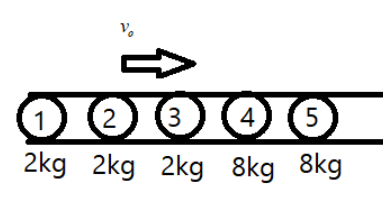
A. total number of collisions in the process is 5
B. the velocity of separation between the first and the fifth ball after the last possible collision is $v_{0}$
C. finally, three balls remain stationary.
D. all of the above.
Answer
 Verified
576.3k+ views
Hint: An elastic collision is said to occur when the total kinetic energy of the two bodies interacting bodies is conserved. We know that the ball which is displaced by some velocity rebounds with the same velocity in an elastic collision.
Formula: $\Delta p=0$
Complete answer:
We know that collision is the interaction between two or more bodies which are moving with some velocities for a short duration of time. We also know that when two bodies undergo collision there is a transfer of momentum and energy between the bodies. Generally, collision results in the change in velocity of the bodies that are interacting in nature. Since velocity is a vector, we can say that collision tends to change the direction and speed of the interacting bodies.
They are broadly classified into two types of collision namely the elastic collision, and the inelastic collision. In elastic collision, both the momentum and the kinetic energy of the system as a whole is conserved. In inelastic collisions, the momentum of the system is conserved while the kinetic energy of the system is not conserved.
Here, it is given that the above collision is elastic.
Since initially the 2nd ball moves with a velocity $v_{o}$, then we can say that this $v_{o}$ affects the 1st and the 3rd ball by $x$ and $y$ respectively, then from the conservation of momentum, we have, $2v_{0}=2x+2y$
$\implies v_{0}=x+y$
Similarly, when the 3rd ball moves with a velocity $v_{o}$, then we can say that this $v_{o}$ affects the 2nd and the 4th ball by $x$ and $y$ respectively, then from the conservation of momentum, we have, $2v_{0}=8y-2x$
Then from the two equations, we have, $x=0.6v_{0}$ and $y=0.4v_{0}$
Similarly, the 1st ball moves with $x=0.6v_{0}$ and 5th moves with $y=0.4v_{0}$
Clearly, there are 5 total collisions in the system. Also, after collision, the three balls, namely, 2,3 and 4 are at rest finally. Also, the total velocity still remains then we can say that all the all the answers are correct.
Hence the correct option is D. all of the above.
Note:
Here, the velocity of the displaced balls remains the same with respect to the x and y axis. Hence using the two equations, we can find the individual velocities. Also note that the balls come to rest after getting displaced by some distance due to some specific velocity.
Formula: $\Delta p=0$
Complete answer:
We know that collision is the interaction between two or more bodies which are moving with some velocities for a short duration of time. We also know that when two bodies undergo collision there is a transfer of momentum and energy between the bodies. Generally, collision results in the change in velocity of the bodies that are interacting in nature. Since velocity is a vector, we can say that collision tends to change the direction and speed of the interacting bodies.
They are broadly classified into two types of collision namely the elastic collision, and the inelastic collision. In elastic collision, both the momentum and the kinetic energy of the system as a whole is conserved. In inelastic collisions, the momentum of the system is conserved while the kinetic energy of the system is not conserved.
Here, it is given that the above collision is elastic.
Since initially the 2nd ball moves with a velocity $v_{o}$, then we can say that this $v_{o}$ affects the 1st and the 3rd ball by $x$ and $y$ respectively, then from the conservation of momentum, we have, $2v_{0}=2x+2y$
$\implies v_{0}=x+y$
Similarly, when the 3rd ball moves with a velocity $v_{o}$, then we can say that this $v_{o}$ affects the 2nd and the 4th ball by $x$ and $y$ respectively, then from the conservation of momentum, we have, $2v_{0}=8y-2x$
Then from the two equations, we have, $x=0.6v_{0}$ and $y=0.4v_{0}$
Similarly, the 1st ball moves with $x=0.6v_{0}$ and 5th moves with $y=0.4v_{0}$
Clearly, there are 5 total collisions in the system. Also, after collision, the three balls, namely, 2,3 and 4 are at rest finally. Also, the total velocity still remains then we can say that all the all the answers are correct.
Hence the correct option is D. all of the above.
Note:
Here, the velocity of the displaced balls remains the same with respect to the x and y axis. Hence using the two equations, we can find the individual velocities. Also note that the balls come to rest after getting displaced by some distance due to some specific velocity.
Recently Updated Pages
Master Class 11 Computer Science: Engaging Questions & Answers for Success

Master Class 11 Business Studies: Engaging Questions & Answers for Success
Master Class 11 Economics: Engaging Questions & Answers for Success
Master Class 11 English: Engaging Questions & Answers for Success
Master Class 11 Maths: Engaging Questions & Answers for Success
Master Class 11 Biology: Engaging Questions & Answers for Success
Trending doubts
One Metric ton is equal to kg A 10000 B 1000 C 100 class 11 physics CBSE
There are 720 permutations of the digits 1 2 3 4 5 class 11 maths CBSE
Discuss the various forms of bacteria class 11 biology CBSE
Draw a diagram of a plant cell and label at least eight class 11 biology CBSE
State the laws of reflection of light
Explain zero factorial class 11 maths CBSE