




What is the first step to occur during the process of replication?
Answer
 Verified
588.9k+ views
Hint: Replication is a process that takes place at the time of reproduction at genetic level. This reproduction can either be for production of new cells or new organisms. It involves duplication of DNA so that uniformity of genes is maintained throughout the organism body.
Complete answer:
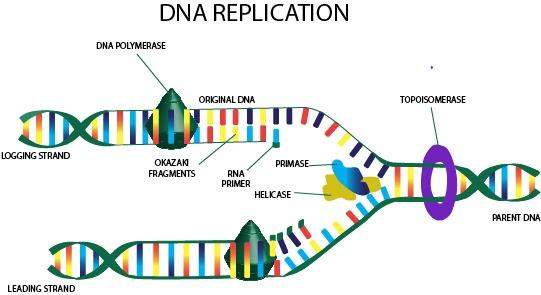
DNA (Deoxyribose Nucleic Acid) replication is a crucial and complex process. Unzipping of the helical structure is the first step which is concerned with breaking down the hydrogen bond between nitrogenous bases. It is possible only with the help of helicase enzyme that breaks these hydrogen bonds and separates the nitrogenous bases leading to formation of Y-shaped fork. Now this fork works as the foundation stone for formation of the new duplicate strand.
Binding of primers to form the duplicate strand is the second step of DNA replication. Replication process is actually initiated from this step. In this step, a primer (piece of RNA) is supposed to bind to the fork strand of DNA. Replication always takes place from the starting point of the DNA strand. However, this primer is formed by action of an enzyme called DNA primase.
Elongation is the third step of the DNA replication process. It involves formation of new contrasting nitrogenous bases alongside the already present nitrogenous bases in the fork strand body. These bases lead to elongation of the new strand into helical structure sonia called elongation. This action is initiated by several replication hormones such as polymerase III.
Note:
Termination is the last step of the DNA replication process. It is concerned with formation of two new DNA structures carrying one parent strand and one new daughter strand. This is possible by action of many enzymes. First an enzyme called exonuclease removes all the RNA primers to allow formation of full fledged daughter strands. Another such hormone does a proof reading to avoid mistakes. Another enzyme called DNA ligase leads to unification of the two strands. At last DNA telomerase breaks these strands to form individual helical structures. Thus, two new DNA strands are formed.
Complete answer:
DNA (Deoxyribose Nucleic Acid) replication is a crucial and complex process. Unzipping of the helical structure is the first step which is concerned with breaking down the hydrogen bond between nitrogenous bases. It is possible only with the help of helicase enzyme that breaks these hydrogen bonds and separates the nitrogenous bases leading to formation of Y-shaped fork. Now this fork works as the foundation stone for formation of the new duplicate strand.
Binding of primers to form the duplicate strand is the second step of DNA replication. Replication process is actually initiated from this step. In this step, a primer (piece of RNA) is supposed to bind to the fork strand of DNA. Replication always takes place from the starting point of the DNA strand. However, this primer is formed by action of an enzyme called DNA primase.
Elongation is the third step of the DNA replication process. It involves formation of new contrasting nitrogenous bases alongside the already present nitrogenous bases in the fork strand body. These bases lead to elongation of the new strand into helical structure sonia called elongation. This action is initiated by several replication hormones such as polymerase III.
Note:
Termination is the last step of the DNA replication process. It is concerned with formation of two new DNA structures carrying one parent strand and one new daughter strand. This is possible by action of many enzymes. First an enzyme called exonuclease removes all the RNA primers to allow formation of full fledged daughter strands. Another such hormone does a proof reading to avoid mistakes. Another enzyme called DNA ligase leads to unification of the two strands. At last DNA telomerase breaks these strands to form individual helical structures. Thus, two new DNA strands are formed.
Recently Updated Pages
Which of the following graphs shows the variation of class 12 physics CBSE

Draw a labelled diagram of the human male reproductive class 12 biology CBSE
Describe the experiment to compare the emf of two cells class 12 physics CBSE
What is standard hydrogen electrode
What is conventional current and electric current class 12 physics CBSE
2Bromopentane is treated with an alcoholic KOH solution class 12 chemistry CBSE
Trending doubts
Draw a labelled sketch of the human eye class 12 physics CBSE
Which are the Top 10 Largest Countries of the World?
Differentiate between homogeneous and heterogeneous class 12 chemistry CBSE
Draw ray diagrams each showing i myopic eye and ii class 12 physics CBSE
Which is the correct genotypic ratio of mendel dihybrid class 12 biology CBSE
What is the Full Form of PVC, PET, HDPE, LDPE, PP and PS ?