




How do you find which quadrant each question is referring to if $0 < a < \dfrac{\pi }{2}$ and $\dfrac{3\pi }{2} < a < 2\pi $?
Answer
 Verified
622.2k+ views
Hint: We explain the central angle around a point. Then we discuss the algebraic and geometric versions of the quadrants. We also find different quadrants and their characteristics. Then we find the solutions for the angles $0 < a < \dfrac{\pi }{2}$ and $\dfrac{3\pi }{2} < a < 2\pi $.
Complete step by step answer:
The central angle around a point is always equal to ${{360}^{\circ }}$.
The total angle is divided into four parts or quadrant as they are called. These quadrants are named in roman numerals of $I,II,III,IV$.
In case of algebraic sense these quadrants give the signs of the x and y coordinates.
These quadrants are also called as the first, second, third and fourth quadrant.
The respective signs for the coordinates of $\left( x,y \right)$ will be \[\left( +,+ \right),\left( -,+ \right),\left( -,- \right),\left( +,- \right)\] respectively for the quadrants.
Now we look for the geometric side of the quadrants where we deal with the angle of the trigonometric ratios.
The total circular angle of $2\pi $ can be divided into four parts. Each part is of $\dfrac{\pi }{2}$.
Therefore, the first quadrant is the interval of $\left( 0,\dfrac{\pi }{2} \right)$. The second quadrant is the interval of $\left( \dfrac{\pi }{2},\pi \right)$. The third quadrant is the interval of $\left( \pi ,\dfrac{3\pi }{2} \right)$. The fourth quadrant is the interval of $\left( \dfrac{3\pi }{2},2\pi \right)$. The $0,\dfrac{\pi }{2},\pi ,\dfrac{3\pi }{2}$ indicates the axes.
Now we find for the quadrants $0 < a < \dfrac{\pi }{2}$ and $\dfrac{3\pi }{2} < a < 2\pi $.
When the angle $0 < a < \dfrac{\pi }{2}$, the quadrant is first and when the angle $\dfrac{3\pi }{2} < a < 2\pi $, the quadrant is fourth.
Note:
We can also represent the quadrants with respect to the image form of both algebraic and geometric versions.
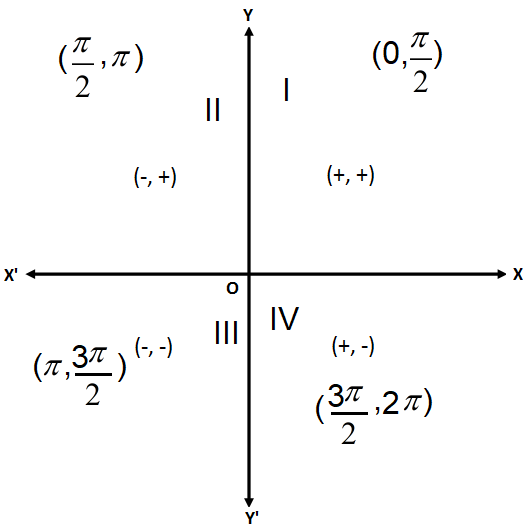
The rotation of the coordinates happens anti-clockwise.
Complete step by step answer:
The central angle around a point is always equal to ${{360}^{\circ }}$.
The total angle is divided into four parts or quadrant as they are called. These quadrants are named in roman numerals of $I,II,III,IV$.
In case of algebraic sense these quadrants give the signs of the x and y coordinates.
These quadrants are also called as the first, second, third and fourth quadrant.
The respective signs for the coordinates of $\left( x,y \right)$ will be \[\left( +,+ \right),\left( -,+ \right),\left( -,- \right),\left( +,- \right)\] respectively for the quadrants.
Now we look for the geometric side of the quadrants where we deal with the angle of the trigonometric ratios.
The total circular angle of $2\pi $ can be divided into four parts. Each part is of $\dfrac{\pi }{2}$.
Therefore, the first quadrant is the interval of $\left( 0,\dfrac{\pi }{2} \right)$. The second quadrant is the interval of $\left( \dfrac{\pi }{2},\pi \right)$. The third quadrant is the interval of $\left( \pi ,\dfrac{3\pi }{2} \right)$. The fourth quadrant is the interval of $\left( \dfrac{3\pi }{2},2\pi \right)$. The $0,\dfrac{\pi }{2},\pi ,\dfrac{3\pi }{2}$ indicates the axes.
Now we find for the quadrants $0 < a < \dfrac{\pi }{2}$ and $\dfrac{3\pi }{2} < a < 2\pi $.
When the angle $0 < a < \dfrac{\pi }{2}$, the quadrant is first and when the angle $\dfrac{3\pi }{2} < a < 2\pi $, the quadrant is fourth.
Note:
We can also represent the quadrants with respect to the image form of both algebraic and geometric versions.
The rotation of the coordinates happens anti-clockwise.
Recently Updated Pages
If x a + bt + ct2 where x is in meters and t is in class 11 physics CBSE

A car covers the first half distance between two places class 11 physics CBSE
The resultant of two vectors overrightarrow P and overrightarrow class 11 physics CBSE
Find the value of cos 135 class 11 maths CBSE
A mass M is held in place by an applied force F and class 11 physics CBSE
A solution of glucose in water is labelled as 10 dfracwv class 11 chemistry CBSE
Trending doubts
One Metric ton is equal to kg A 10000 B 1000 C 100 class 11 physics CBSE
Find the value of the expression given below sin 30circ class 11 maths CBSE
What do you mean by retardation What is its SI uni class 11 physics CBSE
Draw a diagram of nephron and explain its structur class 11 biology CBSE
10 examples of friction in our daily life
Difference between physical and chemical change class 11 chemistry CBSE