




How do you find the $x$ and $y$ intercepts for $y = 7x + 8$?
Answer
 Verified
545.4k+ views
Hint: The $x$ intercepts for a curve on the graph are the points at which the curve intersects the x-axis. At these points $y = 0$. Similarly, $y$ intercepts for a curve on the graph are the points at which the curve intersects the y-axis. At these points $x = 0$.
Complete step by step solution:
We have to find $x$ and $y$ intercepts for the equation $y = 7x + 8$.
First we find the $x$ intercept.
The $x$ intercepts are the points at which the curve intersects the x-axis. To find the abscissa, i.e. $x$ coordinate, we assume $y = 0$ and evaluate the corresponding value of $x$.
$
y = 7x + 8 \\
\Rightarrow 0 = 7x + 8 \\
\Rightarrow 7x = - 8 \\
\Rightarrow x = \dfrac{{ - 8}}{7} \\
$
Thus, we get the point as $(\dfrac{{ - 8}}{7},{\kern 1pt} {\kern 1pt} {\kern 1pt} 0)$. This is the $x$ intercept of the graph of the given equation.
Now we find the $y$ intercept.
The $y$ intercepts are the points at which the curve intersects the y-axis. To find the ordinate, i.e. $y$ coordinate, we assume $x = 0$ and evaluate the corresponding value of $y$.
$
y = 7x + 8 \\
\Rightarrow y = 7 \times 0 + 8 \\
\Rightarrow y = 0 + 8 \\
\Rightarrow y = 8 \\
$
Thus, we get the point as $(0,\,{\kern 1pt} {\kern 1pt} 8)$. This is the $y$ intercept of the graph of the given equation.
Hence, for the graph of the given equation we get the $x$ intercept as $(\dfrac{{ - 8}}{7},{\kern 1pt} {\kern 1pt} {\kern 1pt} 0)$ and the $y$ intercept as $(0,\,{\kern 1pt} {\kern 1pt} 8)$.
This we can also show from the graph of the equation $y = 7x + 8$.
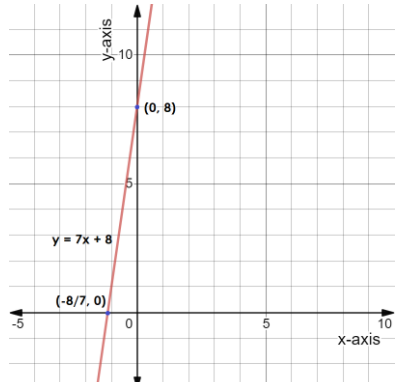
We can see in the above graph that the line of the equation cuts the x-axis at $(\dfrac{{ - 8}}{7},{\kern 1pt} {\kern 1pt} {\kern 1pt} 0)$ and the y-axis at $(0,\,{\kern 1pt} {\kern 1pt} 8)$.
Note:
To find the $x$ intercept we put $y = 0$ and to find $y$ intercept we put $x = 0$ in the given equation. For a linear equation, we can also find the intercepts by writing the equation in the form of $\dfrac{x}{a} + \dfrac{y}{b} = 1$, where $a$ will be the $x$ intercept and $b$ will be the $y$ intercept. For a linear equation in two variables we get at most one $x$ intercept and at most one $y$ intercept.
Complete step by step solution:
We have to find $x$ and $y$ intercepts for the equation $y = 7x + 8$.
First we find the $x$ intercept.
The $x$ intercepts are the points at which the curve intersects the x-axis. To find the abscissa, i.e. $x$ coordinate, we assume $y = 0$ and evaluate the corresponding value of $x$.
$
y = 7x + 8 \\
\Rightarrow 0 = 7x + 8 \\
\Rightarrow 7x = - 8 \\
\Rightarrow x = \dfrac{{ - 8}}{7} \\
$
Thus, we get the point as $(\dfrac{{ - 8}}{7},{\kern 1pt} {\kern 1pt} {\kern 1pt} 0)$. This is the $x$ intercept of the graph of the given equation.
Now we find the $y$ intercept.
The $y$ intercepts are the points at which the curve intersects the y-axis. To find the ordinate, i.e. $y$ coordinate, we assume $x = 0$ and evaluate the corresponding value of $y$.
$
y = 7x + 8 \\
\Rightarrow y = 7 \times 0 + 8 \\
\Rightarrow y = 0 + 8 \\
\Rightarrow y = 8 \\
$
Thus, we get the point as $(0,\,{\kern 1pt} {\kern 1pt} 8)$. This is the $y$ intercept of the graph of the given equation.
Hence, for the graph of the given equation we get the $x$ intercept as $(\dfrac{{ - 8}}{7},{\kern 1pt} {\kern 1pt} {\kern 1pt} 0)$ and the $y$ intercept as $(0,\,{\kern 1pt} {\kern 1pt} 8)$.
This we can also show from the graph of the equation $y = 7x + 8$.
We can see in the above graph that the line of the equation cuts the x-axis at $(\dfrac{{ - 8}}{7},{\kern 1pt} {\kern 1pt} {\kern 1pt} 0)$ and the y-axis at $(0,\,{\kern 1pt} {\kern 1pt} 8)$.
Note:
To find the $x$ intercept we put $y = 0$ and to find $y$ intercept we put $x = 0$ in the given equation. For a linear equation, we can also find the intercepts by writing the equation in the form of $\dfrac{x}{a} + \dfrac{y}{b} = 1$, where $a$ will be the $x$ intercept and $b$ will be the $y$ intercept. For a linear equation in two variables we get at most one $x$ intercept and at most one $y$ intercept.
Recently Updated Pages
Master Class 11 Computer Science: Engaging Questions & Answers for Success

Master Class 11 Business Studies: Engaging Questions & Answers for Success
Master Class 11 Economics: Engaging Questions & Answers for Success
Master Class 11 English: Engaging Questions & Answers for Success
Master Class 11 Maths: Engaging Questions & Answers for Success
Master Class 11 Biology: Engaging Questions & Answers for Success
Trending doubts
One Metric ton is equal to kg A 10000 B 1000 C 100 class 11 physics CBSE
There are 720 permutations of the digits 1 2 3 4 5 class 11 maths CBSE
Discuss the various forms of bacteria class 11 biology CBSE
Draw a diagram of a plant cell and label at least eight class 11 biology CBSE
State the laws of reflection of light
Explain zero factorial class 11 maths CBSE