




Find the work performed by the motor in turning the shaft $B{{B}^{'}}$ through ${{90}^{0}}$ .
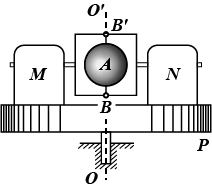
$\begin{align}
& (A)\Rightarrow W=\dfrac{1}{3}\left( \dfrac{{{I}_{0}}^{2}{{\omega }_{0}}^{2}}{I+{{I}_{0}}} \right) \\
& (B)\Rightarrow W=\dfrac{3}{2}\left( \dfrac{{{I}_{0}}^{2}{{\omega }_{0}}^{2}}{I+{{I}_{0}}} \right) \\
& (C)\Rightarrow W=\dfrac{1}{2}\left( \dfrac{{{I}_{0}}^{2}{{\omega }_{0}}^{2}}{I+{{I}_{0}}} \right) \\
& (D)\Rightarrow W=\dfrac{1}{2}\left( \dfrac{{{I}_{0}}^{2}{{\omega }_{0}}^{2}}{I-{{I}_{0}}} \right) \\
\end{align}$
Answer
 Verified
533.7k+ views
Hint: According to the options, it is clear that I is the moment of inertia of the platform with the motor and the balance weight relative to the axis. ${{I}_{0}}$ is the moment of inertia of the sphere about the vertical axis and ${{\omega }_{0}}$is the angular velocity of the sphere about the same axis. Assuming these definitions, we shall proceed with our solution.
Complete answer:
Now, as the motor turns the shaft, the sphere will rotate on its axis due to the system and body constraints. The sphere will rotate about the $O{{O}^{'}}$ axis with the same angular velocity as that of the motor-shaft system.
Now, since there is no moment along the$O{{O}^{'}}$axis, applying the conservation of angular momentum along this axis, we get:
$\begin{align}
& \Rightarrow (I+{{I}_{0}})\omega ={{I}_{0}}{{\omega }_{0}} \\
& \therefore \omega =\dfrac{{{I}_{0}}{{\omega }_{0}}}{I+{{I}_{0}}} \\
\end{align}$
Since, the sphere is rotating freely along the new $BB'$ axis, its momentum will be constant along this axis.
Now, work done by motor in changing the kinetic energy of the system can be calculated as follows:
$\Rightarrow W=\dfrac{1}{2}\left( I+{{I}_{0}} \right){{\omega }^{2}}+\dfrac{1}{2}{{I}_{0}}{{\omega }_{0}}^{2}-\dfrac{1}{2}{{I}_{0}}{{\omega }_{0}}^{2}$
Using the value of $\omega $ calculated above, we can calculate the work done by the motor as:
$\begin{align}
& \Rightarrow W=\dfrac{1}{2}\left( I+{{I}_{0}} \right){{\left( \dfrac{{{I}_{0}}{{\omega }_{0}}}{I+{{I}_{0}}} \right)}^{2}}+0 \\
& \therefore W=\dfrac{1}{2}\left( \dfrac{{{I}_{0}}^{2}{{\omega }_{0}}^{2}}{I+{{I}_{0}}} \right) \\
\end{align}$
Hence, the work performed by the motor in turning the shaft $B{{B}^{'}}$ through ${{90}^{0}}$comes out to be $\dfrac{1}{2}\left( \dfrac{{{I}_{0}}^{2}{{\omega }_{0}}^{2}}{I+{{I}_{0}}} \right)$.
Note:
In problems like these, when no terms have meaning. We can check for them in the options. This would give us an idea of how to solve these types of problems again. Also, while applying any conservation theorem, we should always first make sure that there is no loss of the quantity on which the conservation is applied due to an external force or torque.
Complete answer:
Now, as the motor turns the shaft, the sphere will rotate on its axis due to the system and body constraints. The sphere will rotate about the $O{{O}^{'}}$ axis with the same angular velocity as that of the motor-shaft system.
Now, since there is no moment along the$O{{O}^{'}}$axis, applying the conservation of angular momentum along this axis, we get:
$\begin{align}
& \Rightarrow (I+{{I}_{0}})\omega ={{I}_{0}}{{\omega }_{0}} \\
& \therefore \omega =\dfrac{{{I}_{0}}{{\omega }_{0}}}{I+{{I}_{0}}} \\
\end{align}$
Since, the sphere is rotating freely along the new $BB'$ axis, its momentum will be constant along this axis.
Now, work done by motor in changing the kinetic energy of the system can be calculated as follows:
$\Rightarrow W=\dfrac{1}{2}\left( I+{{I}_{0}} \right){{\omega }^{2}}+\dfrac{1}{2}{{I}_{0}}{{\omega }_{0}}^{2}-\dfrac{1}{2}{{I}_{0}}{{\omega }_{0}}^{2}$
Using the value of $\omega $ calculated above, we can calculate the work done by the motor as:
$\begin{align}
& \Rightarrow W=\dfrac{1}{2}\left( I+{{I}_{0}} \right){{\left( \dfrac{{{I}_{0}}{{\omega }_{0}}}{I+{{I}_{0}}} \right)}^{2}}+0 \\
& \therefore W=\dfrac{1}{2}\left( \dfrac{{{I}_{0}}^{2}{{\omega }_{0}}^{2}}{I+{{I}_{0}}} \right) \\
\end{align}$
Hence, the work performed by the motor in turning the shaft $B{{B}^{'}}$ through ${{90}^{0}}$comes out to be $\dfrac{1}{2}\left( \dfrac{{{I}_{0}}^{2}{{\omega }_{0}}^{2}}{I+{{I}_{0}}} \right)$.
Note:
In problems like these, when no terms have meaning. We can check for them in the options. This would give us an idea of how to solve these types of problems again. Also, while applying any conservation theorem, we should always first make sure that there is no loss of the quantity on which the conservation is applied due to an external force or torque.
Recently Updated Pages
Master Class 11 Computer Science: Engaging Questions & Answers for Success

Master Class 11 Business Studies: Engaging Questions & Answers for Success
Master Class 11 Economics: Engaging Questions & Answers for Success
Master Class 11 English: Engaging Questions & Answers for Success
Master Class 11 Maths: Engaging Questions & Answers for Success
Master Class 11 Biology: Engaging Questions & Answers for Success
Trending doubts
One Metric ton is equal to kg A 10000 B 1000 C 100 class 11 physics CBSE
There are 720 permutations of the digits 1 2 3 4 5 class 11 maths CBSE
Discuss the various forms of bacteria class 11 biology CBSE
Draw a diagram of a plant cell and label at least eight class 11 biology CBSE
State the laws of reflection of light
Explain zero factorial class 11 maths CBSE