




How do you find the vertical asymptote of a logarithmic function?
Answer
 Verified
595.2k+ views
Hint: Horizontal asymptote is the value that any function in x-variable approaches infinity x approaches infinity and as x approaches negative infinity. Vertical asymptotes occur wherever the value of function approaches infinity or negative infinity. Keeping this information in mind, we shall proceed to find the vertical asymptote of a logarithmic function.
Complete step-by-step solution:
Vertical asymptote is basically an invisible vertical line that the graph of a function approaches and gets really close to but never actually touches. The point that the graph of a function never touches is the point where it is undefined.
We know that the logarithmic function is not defined at $x=0$. This is the equation of y-axis as well. Therefore, we understand that the graph of logarithmic function never touches the y-axis but it approaches negative infinity at the y-axis.
The graph of $\log x$ function is given below.
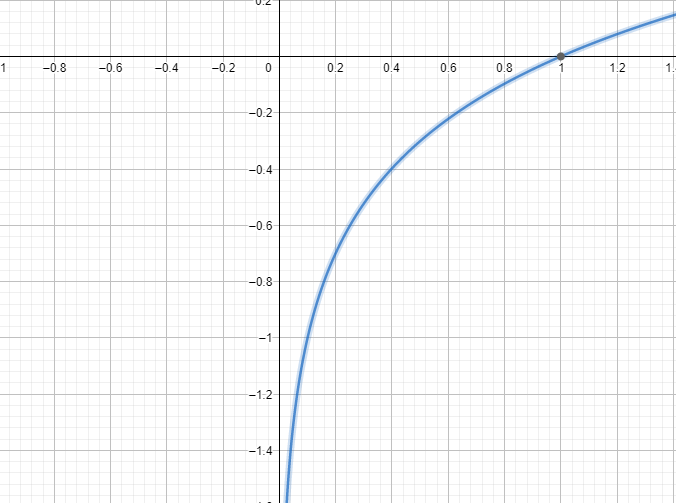
Even though the function seems to be approaching the y-axis but it never touches it in real. Therefore, the vertical asymptote of a logarithmic function is the y-axis.
Note: As we approach from the left, a vertical asymptote looks like the graph is approaching a vertical up to infinity but it never intersects with any point on the x-axis as it is not defined at that point. Similarly, as we approach from the right, the graph again does not intersect at any point and approaches a vertical up to infinity as it is undefined at that same point.
Complete step-by-step solution:
Vertical asymptote is basically an invisible vertical line that the graph of a function approaches and gets really close to but never actually touches. The point that the graph of a function never touches is the point where it is undefined.
We know that the logarithmic function is not defined at $x=0$. This is the equation of y-axis as well. Therefore, we understand that the graph of logarithmic function never touches the y-axis but it approaches negative infinity at the y-axis.
The graph of $\log x$ function is given below.
Even though the function seems to be approaching the y-axis but it never touches it in real. Therefore, the vertical asymptote of a logarithmic function is the y-axis.
Note: As we approach from the left, a vertical asymptote looks like the graph is approaching a vertical up to infinity but it never intersects with any point on the x-axis as it is not defined at that point. Similarly, as we approach from the right, the graph again does not intersect at any point and approaches a vertical up to infinity as it is undefined at that same point.
Recently Updated Pages
Master Class 11 English: Engaging Questions & Answers for Success

Master Class 11 Social Science: Engaging Questions & Answers for Success
Master Class 11 Maths: Engaging Questions & Answers for Success
Master Class 11 Biology: Engaging Questions & Answers for Success
Master Class 11 Physics: Engaging Questions & Answers for Success
Master Class 11 Chemistry: Engaging Questions & Answers for Success
Trending doubts
One Metric ton is equal to kg A 10000 B 1000 C 100 class 11 physics CBSE
Difference Between Prokaryotic Cells and Eukaryotic Cells
Find the value of the expression given below sin 30circ class 11 maths CBSE
Difference between physical and chemical change class 11 chemistry CBSE
Two of the body parts which do not appear in MRI are class 11 biology CBSE
Draw a diagram of a plant cell and label at least eight class 11 biology CBSE