




Find the velocity of the pan + ball system at t = 2.6 s. Assume that the block comes to rest instantaneously after striking the floor
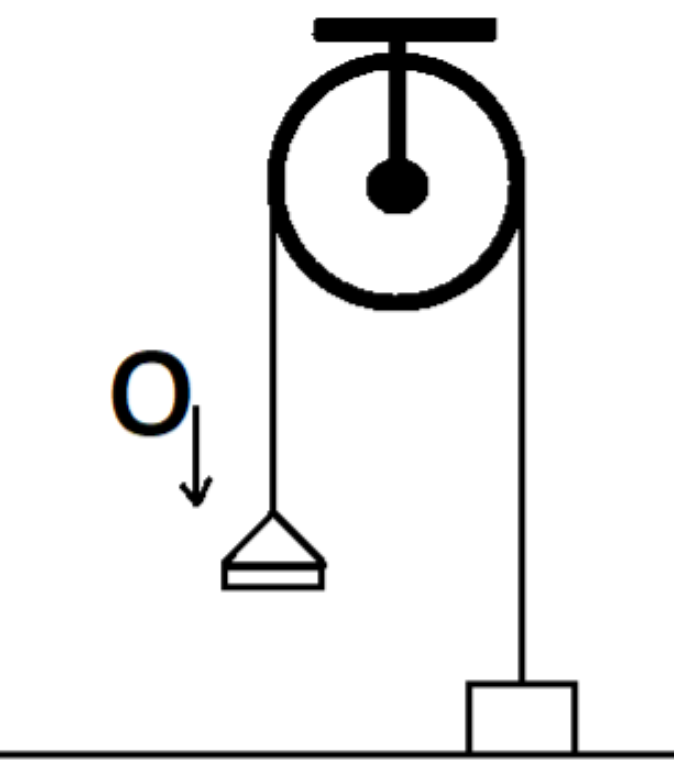
A. 4 m/s downwards
B. 0.6 m/s upwards
C. 4 m/s upwards
D. 0.4 m/s downwards
Answer
 Verified
568.5k+ views
Hint: This question can be solved by the concept of impulse. In classical mechanics, the impulse (symbolised by I or Imp) is the integral part of a force for which it functions over the time interval. Since force is a quantity of vectors, impulse is a quantity of vectors as well. An object's impulse induces an analogous vector shift in its linear momentum, often in the same direction.
Complete step by step answer:
Before we start solving the given question, let us take a look at all the parameters that are given to us.
GIVEN PARAMETERS
Let the mass of ball be,
\[{{m}_{0}}\] = 0.5 kgs
Now, mass block
M = 3 kg
And, mass of pan
m = 1.5 kg
\[{{v}_{0}}\] = 20 m/s
Now,
As the string is inextensible the velocity of all the masses will be same
Also,
v is the final velocity of each mass.
Now,
Impulse on the ball,
\[I=\Delta P\]
\[\Rightarrow I={{m}_{0}}\left( {{v}_{0}}-v \right)\]
\[\Rightarrow I=0.5\left( 20-v \right)\] ……………………(1)
And, impulse on the block
\[{{I}_{1}}=Mv=3v\] ……………………(2)
Impulse on the pan,
\[I-{{I}_{1}}=mv=1.5v\]
Now, substituting the values from equations (1) and (2)
We have,
$\Rightarrow 10-0.5v-3v=1.5v$
$\Rightarrow 5v=10$
We have,
the final velocity,
v = 2m/s in upward direction.
Let the tension acting on the string be T
So,
Mg – T = Ma
\[\Rightarrow 30\text{ }\text{ -}T\text{ }=3a\] ……………………..(4)
Also,
$T-20=2a$ ……………………..(5)
By adding equation (4) and (5), we get
\[30-T+T-20=3a+2a\]
$\Rightarrow 5a=10$
So, we have
\[a=2m/{{s}^{2}}\]
So,
Before the jerk, the velocity of the mass is
v = 2m/s
and,
After the jerk, the velocity of the block is u.
Impulse on block is
${{I}_{1}}=3u$
\[\Rightarrow {{I}_{1}}=\Delta P=2\left( 2-u \right)\]
So,
Using the values from above
\[\Rightarrow 3u=2\left( 2-u \right)\]
\[\Rightarrow 3u=4-2u\]
\[\Rightarrow 5u=4\]
\[\Rightarrow u=\dfrac{4}{5}\]
\[\Rightarrow u=0.8m/s\]
Velocity of each masses will be
u = 0.8 m/s
So,
Block goes down with velocity v after 2.4 seconds and accelerates in the upward direction with \[2m/{{s}^{2}}\]
Equation of motion,
v = u + at
$\Rightarrow v\text{ }=\text{ }0.8-2\times 0.2$
So, we have
$v\text{ }=0.4m/s$ Downward.
So, the velocity of pan + ball system at t = 2.6 s will be
$\therefore $$v\text{ }=0.4m/s$ Downward.
So, the correct answer is “Option D”.
Note: Examples of incorporating the principle of impulse to minimise the force of impact are automotive airbags and cushioned gymnasiums. The force on a tennis ball is improved by providing great racquet head speed. This reduces the impact time between the ball and the racquet, thereby increasing the impact force.
Complete step by step answer:
Before we start solving the given question, let us take a look at all the parameters that are given to us.
GIVEN PARAMETERS
Let the mass of ball be,
\[{{m}_{0}}\] = 0.5 kgs
Now, mass block
M = 3 kg
And, mass of pan
m = 1.5 kg
\[{{v}_{0}}\] = 20 m/s
Now,
As the string is inextensible the velocity of all the masses will be same
Also,
v is the final velocity of each mass.
Now,
Impulse on the ball,
\[I=\Delta P\]
\[\Rightarrow I={{m}_{0}}\left( {{v}_{0}}-v \right)\]
\[\Rightarrow I=0.5\left( 20-v \right)\] ……………………(1)
And, impulse on the block
\[{{I}_{1}}=Mv=3v\] ……………………(2)
Impulse on the pan,
\[I-{{I}_{1}}=mv=1.5v\]
Now, substituting the values from equations (1) and (2)
We have,
$\Rightarrow 10-0.5v-3v=1.5v$
$\Rightarrow 5v=10$
We have,
the final velocity,
v = 2m/s in upward direction.
Let the tension acting on the string be T
So,
Mg – T = Ma
\[\Rightarrow 30\text{ }\text{ -}T\text{ }=3a\] ……………………..(4)
Also,
$T-20=2a$ ……………………..(5)
By adding equation (4) and (5), we get
\[30-T+T-20=3a+2a\]
$\Rightarrow 5a=10$
So, we have
\[a=2m/{{s}^{2}}\]
So,
Before the jerk, the velocity of the mass is
v = 2m/s
and,
After the jerk, the velocity of the block is u.
Impulse on block is
${{I}_{1}}=3u$
\[\Rightarrow {{I}_{1}}=\Delta P=2\left( 2-u \right)\]
So,
Using the values from above
\[\Rightarrow 3u=2\left( 2-u \right)\]
\[\Rightarrow 3u=4-2u\]
\[\Rightarrow 5u=4\]
\[\Rightarrow u=\dfrac{4}{5}\]
\[\Rightarrow u=0.8m/s\]
Velocity of each masses will be
u = 0.8 m/s
So,
Block goes down with velocity v after 2.4 seconds and accelerates in the upward direction with \[2m/{{s}^{2}}\]
Equation of motion,
v = u + at
$\Rightarrow v\text{ }=\text{ }0.8-2\times 0.2$
So, we have
$v\text{ }=0.4m/s$ Downward.
So, the velocity of pan + ball system at t = 2.6 s will be
$\therefore $$v\text{ }=0.4m/s$ Downward.
So, the correct answer is “Option D”.
Note: Examples of incorporating the principle of impulse to minimise the force of impact are automotive airbags and cushioned gymnasiums. The force on a tennis ball is improved by providing great racquet head speed. This reduces the impact time between the ball and the racquet, thereby increasing the impact force.
Recently Updated Pages
Master Class 11 Computer Science: Engaging Questions & Answers for Success

Master Class 11 Business Studies: Engaging Questions & Answers for Success
Master Class 11 Economics: Engaging Questions & Answers for Success
Master Class 11 English: Engaging Questions & Answers for Success
Master Class 11 Maths: Engaging Questions & Answers for Success
Master Class 11 Biology: Engaging Questions & Answers for Success
Trending doubts
One Metric ton is equal to kg A 10000 B 1000 C 100 class 11 physics CBSE
There are 720 permutations of the digits 1 2 3 4 5 class 11 maths CBSE
Discuss the various forms of bacteria class 11 biology CBSE
Draw a diagram of a plant cell and label at least eight class 11 biology CBSE
State the laws of reflection of light
10 examples of friction in our daily life