




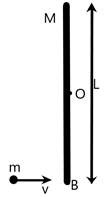
Find the velocity of the center of mass C and the angular velocity of the system about the center of mass after the collision.
\[\begin{align}
& \text{A) }\dfrac{2mv}{M+m},\dfrac{3Mv}{(M+2m)L} \\
& \text{B) }\dfrac{Mv}{M+m},\dfrac{6Mv}{(M+4m)L} \\
& \text{C) }\dfrac{2Mv}{M+m},\dfrac{3mv}{(M+4m)L} \\
& \text{D) }\dfrac{mv}{M+m},\dfrac{6Mv}{(M+4m)L} \\
\end{align}\]
Answer
 Verified
569.1k+ views
Hint: We need to understand the given situation in which two bodies are moving, then collides and eventually sticks together and travels with a center of mass. We can find the relation between the given parameters to get the required solution.
Complete answer: We are given a point mass ‘m’ and a rod of mass ‘M’. The point mass is moving perpendicular to the rod which is initially at rest and collides at one end of the rod.
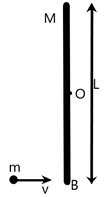
As a result of this collision, the point mass sticks to the rod and both undergo a motion along the center of mass of the system.
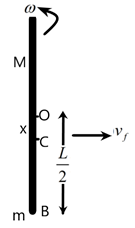
The length of the rod is given to be of ‘L’ units. So, we can find the position of the center of mass of the system ‘x’ from the origin O, which is the center of the rod as –
\[\begin{align}
& (m+M)x=m(0)+m\dfrac{L}{2} \\
& \therefore x=\dfrac{mL}{(m+M)2} \\
\end{align}\]
The distance from the position of the mass ‘m’ to the center of mass will be given as –
\[\begin{align}
& \dfrac{L}{2}=x+BC \\
& \Rightarrow BC=\dfrac{L}{2}-\dfrac{m}{(m+M)}\dfrac{L}{2} \\
& \therefore BC=\dfrac{M}{(m+M)}\dfrac{L}{2} \\
\end{align}\]
Now, we know that the collision has to conserve the linear momentum. We can use this idea to find the final velocity of the system as –
\[\begin{align}
& \text{Initial momentum = Final momentum} \\
& \Rightarrow mv+M(0)=(m+M){{v}_{f}} \\
& \therefore {{v}_{f}}=\dfrac{mv}{(m+M)}\text{ --(1)} \\
\end{align}\]
We know that the rod being hit at the end has a tendency to rotate. The moment of inertia of the center of mass is dependent on the moment of inertia of the rod and the point mass, which can be calculated using the perpendicular axis theorem as –
\[\begin{align}
& {{I}_{CM}}={{I}_{rod}}+{{I}_{po\operatorname{int}}} \\
& \Rightarrow {{I}_{CM}}=[\dfrac{1}{12}M{{L}^{2}}+M{{x}^{2}}]+m{{(BC)}^{2}} \\
& \Rightarrow {{I}_{CM}}=\dfrac{1}{12}M{{L}^{2}}+M{{x}^{2}}+m{{\left( \dfrac{ML}{2(m+M)} \right)}^{2}} \\
& \therefore {{I}_{CM}}=\left( \dfrac{M+4m}{M+m} \right)\dfrac{M{{L}^{2}}}{12} \\
\end{align}\]
Also, the angular momentum at the center of mass has to be conserved. The initial angular momentum was zero, therefore, the angular momentum of the system after should also be the same. We can calculate the angular velocity from the conservation of angular momentum as –
\[\begin{align}
& \text{Initial angular momentum = Final angular momentum} \\
& \Rightarrow 0={{I}_{CM}}.\omega -{{p}_{f}}BC \\
& \Rightarrow 0=\left( \dfrac{M+4m}{M+m} \right)\dfrac{M{{L}^{2}}}{12}\omega -[(M+m){{v}_{f}}\dfrac{M}{(m+M)}\dfrac{L}{2}] \\
& \Rightarrow \dfrac{{{v}_{f}}}{2}ML=\left( \dfrac{M+4m}{M+m} \right)\dfrac{M{{L}^{2}}}{12}\omega \\
& \Rightarrow \omega =\dfrac{{{v}_{f}}}{2\left( \dfrac{M+4m}{M+m} \right)\dfrac{L}{12}} \\
& \Rightarrow \omega =\dfrac{12\dfrac{mv}{(m+M)}}{2L\dfrac{(M+4m)}{(M+m)}} \\
& \therefore \omega =\dfrac{6mv}{(M+4m)L} \\
\end{align}\]
So, we get the required solutions for the problem.
The correct answer is option D.
Note:
According to the perpendicular axis theorem, the moment of inertia of a point can be the sum of the moments of inertia of the two perpendicular axes which are mutually perpendicular and perpendicular to the unknown axis. We have used this theorem to solve.
Complete answer: We are given a point mass ‘m’ and a rod of mass ‘M’. The point mass is moving perpendicular to the rod which is initially at rest and collides at one end of the rod.
As a result of this collision, the point mass sticks to the rod and both undergo a motion along the center of mass of the system.
The length of the rod is given to be of ‘L’ units. So, we can find the position of the center of mass of the system ‘x’ from the origin O, which is the center of the rod as –
\[\begin{align}
& (m+M)x=m(0)+m\dfrac{L}{2} \\
& \therefore x=\dfrac{mL}{(m+M)2} \\
\end{align}\]
The distance from the position of the mass ‘m’ to the center of mass will be given as –
\[\begin{align}
& \dfrac{L}{2}=x+BC \\
& \Rightarrow BC=\dfrac{L}{2}-\dfrac{m}{(m+M)}\dfrac{L}{2} \\
& \therefore BC=\dfrac{M}{(m+M)}\dfrac{L}{2} \\
\end{align}\]
Now, we know that the collision has to conserve the linear momentum. We can use this idea to find the final velocity of the system as –
\[\begin{align}
& \text{Initial momentum = Final momentum} \\
& \Rightarrow mv+M(0)=(m+M){{v}_{f}} \\
& \therefore {{v}_{f}}=\dfrac{mv}{(m+M)}\text{ --(1)} \\
\end{align}\]
We know that the rod being hit at the end has a tendency to rotate. The moment of inertia of the center of mass is dependent on the moment of inertia of the rod and the point mass, which can be calculated using the perpendicular axis theorem as –
\[\begin{align}
& {{I}_{CM}}={{I}_{rod}}+{{I}_{po\operatorname{int}}} \\
& \Rightarrow {{I}_{CM}}=[\dfrac{1}{12}M{{L}^{2}}+M{{x}^{2}}]+m{{(BC)}^{2}} \\
& \Rightarrow {{I}_{CM}}=\dfrac{1}{12}M{{L}^{2}}+M{{x}^{2}}+m{{\left( \dfrac{ML}{2(m+M)} \right)}^{2}} \\
& \therefore {{I}_{CM}}=\left( \dfrac{M+4m}{M+m} \right)\dfrac{M{{L}^{2}}}{12} \\
\end{align}\]
Also, the angular momentum at the center of mass has to be conserved. The initial angular momentum was zero, therefore, the angular momentum of the system after should also be the same. We can calculate the angular velocity from the conservation of angular momentum as –
\[\begin{align}
& \text{Initial angular momentum = Final angular momentum} \\
& \Rightarrow 0={{I}_{CM}}.\omega -{{p}_{f}}BC \\
& \Rightarrow 0=\left( \dfrac{M+4m}{M+m} \right)\dfrac{M{{L}^{2}}}{12}\omega -[(M+m){{v}_{f}}\dfrac{M}{(m+M)}\dfrac{L}{2}] \\
& \Rightarrow \dfrac{{{v}_{f}}}{2}ML=\left( \dfrac{M+4m}{M+m} \right)\dfrac{M{{L}^{2}}}{12}\omega \\
& \Rightarrow \omega =\dfrac{{{v}_{f}}}{2\left( \dfrac{M+4m}{M+m} \right)\dfrac{L}{12}} \\
& \Rightarrow \omega =\dfrac{12\dfrac{mv}{(m+M)}}{2L\dfrac{(M+4m)}{(M+m)}} \\
& \therefore \omega =\dfrac{6mv}{(M+4m)L} \\
\end{align}\]
So, we get the required solutions for the problem.
The correct answer is option D.
Note:
According to the perpendicular axis theorem, the moment of inertia of a point can be the sum of the moments of inertia of the two perpendicular axes which are mutually perpendicular and perpendicular to the unknown axis. We have used this theorem to solve.
Recently Updated Pages
Master Class 12 Economics: Engaging Questions & Answers for Success

Master Class 12 Physics: Engaging Questions & Answers for Success
Master Class 12 English: Engaging Questions & Answers for Success
Master Class 12 Social Science: Engaging Questions & Answers for Success
Master Class 12 Maths: Engaging Questions & Answers for Success
Master Class 12 Business Studies: Engaging Questions & Answers for Success
Trending doubts
Which are the Top 10 Largest Countries of the World?
What are the major means of transport Explain each class 12 social science CBSE
Draw a labelled sketch of the human eye class 12 physics CBSE
Differentiate between insitu conservation and exsitu class 12 biology CBSE
Draw a neat and well labeled diagram of TS of ovary class 12 biology CBSE
Give 10 examples of unisexual and bisexual flowers