




Find the values of $\sin \left( \dfrac{x}{2} \right)$ , $\cos \left( \dfrac{x}{2} \right)$ and $\tan \left( \dfrac{x}{2} \right)$ if
$\sin \left( x \right)=\dfrac{1}{4}$ And x is in the second quadrant.
Answer
 Verified
659.4k+ views
Hint: In this question, we are given the value of sine of x of the angle and the quadrant in which the angle x lies. Therefore, using the definition of $\sin \left( \dfrac{x}{2} \right)$ , and other trigonometric formulas, we can obtain the values of $\sin \left( \dfrac{x}{2} \right)$ , $\cos \left( \dfrac{x}{2} \right)$ and $\tan \left( \dfrac{x}{2} \right)$ by solving the corresponding trigonometric equations.
Complete step-by-step solution -
In this given question, we are asked to find the value of $\sin \left( \dfrac{x}{2} \right)$ , $\cos \left( \dfrac{x}{2} \right)$ and $\tan \left( \dfrac{x}{2} \right)$ if
$\sin \left( x \right)=\dfrac{1}{4}$ And x is in the second quadrant.
We know that for any angle a,
${{\cos }^{2}}a=1-{{\sin }^{2}}a........(1.1)$
Therefore, taking $a=x$ in equation (1.1) and using the given value of \[sin\left( x \right)\] , we obtain
$\begin{align}
& {{\cos }^{2}}x=1-{{\sin }^{2}}x=1-{{\left( \dfrac{1}{4} \right)}^{2}}=\dfrac{15}{16} \\
& \Rightarrow \cos x=\pm \sqrt{\dfrac{15}{16}}.................(1.2) \\
\end{align}$
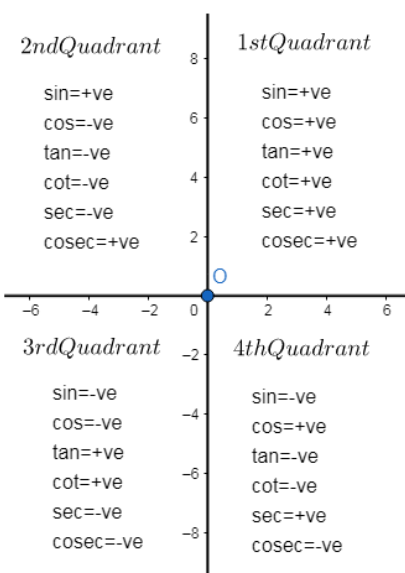
However, as x lies in the second quadrant, the value of \[cos\left( x \right)\]should be negative as shown in the figure below, thus the value of \[cos\left( x \right)\] should be equal to $-\sqrt{\dfrac{15}{16}}=-\dfrac{\sqrt{15}}{4}$ ………………(1.3)
Now, we also know that for any angle $\theta $ ,
$\sin \left( \theta \right)=\sqrt{\dfrac{1-\cos \left( 2\theta \right)}{2}}.........................(1.4)$
Therefore, using $\theta =\dfrac{x}{2}$ in equation (1.4), and using the value of $\cos 2\theta =\cos x$ from (1.3), we obtain
$\sin \left( \dfrac{x}{2} \right)=\sqrt{\dfrac{1-\cos \left( 2\times \dfrac{x}{2} \right)}{2}=}\sqrt{\dfrac{1+\dfrac{\sqrt{15}}{4}}{2}}=\sqrt{\dfrac{4+\sqrt{15}}{8}}.........................(1.5)$
Again, as x lies in the second quadrant, $\dfrac{\pi }{2}Again using equation (1.1) and (1.5), we obtain
$\begin{align}
& {{\cos }^{2}}\left( \dfrac{x}{2} \right)=1-{{\sin }^{2}}\left( \dfrac{x}{2} \right)=1-\left( \dfrac{4+\sqrt{15}}{8} \right)=\dfrac{4-\sqrt{15}}{8} \\
& \Rightarrow \cos \left( \dfrac{x}{2} \right)=\sqrt{\dfrac{4-\sqrt{15}}{8}}........................(1.7) \\
\end{align}$
The value of $\cos \left( \dfrac{x}{2} \right)$ in equation 1.7 should be taken as positive as explained in (1.6).
Again the tangent is defined as
$\tan \left( a \right)=\dfrac{\sin a}{\cos a}$
For any angle a, using (1.5) and (1.7) as
\[\begin{align}
& \tan \left( \dfrac{x}{2} \right)=\dfrac{\sin \left( \dfrac{x}{2} \right)}{\cos \left( \dfrac{x}{2} \right)}=\dfrac{\sqrt{\dfrac{4+\sqrt{15}}{8}}}{\sqrt{\dfrac{4-\sqrt{15}}{8}}}=\sqrt{\dfrac{4+\sqrt{15}}{4-\sqrt{15}}}= \\
& =\sqrt{\dfrac{\left( 4+\sqrt{15} \right)\left( 4+\sqrt{15} \right)}{\left( 4-\sqrt{15} \right)\left( 4+\sqrt{15} \right)}}=\sqrt{\dfrac{{{\left( 4+\sqrt{15} \right)}^{2}}}{{{4}^{2}}-{{\left( \sqrt{15} \right)}^{2}}}}=\sqrt{\dfrac{{{\left( 4+\sqrt{15} \right)}^{2}}}{16-15}}=4+\sqrt{15}............(1.8) \\
\end{align}\]
Therefore, form equations (1.5), (1.7) and (1.8), we obtain the answer as
$\sin \left( \dfrac{x}{2} \right)=\sqrt{\dfrac{4+\sqrt{15}}{8}},\cos \left( \dfrac{x}{2} \right)=\sqrt{\dfrac{4-\sqrt{15}}{8},}\tan \left( \dfrac{x}{2} \right)=4+\sqrt{15}$
which is the required answer to this question.
Note: We could also have found tan(x) by using $\tan (x)=\dfrac{\sin x}{\cos x}$ and then found $\tan \left( \dfrac{x}{2} \right)$ by using the identity $\tan \left( x \right)=\dfrac{2\tan \left( \dfrac{x}{2} \right)}{1-{{\tan }^{2}}\left( \dfrac{x}{2} \right)}$ and from there we could have found $\sin \left( \dfrac{x}{2} \right)$ and $\cos \left( \dfrac{x}{2} \right)$ by using other trigonometric identities. However, the answer would have remained the same as found out in the solution above.
Complete step-by-step solution -
In this given question, we are asked to find the value of $\sin \left( \dfrac{x}{2} \right)$ , $\cos \left( \dfrac{x}{2} \right)$ and $\tan \left( \dfrac{x}{2} \right)$ if
$\sin \left( x \right)=\dfrac{1}{4}$ And x is in the second quadrant.
We know that for any angle a,
${{\cos }^{2}}a=1-{{\sin }^{2}}a........(1.1)$
Therefore, taking $a=x$ in equation (1.1) and using the given value of \[sin\left( x \right)\] , we obtain
$\begin{align}
& {{\cos }^{2}}x=1-{{\sin }^{2}}x=1-{{\left( \dfrac{1}{4} \right)}^{2}}=\dfrac{15}{16} \\
& \Rightarrow \cos x=\pm \sqrt{\dfrac{15}{16}}.................(1.2) \\
\end{align}$
However, as x lies in the second quadrant, the value of \[cos\left( x \right)\]should be negative as shown in the figure below, thus the value of \[cos\left( x \right)\] should be equal to $-\sqrt{\dfrac{15}{16}}=-\dfrac{\sqrt{15}}{4}$ ………………(1.3)
Now, we also know that for any angle $\theta $ ,
$\sin \left( \theta \right)=\sqrt{\dfrac{1-\cos \left( 2\theta \right)}{2}}.........................(1.4)$
Therefore, using $\theta =\dfrac{x}{2}$ in equation (1.4), and using the value of $\cos 2\theta =\cos x$ from (1.3), we obtain
$\sin \left( \dfrac{x}{2} \right)=\sqrt{\dfrac{1-\cos \left( 2\times \dfrac{x}{2} \right)}{2}=}\sqrt{\dfrac{1+\dfrac{\sqrt{15}}{4}}{2}}=\sqrt{\dfrac{4+\sqrt{15}}{8}}.........................(1.5)$
Again, as x lies in the second quadrant, $\dfrac{\pi }{2}
$\begin{align}
& {{\cos }^{2}}\left( \dfrac{x}{2} \right)=1-{{\sin }^{2}}\left( \dfrac{x}{2} \right)=1-\left( \dfrac{4+\sqrt{15}}{8} \right)=\dfrac{4-\sqrt{15}}{8} \\
& \Rightarrow \cos \left( \dfrac{x}{2} \right)=\sqrt{\dfrac{4-\sqrt{15}}{8}}........................(1.7) \\
\end{align}$
The value of $\cos \left( \dfrac{x}{2} \right)$ in equation 1.7 should be taken as positive as explained in (1.6).
Again the tangent is defined as
$\tan \left( a \right)=\dfrac{\sin a}{\cos a}$
For any angle a, using (1.5) and (1.7) as
\[\begin{align}
& \tan \left( \dfrac{x}{2} \right)=\dfrac{\sin \left( \dfrac{x}{2} \right)}{\cos \left( \dfrac{x}{2} \right)}=\dfrac{\sqrt{\dfrac{4+\sqrt{15}}{8}}}{\sqrt{\dfrac{4-\sqrt{15}}{8}}}=\sqrt{\dfrac{4+\sqrt{15}}{4-\sqrt{15}}}= \\
& =\sqrt{\dfrac{\left( 4+\sqrt{15} \right)\left( 4+\sqrt{15} \right)}{\left( 4-\sqrt{15} \right)\left( 4+\sqrt{15} \right)}}=\sqrt{\dfrac{{{\left( 4+\sqrt{15} \right)}^{2}}}{{{4}^{2}}-{{\left( \sqrt{15} \right)}^{2}}}}=\sqrt{\dfrac{{{\left( 4+\sqrt{15} \right)}^{2}}}{16-15}}=4+\sqrt{15}............(1.8) \\
\end{align}\]
Therefore, form equations (1.5), (1.7) and (1.8), we obtain the answer as
$\sin \left( \dfrac{x}{2} \right)=\sqrt{\dfrac{4+\sqrt{15}}{8}},\cos \left( \dfrac{x}{2} \right)=\sqrt{\dfrac{4-\sqrt{15}}{8},}\tan \left( \dfrac{x}{2} \right)=4+\sqrt{15}$
which is the required answer to this question.
Note: We could also have found tan(x) by using $\tan (x)=\dfrac{\sin x}{\cos x}$ and then found $\tan \left( \dfrac{x}{2} \right)$ by using the identity $\tan \left( x \right)=\dfrac{2\tan \left( \dfrac{x}{2} \right)}{1-{{\tan }^{2}}\left( \dfrac{x}{2} \right)}$ and from there we could have found $\sin \left( \dfrac{x}{2} \right)$ and $\cos \left( \dfrac{x}{2} \right)$ by using other trigonometric identities. However, the answer would have remained the same as found out in the solution above.
Recently Updated Pages
Class 10 Question and Answer - Your Ultimate Solutions Guide

Master Class 10 Computer Science: Engaging Questions & Answers for Success
Master Class 10 General Knowledge: Engaging Questions & Answers for Success
Master Class 12 Economics: Engaging Questions & Answers for Success
Master Class 12 Social Science: Engaging Questions & Answers for Success
Master Class 12 English: Engaging Questions & Answers for Success
Trending doubts
Explain the Treaty of Vienna of 1815 class 10 social science CBSE
The slogan Jai Hind was given by A Lal Bahadur Shastri class 10 social science CBSE
10 examples of evaporation in daily life with explanations
What is the full form of POSCO class 10 social science CBSE
Identify the feminine form of noun nephew a shenephew class 10 english CBSE
CSIR full form?