




Find the value of x if $tanx=\sin 45{}^\circ \cos 45{}^\circ +\sin 30{}^\circ $ .
Answer
 Verified
595.8k+ views
Hint: In the equation given in the question, put the values $\sin 45{}^\circ =\dfrac{1}{\sqrt{2}}$ , $\cos 45{}^\circ =\dfrac{1}{\sqrt{2}}$ and $\sin 30{}^\circ =\dfrac{1}{2}$ , which are known to us the all this angles are standard angles. Once you put the values, convert the equation to the form $\tan x=\tan y$ and use the formula of general solution of $\tan x=\tan y$ , i.e., $x=n\pi +y$ to reach the final answer.
Complete step by step solution:
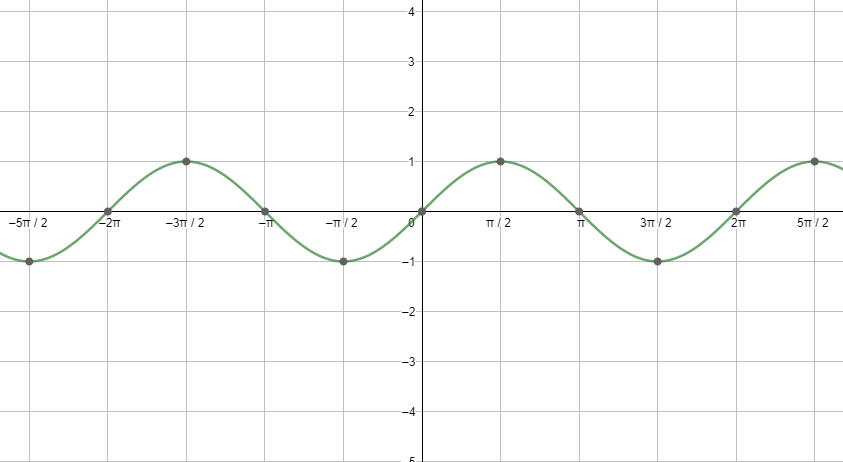
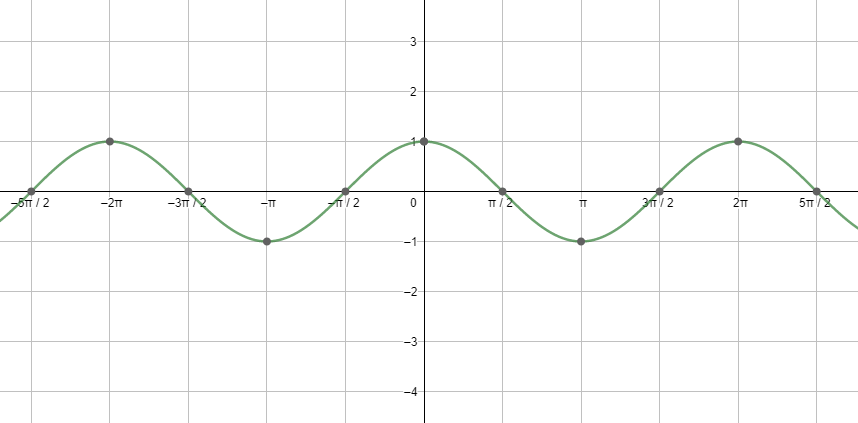
Before moving to the solution, let us discuss the nature of sine and cosine function, which we would be using in the solution. We can better understand this using the graph of sine and cosine.
First, let us start with the graph of sinx.
Next, let us see the graph of cosx.
Looking at both the graphs, and using the relations between the different trigonometric ratios, we get
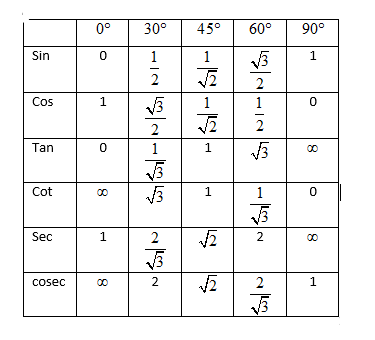
Now to start with the solution to the above question, we will try to simplify the expression given in the question. From the trigonometric table, we know that $\sin 45{}^\circ =\dfrac{1}{\sqrt{2}},\text{ }\cos 45{}^\circ =\dfrac{1}{\sqrt{2}}\text{ }$ and $\text{sin30}{}^\circ \text{=}\dfrac{1}{2}$ . So, if we put the values in our equation, we get
$tanx=\sin 45{}^\circ \cos 45{}^\circ +\sin 30{}^\circ $
$\Rightarrow tanx=\dfrac{1}{\sqrt{2}}\times \dfrac{1}{\sqrt{2}}+\dfrac{1}{2}$
$\Rightarrow tanx=\dfrac{1}{2}+\dfrac{1}{2}$
$\Rightarrow tanx=1$
We can also use the trigonometric table to say that the value of $\tan \dfrac{\pi }{4}=1$ .
$\therefore tanx=\tan \dfrac{\pi }{4}$
We know that the general solution of the trigonometric equation $tanx=\operatorname{tany}$ is $x=n\pi +y$ .
Therefore, the general solution to our equation is $x=n\pi +\dfrac{\pi }{4}$ , where n is an integer.
Note: Be careful about the calculation and the signs of the formulas you use as the signs in the formulas are very confusing and are very important for solving the problems. Also, it would help if you remember the properties related to complementary angles and trigonometric ratios. The above equation has infinite values of x satisfying the equation $\tan x=\tan \dfrac{\pi }{4}$ , which is clear from the general solution. However, the principal values of x are $\dfrac{\pi }{4}\text{ and }\dfrac{5\pi }{4}$ .
Complete step by step solution:
Before moving to the solution, let us discuss the nature of sine and cosine function, which we would be using in the solution. We can better understand this using the graph of sine and cosine.
First, let us start with the graph of sinx.
Next, let us see the graph of cosx.
Looking at both the graphs, and using the relations between the different trigonometric ratios, we get
Now to start with the solution to the above question, we will try to simplify the expression given in the question. From the trigonometric table, we know that $\sin 45{}^\circ =\dfrac{1}{\sqrt{2}},\text{ }\cos 45{}^\circ =\dfrac{1}{\sqrt{2}}\text{ }$ and $\text{sin30}{}^\circ \text{=}\dfrac{1}{2}$ . So, if we put the values in our equation, we get
$tanx=\sin 45{}^\circ \cos 45{}^\circ +\sin 30{}^\circ $
$\Rightarrow tanx=\dfrac{1}{\sqrt{2}}\times \dfrac{1}{\sqrt{2}}+\dfrac{1}{2}$
$\Rightarrow tanx=\dfrac{1}{2}+\dfrac{1}{2}$
$\Rightarrow tanx=1$
We can also use the trigonometric table to say that the value of $\tan \dfrac{\pi }{4}=1$ .
$\therefore tanx=\tan \dfrac{\pi }{4}$
We know that the general solution of the trigonometric equation $tanx=\operatorname{tany}$ is $x=n\pi +y$ .
Therefore, the general solution to our equation is $x=n\pi +\dfrac{\pi }{4}$ , where n is an integer.
Note: Be careful about the calculation and the signs of the formulas you use as the signs in the formulas are very confusing and are very important for solving the problems. Also, it would help if you remember the properties related to complementary angles and trigonometric ratios. The above equation has infinite values of x satisfying the equation $\tan x=\tan \dfrac{\pi }{4}$ , which is clear from the general solution. However, the principal values of x are $\dfrac{\pi }{4}\text{ and }\dfrac{5\pi }{4}$ .
Recently Updated Pages
Master Class 11 Computer Science: Engaging Questions & Answers for Success

Master Class 11 Business Studies: Engaging Questions & Answers for Success
Master Class 11 Economics: Engaging Questions & Answers for Success
Master Class 11 English: Engaging Questions & Answers for Success
Master Class 11 Maths: Engaging Questions & Answers for Success
Master Class 11 Biology: Engaging Questions & Answers for Success
Trending doubts
One Metric ton is equal to kg A 10000 B 1000 C 100 class 11 physics CBSE
There are 720 permutations of the digits 1 2 3 4 5 class 11 maths CBSE
Discuss the various forms of bacteria class 11 biology CBSE
Draw a diagram of a plant cell and label at least eight class 11 biology CBSE
State the laws of reflection of light
Explain zero factorial class 11 maths CBSE