




Find the value of x if $\sqrt{3}tan2x=\sin 45{}^\circ \cos 45{}^\circ +\cos 60{}^\circ $ .
Answer
 Verified
655.2k+ views
Hint: The point to focus in the equation given in the question is that all the trigonometric ratios other than tan2x are of the standard angles and we know the values of trigonometric ratios of standard angles, i.e., $\sin 45{}^\circ =\cos 45{}^\circ =\dfrac{1}{\sqrt{2}}$ and $\cos 60{}^\circ =\dfrac{1}{2}$ . So, just put the values and simplify the equation to the form $\tan 2x=\tan y$ and use the formula of general equation of $\tan kx=\tan y$ , i.e., $2x=n\pi +y$ to reach the answer.
Complete step by step solution:
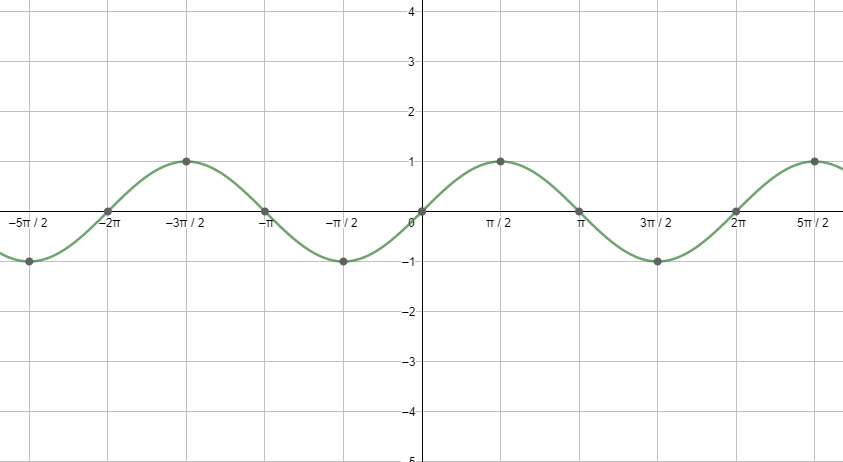
Before moving to the solution, let us discuss the nature of sine and cosine function, which we would be using in the solution. We can better understand this using the graph of sine and cosine.
First, let us start with the graph of sinx.
Next, let us see the graph of cosx.
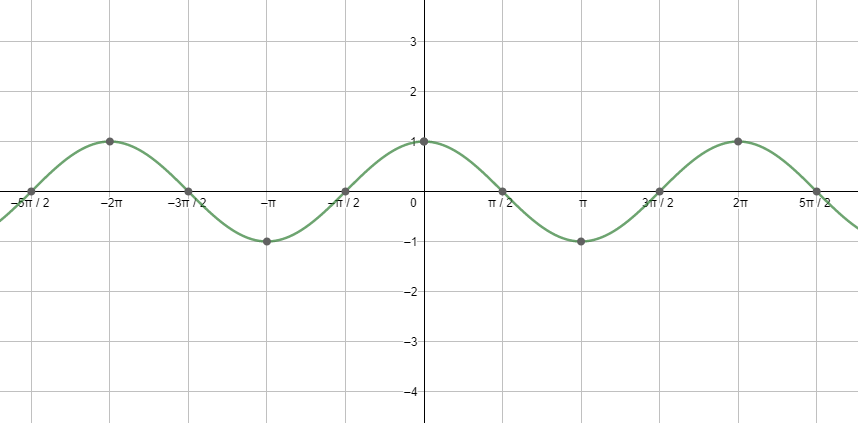
Looking at both the graphs, and using the relations between the different trigonometric ratios, we get

Now to start with the solution to the above question, we will try to simplify the expression given in the question. From the trigonometric table, we know that $\sin 45{}^\circ =\dfrac{1}{\sqrt{2}},\text{ }\cos 45{}^\circ =\dfrac{1}{\sqrt{2}}\text{ }$ and $\cos 60{}^\circ \text{=}\dfrac{1}{2}$ . So, if we put the values in our equation, we get
$\sqrt{3}tan2x=\sin 45{}^\circ \cos 45{}^\circ +\cos 60{}^\circ $
$\Rightarrow \sqrt{3}tan2x=\dfrac{1}{\sqrt{2}}\times \dfrac{1}{\sqrt{2}}+\dfrac{1}{2}$
$\Rightarrow \sqrt{3}tan2x=\dfrac{1}{2}+\dfrac{1}{2}$
$\Rightarrow \sqrt{3}tan2x=1$
$\Rightarrow tan2x=\dfrac{1}{\sqrt{3}}$
We can also use the trigonometric table to say that the value of $\tan \dfrac{\pi }{6}=\dfrac{1}{\sqrt{3}}$ .
$\therefore tan2x=\tan \dfrac{\pi }{6}$
We know that the general solution of the trigonometric equation $tanx=\operatorname{tany}$ is $x=n\pi +y$ .
Therefore, the general solution to our equation is $2x=n\pi +\dfrac{\pi }{6}$ , where n is an integer. If we further simplify the general equation, we get
$2x=n\pi +\dfrac{\pi }{6}$
$\Rightarrow x=\dfrac{1}{2}\left( n\pi +\dfrac{\pi }{6} \right)$
$\Rightarrow x=\dfrac{n\pi }{2}+\dfrac{\pi }{12}$
Note: Be careful about the calculation and the signs of the formulas you use as the signs in the formulas are very confusing and are very important for solving the problems. Also, it would help if you remember the properties related to complementary angles and trigonometric ratios. The above equation has infinite values of x satisfying the equation $\sqrt{3}tan2x=\sin 45{}^\circ \cos 45{}^\circ +\cos 60{}^\circ $ , which is clear from the general solution. However, the principal values of x are $\dfrac{\pi }{12}\text{, }\dfrac{7\pi }{12}\text{ , }\dfrac{13\pi }{12}\text{ and }\dfrac{19\pi }{12}$ . Also, don’t miss the point that the angle given in the question is of the type $2x$ and you need to report the possible values of x.
Complete step by step solution:
Before moving to the solution, let us discuss the nature of sine and cosine function, which we would be using in the solution. We can better understand this using the graph of sine and cosine.
First, let us start with the graph of sinx.
Next, let us see the graph of cosx.
Looking at both the graphs, and using the relations between the different trigonometric ratios, we get
Now to start with the solution to the above question, we will try to simplify the expression given in the question. From the trigonometric table, we know that $\sin 45{}^\circ =\dfrac{1}{\sqrt{2}},\text{ }\cos 45{}^\circ =\dfrac{1}{\sqrt{2}}\text{ }$ and $\cos 60{}^\circ \text{=}\dfrac{1}{2}$ . So, if we put the values in our equation, we get
$\sqrt{3}tan2x=\sin 45{}^\circ \cos 45{}^\circ +\cos 60{}^\circ $
$\Rightarrow \sqrt{3}tan2x=\dfrac{1}{\sqrt{2}}\times \dfrac{1}{\sqrt{2}}+\dfrac{1}{2}$
$\Rightarrow \sqrt{3}tan2x=\dfrac{1}{2}+\dfrac{1}{2}$
$\Rightarrow \sqrt{3}tan2x=1$
$\Rightarrow tan2x=\dfrac{1}{\sqrt{3}}$
We can also use the trigonometric table to say that the value of $\tan \dfrac{\pi }{6}=\dfrac{1}{\sqrt{3}}$ .
$\therefore tan2x=\tan \dfrac{\pi }{6}$
We know that the general solution of the trigonometric equation $tanx=\operatorname{tany}$ is $x=n\pi +y$ .
Therefore, the general solution to our equation is $2x=n\pi +\dfrac{\pi }{6}$ , where n is an integer. If we further simplify the general equation, we get
$2x=n\pi +\dfrac{\pi }{6}$
$\Rightarrow x=\dfrac{1}{2}\left( n\pi +\dfrac{\pi }{6} \right)$
$\Rightarrow x=\dfrac{n\pi }{2}+\dfrac{\pi }{12}$
Note: Be careful about the calculation and the signs of the formulas you use as the signs in the formulas are very confusing and are very important for solving the problems. Also, it would help if you remember the properties related to complementary angles and trigonometric ratios. The above equation has infinite values of x satisfying the equation $\sqrt{3}tan2x=\sin 45{}^\circ \cos 45{}^\circ +\cos 60{}^\circ $ , which is clear from the general solution. However, the principal values of x are $\dfrac{\pi }{12}\text{, }\dfrac{7\pi }{12}\text{ , }\dfrac{13\pi }{12}\text{ and }\dfrac{19\pi }{12}$ . Also, don’t miss the point that the angle given in the question is of the type $2x$ and you need to report the possible values of x.
Recently Updated Pages
Which will be the least stable resonating structure class 11 chemistry CBSE

How many 5 digit telephone numbers can be construc-class-11-maths-CBSE
How do you find the angle of the resultant vector class 11 physics CBSE
Draw labelled diagram of the following i Gram seed class 11 biology CBSE
1 Quintal is equal to a 110 kg b 10 kg c 100kg d 1000 class 11 physics CBSE
What is the need and importance of classification class 11 biology CBSE
Trending doubts
One Metric ton is equal to kg A 10000 B 1000 C 100 class 11 physics CBSE
Find the value of the expression given below sin 30circ class 11 maths CBSE
Draw a diagram of nephron and explain its structur class 11 biology CBSE
10 examples of friction in our daily life
Proton was discovered by A Thomson B Rutherford C Chadwick class 11 chemistry CBSE
The teeth used for biting and cutting food are called class 11 biology CBSE