




Find the value of x for the following $\dfrac{14x}{x+1}-\dfrac{9x-30}{x-4}< 0$
Answer
 Verified
570.6k+ views
Hint: For this kind of problem we have to find the range of $x$ for which the given expression is valid. So, we will first observe the expression, then we will find that for $x+1\ne 0$, $x-4\ne 0$ the given expression gives a real output. From these conditions, we can have the values of $x$ for which the given expression becomes undefined. Further, we will simplify the given expression by subtracting the given terms. Now we will get a quadratic equation in terms of $x$, so we will solve this quadratic equation according to the given expression, then we will get the range of the $x$, for which the given expression is valid. Now For the final result, we will exclude the values of $x$ where the function becomes undefined, from the range of $x$.
Complete step-by-step solution:
Given that, $\dfrac{14x}{x+1}-\dfrac{9x-30}{x-4}< 0$
Now we are taking L.C.M of the terms $\left( x+1 \right)$ and $\left( x-4 \right)$ as $\left( x+1 \right)\left( x-4 \right)$ and simplifying the above expression, then we will get
$\begin{align}
& \Rightarrow \dfrac{14x}{x+1}-\dfrac{9x-30}{x-4}< 0 \\
& \Rightarrow \dfrac{14x\left( x-4 \right)-\left( 9x-30 \right)\left( x+1 \right)}{\left( x+1 \right)\left( x-4 \right)}< 0 \\
\end{align}$
Here the values of $x+1$ and $x-4$ should not be equals to zero, then only the given expression is valid. Hence
$\begin{align}
& \Rightarrow x+1\ne 0 \\
&\Rightarrow x\ne 0-1 \\
&\Rightarrow x\ne -1 \\
\end{align}$ and $\begin{align}
& \Rightarrow x-4\ne 0 \\
& \Rightarrow x\ne 0+4 \\
& \Rightarrow x\ne 4 \\
\end{align}$
We have distribution property in multiplication as $a\left( b+c \right)=ab+ac$, $\left( a+b \right)\left( c+d \right)=a\left( c+d \right)+b\left( c+d \right)$ hence
$\dfrac{14x\left( x \right)-14x\left( 4 \right)-\left[ 9x\left( x+1 \right)-30\left( x+1 \right) \right]}{\left( x+1 \right)\left( x-4 \right)} < 0$
When we multiplied a positive sign/integer with the negative sign/integer then we will get a negative sign/integer. At the same time, we will get a positive sign/integer when we multiplied a positive sign/integer with the same positive sign/integer. Then we will have
$\begin{align}
& \Rightarrow \dfrac{14{{x}^{2}}-56x-\left[ 9{{x}^{2}}+9x-30x-30 \right]}{\left( x+1 \right)\left( x-4 \right)}< 0 \\
& \Rightarrow \dfrac{14{{x}^{2}}-56x-9{{x}^{2}}-9x+30x+30}{\left( x+1 \right)\left( x-4 \right)}< 0 \\
\end{align}$
Rearranging the above terms to simplify the above expression
$\begin{align}
&\Rightarrow \dfrac{14{{x}^{2}}-9{{x}^{2}}-56x-9x+30x+30}{\left( x+1 \right)\left( x-4 \right)}< 0 \\
& \Rightarrow \dfrac{5{{x}^{2}}-35x+30}{\left( x+1 \right)\left( x-4 \right)}< 0 \\
\end{align}$
Multiplying the above expression with $\left( x+1 \right)\left( x-4 \right)$on both sides, then we will get
$\Rightarrow \left( x+1 \right)\left( x-4 \right)\times \dfrac{5{{x}^{2}}-35x+30}{\left( x+1 \right)\left( x-4 \right)}<0\left( x+1 \right)\left( x-4 \right)$
We know that when we multiplied something with Zero then we will get Zero as result and $a\times \dfrac{1}{a}=1$, then we will have
$ \Rightarrow 5{{x}^{2}}-35x+30< 0$
Dividing the above equation with $5$ into both sides of the expression, then we will have
$\begin{align}
& \Rightarrow \dfrac{1}{5}\left( 5{{x}^{2}}-35x+30 \right)< \dfrac{1}{5}\left( 0 \right) \\
& \Rightarrow {{x}^{2}}-7x+6< 0 \\
\end{align}$
Now finding the solution for the above expression, then we will have
$\begin{align}
& \Rightarrow {{x}^{2}}-7x+6< 0 \\
& \Rightarrow {{x}^{2}}-x-6x+6< 0 \\
\end{align}$
Taking $x$ common from ${{x}^{2}}-x$ and taking $-6$ common from $-6x+6$, then we will have
$\Rightarrow x\left( x-1 \right)-6\left( x-1 \right)< 0$
Again taking $\left( x-1 \right)$ as common from the above expression, then we will have
$\Rightarrow \left( x-1 \right)\left( x-6 \right)< 0$
Now equating both the terms in the above expression individually, then we will get
$\begin{align}
& \Rightarrow x-1>0\text{ and }x-6<0 \\
& \Rightarrow x>0+1\text{ and }x<0+6 \\
& \Rightarrow x>1\text{ and }x<6 \\
\end{align}$
Now we use the wavy curve method to have and check the sign of the function say \[f\left( x \right)=\dfrac{14x}{x+1}-\dfrac{9x-30}{x-4}\] within the intervals $\left( -1,1 \right),\left( 1,4 \right),\left( 4,6 \right)$ by taking any value within those intervals.
\[\begin{align}
& \Rightarrow f\left( 0 \right)=\dfrac{14\cdot 0}{0+1}-\dfrac{9\cdot 0-30}{0-4}=-34<0 \\
& \Rightarrow f\left( 3 \right)=\dfrac{14\cdot 3}{3+1}-\dfrac{9\cdot 3-30}{3-4}=10.5-3>0 \\
& \Rightarrow f\left( 5 \right)=\dfrac{14\cdot 5}{5+1}-\dfrac{9\cdot 5-30}{5-4}=11.\overline{6}-21.5<0 \\
\end{align}\]
We have;
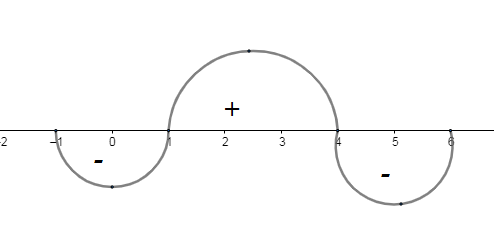
So the function satisfies only in the intervals$\left( -1,1 \right),\left( 4,6 \right)$ and the value of $x$ lie in $\left( -1,1 \right),\left( 4,6 \right)$.
Note: We should consider the terms which are in denominator, then only the function is valid for the given values of $x$. Students may don’t know what to find in this type of problem since in the problem we are not asked to find anything. So here the problem is given to us to calculate the range of $x$, where the given expression is valid.
Complete step-by-step solution:
Given that, $\dfrac{14x}{x+1}-\dfrac{9x-30}{x-4}< 0$
Now we are taking L.C.M of the terms $\left( x+1 \right)$ and $\left( x-4 \right)$ as $\left( x+1 \right)\left( x-4 \right)$ and simplifying the above expression, then we will get
$\begin{align}
& \Rightarrow \dfrac{14x}{x+1}-\dfrac{9x-30}{x-4}< 0 \\
& \Rightarrow \dfrac{14x\left( x-4 \right)-\left( 9x-30 \right)\left( x+1 \right)}{\left( x+1 \right)\left( x-4 \right)}< 0 \\
\end{align}$
Here the values of $x+1$ and $x-4$ should not be equals to zero, then only the given expression is valid. Hence
$\begin{align}
& \Rightarrow x+1\ne 0 \\
&\Rightarrow x\ne 0-1 \\
&\Rightarrow x\ne -1 \\
\end{align}$ and $\begin{align}
& \Rightarrow x-4\ne 0 \\
& \Rightarrow x\ne 0+4 \\
& \Rightarrow x\ne 4 \\
\end{align}$
We have distribution property in multiplication as $a\left( b+c \right)=ab+ac$, $\left( a+b \right)\left( c+d \right)=a\left( c+d \right)+b\left( c+d \right)$ hence
$\dfrac{14x\left( x \right)-14x\left( 4 \right)-\left[ 9x\left( x+1 \right)-30\left( x+1 \right) \right]}{\left( x+1 \right)\left( x-4 \right)} < 0$
When we multiplied a positive sign/integer with the negative sign/integer then we will get a negative sign/integer. At the same time, we will get a positive sign/integer when we multiplied a positive sign/integer with the same positive sign/integer. Then we will have
$\begin{align}
& \Rightarrow \dfrac{14{{x}^{2}}-56x-\left[ 9{{x}^{2}}+9x-30x-30 \right]}{\left( x+1 \right)\left( x-4 \right)}< 0 \\
& \Rightarrow \dfrac{14{{x}^{2}}-56x-9{{x}^{2}}-9x+30x+30}{\left( x+1 \right)\left( x-4 \right)}< 0 \\
\end{align}$
Rearranging the above terms to simplify the above expression
$\begin{align}
&\Rightarrow \dfrac{14{{x}^{2}}-9{{x}^{2}}-56x-9x+30x+30}{\left( x+1 \right)\left( x-4 \right)}< 0 \\
& \Rightarrow \dfrac{5{{x}^{2}}-35x+30}{\left( x+1 \right)\left( x-4 \right)}< 0 \\
\end{align}$
Multiplying the above expression with $\left( x+1 \right)\left( x-4 \right)$on both sides, then we will get
$\Rightarrow \left( x+1 \right)\left( x-4 \right)\times \dfrac{5{{x}^{2}}-35x+30}{\left( x+1 \right)\left( x-4 \right)}<0\left( x+1 \right)\left( x-4 \right)$
We know that when we multiplied something with Zero then we will get Zero as result and $a\times \dfrac{1}{a}=1$, then we will have
$ \Rightarrow 5{{x}^{2}}-35x+30< 0$
Dividing the above equation with $5$ into both sides of the expression, then we will have
$\begin{align}
& \Rightarrow \dfrac{1}{5}\left( 5{{x}^{2}}-35x+30 \right)< \dfrac{1}{5}\left( 0 \right) \\
& \Rightarrow {{x}^{2}}-7x+6< 0 \\
\end{align}$
Now finding the solution for the above expression, then we will have
$\begin{align}
& \Rightarrow {{x}^{2}}-7x+6< 0 \\
& \Rightarrow {{x}^{2}}-x-6x+6< 0 \\
\end{align}$
Taking $x$ common from ${{x}^{2}}-x$ and taking $-6$ common from $-6x+6$, then we will have
$\Rightarrow x\left( x-1 \right)-6\left( x-1 \right)< 0$
Again taking $\left( x-1 \right)$ as common from the above expression, then we will have
$\Rightarrow \left( x-1 \right)\left( x-6 \right)< 0$
Now equating both the terms in the above expression individually, then we will get
$\begin{align}
& \Rightarrow x-1>0\text{ and }x-6<0 \\
& \Rightarrow x>0+1\text{ and }x<0+6 \\
& \Rightarrow x>1\text{ and }x<6 \\
\end{align}$
Now we use the wavy curve method to have and check the sign of the function say \[f\left( x \right)=\dfrac{14x}{x+1}-\dfrac{9x-30}{x-4}\] within the intervals $\left( -1,1 \right),\left( 1,4 \right),\left( 4,6 \right)$ by taking any value within those intervals.
\[\begin{align}
& \Rightarrow f\left( 0 \right)=\dfrac{14\cdot 0}{0+1}-\dfrac{9\cdot 0-30}{0-4}=-34<0 \\
& \Rightarrow f\left( 3 \right)=\dfrac{14\cdot 3}{3+1}-\dfrac{9\cdot 3-30}{3-4}=10.5-3>0 \\
& \Rightarrow f\left( 5 \right)=\dfrac{14\cdot 5}{5+1}-\dfrac{9\cdot 5-30}{5-4}=11.\overline{6}-21.5<0 \\
\end{align}\]
We have;
So the function satisfies only in the intervals$\left( -1,1 \right),\left( 4,6 \right)$ and the value of $x$ lie in $\left( -1,1 \right),\left( 4,6 \right)$.
Note: We should consider the terms which are in denominator, then only the function is valid for the given values of $x$. Students may don’t know what to find in this type of problem since in the problem we are not asked to find anything. So here the problem is given to us to calculate the range of $x$, where the given expression is valid.
Recently Updated Pages
Master Class 11 Computer Science: Engaging Questions & Answers for Success

Master Class 11 Business Studies: Engaging Questions & Answers for Success
Master Class 11 Economics: Engaging Questions & Answers for Success
Master Class 11 English: Engaging Questions & Answers for Success
Master Class 11 Maths: Engaging Questions & Answers for Success
Master Class 11 Biology: Engaging Questions & Answers for Success
Trending doubts
One Metric ton is equal to kg A 10000 B 1000 C 100 class 11 physics CBSE
There are 720 permutations of the digits 1 2 3 4 5 class 11 maths CBSE
Discuss the various forms of bacteria class 11 biology CBSE
Draw a diagram of a plant cell and label at least eight class 11 biology CBSE
State the laws of reflection of light
Explain zero factorial class 11 maths CBSE