




Find the value of the expression $\tan \left( {{120}^{\circ }} \right)$ \[\]
A.$1$ \[\]
B.$-1$ \[\]
C. $\sqrt{3}$ \[\]
D.$-\sqrt{3}$ \[\]
Answer
 Verified
620.1k+ views
Hint: We recall the sine, cosine and tangent trigonometric ratios in the right angled triangle. We find the value of $\sin {{120}^{\circ }},\cos {{120}^{\circ }}$ using the shift formulas $\sin \left( \theta +{{90}^{\circ }} \right)=\cos \theta ,\cos \left( \theta +{{90}^{\circ }} \right)=-\sin \theta $ and use the trigonometric identity $\tan \theta =\dfrac{\sin \theta }{\cos \theta }$ for $\theta ={{120}^{\circ }}$.
Complete step-by-step solution:
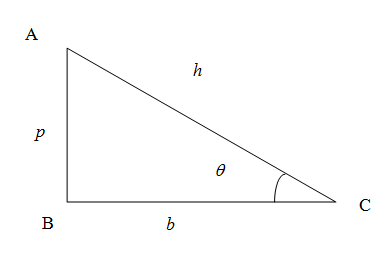
We know from the trigonometric ratios in a right angled triangle that the sine of any angle is given by the ratio of side length of opposite side to the angle to the length of hypotenuse. In the figure the sine of the angle $\theta $ is given by
\[\sin \theta =\dfrac{p}{h}...(1)\]
Similarly the cosine of an angle is the ratio of length of side adjacent to the angle (excluding hypotenuse) to the hypotenuse. So we have cosine of angle $\theta $
\[\cos \theta =\dfrac{b}{h}...(2)\]
We know from the trigonometric ratios in a right angled triangle that the tangent of the angle is the ratio of length of opposite side to length of the adjacent side (excluding hypotenuse) to that angle. So we have tangent of the angle $\theta $ as
\[\tan \theta =\dfrac{p}{b}\]
We have from (1) and (2) that
\[\tan \theta =\dfrac{\sin \theta }{\cos \theta }\]
We know from the shift formula that when an acute angle $\theta $ is turned by a right angle or quarter turn the trigonometric function for that angle $\theta $ will be equal to the complimentary trigonometric function with argument $\theta $ with possibly sign change. The shift formula for right angle or ${{90}^{\circ }}$turn is given by
\[\begin{align}
& \Rightarrow \sin \left( \theta +{{90}^{\circ }} \right)=\cos \theta \\
& \Rightarrow \cos \left( \theta +{{90}^{\circ }} \right)=-\sin \theta \\
\end{align}\]
Let us take $\theta ={{30}^{\circ }}$ and have;
\[\begin{align}
& \Rightarrow \sin {{120}^{\circ }}=\sin \left( {{30}^{\circ }}+{{90}^{\circ }} \right)=\cos {{30}^{\circ }}=\dfrac{\sqrt{3}}{2} \\
& \Rightarrow \cos {{120}^{\circ }}=\cos \left( \theta +{{90}^{\circ }} \right)=-\sin {{30}^{\circ }}=\dfrac{-1}{2} \\
\end{align}\]
So we have the required value as
\[\tan {{120}^{\circ }}=\dfrac{\sin {{120}^{\circ }}}{\cos {{120}^{\circ }}}=\dfrac{\dfrac{\sqrt{3}}{2}}{\dfrac{-1}{2}}=-\sqrt{3}\]
So the correct option is D.
Note: We can directly use shift by ${{90}^{\circ }}$ formula for tangent function as $\tan \left( \theta +{{90}^{\circ }} \right)=-\cot \theta $ for $\theta ={{30}^{\circ }}$. We can also shift for odd integral times of ${{90}^{\circ }}$ and we shall get the same result as in shift for ${{90}^{\circ }}$.We must be careful of the confusion between shift forward formula from shift backward formula $\sin \left( \theta -{{90}^{\circ }} \right)=-\cos \theta ,\cos \left( \theta -{{90}^{\circ }} \right)=\sin \theta $ and also from the reduction formulas $\sin \left( {{90}^{\circ }}-\theta \right)=\cos \theta ,\cos \left( {{90}^{\circ }}-\theta \right)=\sin \theta $.
Complete step-by-step solution:
We know from the trigonometric ratios in a right angled triangle that the sine of any angle is given by the ratio of side length of opposite side to the angle to the length of hypotenuse. In the figure the sine of the angle $\theta $ is given by
\[\sin \theta =\dfrac{p}{h}...(1)\]
Similarly the cosine of an angle is the ratio of length of side adjacent to the angle (excluding hypotenuse) to the hypotenuse. So we have cosine of angle $\theta $
\[\cos \theta =\dfrac{b}{h}...(2)\]
We know from the trigonometric ratios in a right angled triangle that the tangent of the angle is the ratio of length of opposite side to length of the adjacent side (excluding hypotenuse) to that angle. So we have tangent of the angle $\theta $ as
\[\tan \theta =\dfrac{p}{b}\]
We have from (1) and (2) that
\[\tan \theta =\dfrac{\sin \theta }{\cos \theta }\]
We know from the shift formula that when an acute angle $\theta $ is turned by a right angle or quarter turn the trigonometric function for that angle $\theta $ will be equal to the complimentary trigonometric function with argument $\theta $ with possibly sign change. The shift formula for right angle or ${{90}^{\circ }}$turn is given by
\[\begin{align}
& \Rightarrow \sin \left( \theta +{{90}^{\circ }} \right)=\cos \theta \\
& \Rightarrow \cos \left( \theta +{{90}^{\circ }} \right)=-\sin \theta \\
\end{align}\]
Let us take $\theta ={{30}^{\circ }}$ and have;
\[\begin{align}
& \Rightarrow \sin {{120}^{\circ }}=\sin \left( {{30}^{\circ }}+{{90}^{\circ }} \right)=\cos {{30}^{\circ }}=\dfrac{\sqrt{3}}{2} \\
& \Rightarrow \cos {{120}^{\circ }}=\cos \left( \theta +{{90}^{\circ }} \right)=-\sin {{30}^{\circ }}=\dfrac{-1}{2} \\
\end{align}\]
So we have the required value as
\[\tan {{120}^{\circ }}=\dfrac{\sin {{120}^{\circ }}}{\cos {{120}^{\circ }}}=\dfrac{\dfrac{\sqrt{3}}{2}}{\dfrac{-1}{2}}=-\sqrt{3}\]
So the correct option is D.
Note: We can directly use shift by ${{90}^{\circ }}$ formula for tangent function as $\tan \left( \theta +{{90}^{\circ }} \right)=-\cot \theta $ for $\theta ={{30}^{\circ }}$. We can also shift for odd integral times of ${{90}^{\circ }}$ and we shall get the same result as in shift for ${{90}^{\circ }}$.We must be careful of the confusion between shift forward formula from shift backward formula $\sin \left( \theta -{{90}^{\circ }} \right)=-\cos \theta ,\cos \left( \theta -{{90}^{\circ }} \right)=\sin \theta $ and also from the reduction formulas $\sin \left( {{90}^{\circ }}-\theta \right)=\cos \theta ,\cos \left( {{90}^{\circ }}-\theta \right)=\sin \theta $.
Recently Updated Pages
Basicity of sulphurous acid and sulphuric acid are

Master Class 11 English: Engaging Questions & Answers for Success
Master Class 11 Physics: Engaging Questions & Answers for Success
Master Class 11 Computer Science: Engaging Questions & Answers for Success
Master Class 11 Chemistry: Engaging Questions & Answers for Success
Master Class 11 Social Science: Engaging Questions & Answers for Success
Trending doubts
Difference Between Prokaryotic Cells and Eukaryotic Cells
Two of the body parts which do not appear in MRI are class 11 biology CBSE
One Metric ton is equal to kg A 10000 B 1000 C 100 class 11 physics CBSE
10 examples of friction in our daily life
Draw a diagram of nephron and explain its structur class 11 biology CBSE
What will happen if the mucus is not secreted by the class 11 biology CBSE