




Find the value of the expression $\dfrac{\sin {{53}^{0}}}{\cos {{37}^{0}}}+2\tan {{45}^{0}}-\dfrac{\cos ec{{60}^{0}}}{\sec {{30}^{0}}}$ .
Answer
 Verified
610.5k+ views
Hint: Here, we will use certain trigonometric formulas, that is formulas for complementary angles to find the value of the given expression. The complementary angle formulas states that :
$\begin{align}
& \sin \left( {{90}^{0}}-\theta \right)=\cos \theta \\
& \cos ec\left( {{90}^{0}}-\theta \right)=\sec \theta \\
& \tan \left( {{90}^{0}}-\theta \right)=\cot \theta \\
\end{align}$
Trigonometry is a branch of mathematics that studies the relationship between side lengths and angles of triangles. Trigonometric ratios are the ratios between edges of a right triangle. These ratios are given by trigonometric functions of the known angle A, where a, b and c refers to the lengths of the sides in the triangle given:-
Complete step-by-step answer:
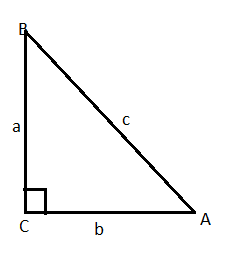
Sine function is defined as the ratio of the perpendicular of the triangle to its hypotenuse.
$\sin A=\dfrac{perpendicular}{hypotenuse}=\dfrac{a}{c}$
Cosine function is defined as the ratio of the base of the triangle to its hypotenuse.
$\cos A=\dfrac{base}{hypotenuse}=\dfrac{b}{c}$
Tangent function is defined as the ratio of perpendicular to base of the triangle.
$\text{tan}A=\dfrac{perpendicular}{base}$
The hypotenuse is the side opposite to the 90 degree angle in a right angle triangle; it is the longest side of the triangle. The terms perpendicular and base are used for the opposite and adjacent sides respectively.
We also have:
$\begin{align}
& \cos ecA=\dfrac{1}{\sin A} \\
& \sec A=\dfrac{1}{\cos A} \\
& \cot A=\dfrac{1}{\tan A} \\
\end{align}$
According to the complementary angle formula of trigonometry, we can write:
$\begin{align}
& \sin \left( {{90}^{0}}-\theta \right)=\cos \theta \\
& \cos ec\left( {{90}^{0}}-\theta \right)=\sec \theta \\
& \tan \left( {{90}^{0}}-\theta \right)=\cot \theta \\
\end{align}$
Now, the expression given to us is:
$\dfrac{\sin {{53}^{0}}}{\cos {{37}^{0}}}+2\tan {{45}^{0}}-\dfrac{\cos ec{{60}^{0}}}{\sec {{30}^{0}}}$
Since, using complementary angle formulas we can write:
$\begin{align}
& \cos {{37}^{0}}=\sin \left( {{90}^{0}}-{{37}^{0}} \right) \\
& \Rightarrow \cos {{37}^{0}}=\sin {{53}^{0}} \\
\end{align}$
Also,
$\begin{align}
& \sec {{30}^{0}}=\cos ec\left( {{90}^{0}}-{{30}^{0}} \right) \\
& \Rightarrow \sec {{30}^{0}}=\cos ec{{60}^{0}} \\
\end{align}$
So, the given expression can be written as:
$\begin{align}
& \dfrac{\sin {{53}^{0}}}{\sin {{53}^{0}}}+2\tan {{45}^{0}}-\dfrac{\cos ec{{60}^{0}}}{\cos ec{{60}^{0}}} \\
& =1+2\tan {{45}^{0}}-1 \\
\end{align}$
We know that the value of $\tan {{45}^{0}}=1$.
Therefore:
$1+2\tan {{45}^{0}}-1=1+2-1=2$
Hence, the value of the given expression is 2.
Note: Students should note here that we can calculate the value of the given expression by directly putting the values of the trigonometric ratios but the use of complementary angle formulas makes it easy to solve. Students should remember the values of standard trigonometric values like tan45 = 1.
$\begin{align}
& \sin \left( {{90}^{0}}-\theta \right)=\cos \theta \\
& \cos ec\left( {{90}^{0}}-\theta \right)=\sec \theta \\
& \tan \left( {{90}^{0}}-\theta \right)=\cot \theta \\
\end{align}$
Trigonometry is a branch of mathematics that studies the relationship between side lengths and angles of triangles. Trigonometric ratios are the ratios between edges of a right triangle. These ratios are given by trigonometric functions of the known angle A, where a, b and c refers to the lengths of the sides in the triangle given:-
Complete step-by-step answer:
Sine function is defined as the ratio of the perpendicular of the triangle to its hypotenuse.
$\sin A=\dfrac{perpendicular}{hypotenuse}=\dfrac{a}{c}$
Cosine function is defined as the ratio of the base of the triangle to its hypotenuse.
$\cos A=\dfrac{base}{hypotenuse}=\dfrac{b}{c}$
Tangent function is defined as the ratio of perpendicular to base of the triangle.
$\text{tan}A=\dfrac{perpendicular}{base}$
The hypotenuse is the side opposite to the 90 degree angle in a right angle triangle; it is the longest side of the triangle. The terms perpendicular and base are used for the opposite and adjacent sides respectively.
We also have:
$\begin{align}
& \cos ecA=\dfrac{1}{\sin A} \\
& \sec A=\dfrac{1}{\cos A} \\
& \cot A=\dfrac{1}{\tan A} \\
\end{align}$
According to the complementary angle formula of trigonometry, we can write:
$\begin{align}
& \sin \left( {{90}^{0}}-\theta \right)=\cos \theta \\
& \cos ec\left( {{90}^{0}}-\theta \right)=\sec \theta \\
& \tan \left( {{90}^{0}}-\theta \right)=\cot \theta \\
\end{align}$
Now, the expression given to us is:
$\dfrac{\sin {{53}^{0}}}{\cos {{37}^{0}}}+2\tan {{45}^{0}}-\dfrac{\cos ec{{60}^{0}}}{\sec {{30}^{0}}}$
Since, using complementary angle formulas we can write:
$\begin{align}
& \cos {{37}^{0}}=\sin \left( {{90}^{0}}-{{37}^{0}} \right) \\
& \Rightarrow \cos {{37}^{0}}=\sin {{53}^{0}} \\
\end{align}$
Also,
$\begin{align}
& \sec {{30}^{0}}=\cos ec\left( {{90}^{0}}-{{30}^{0}} \right) \\
& \Rightarrow \sec {{30}^{0}}=\cos ec{{60}^{0}} \\
\end{align}$
So, the given expression can be written as:
$\begin{align}
& \dfrac{\sin {{53}^{0}}}{\sin {{53}^{0}}}+2\tan {{45}^{0}}-\dfrac{\cos ec{{60}^{0}}}{\cos ec{{60}^{0}}} \\
& =1+2\tan {{45}^{0}}-1 \\
\end{align}$
We know that the value of $\tan {{45}^{0}}=1$.
Therefore:
$1+2\tan {{45}^{0}}-1=1+2-1=2$
Hence, the value of the given expression is 2.
Note: Students should note here that we can calculate the value of the given expression by directly putting the values of the trigonometric ratios but the use of complementary angle formulas makes it easy to solve. Students should remember the values of standard trigonometric values like tan45 = 1.
Recently Updated Pages
Master Class 10 Computer Science: Engaging Questions & Answers for Success

Master Class 10 General Knowledge: Engaging Questions & Answers for Success
Master Class 10 English: Engaging Questions & Answers for Success
Master Class 10 Social Science: Engaging Questions & Answers for Success
Master Class 10 Maths: Engaging Questions & Answers for Success
Master Class 10 Science: Engaging Questions & Answers for Success
Trending doubts
What is the median of the first 10 natural numbers class 10 maths CBSE
Which women's tennis player has 24 Grand Slam singles titles?
Who is the Brand Ambassador of Incredible India?
Why is there a time difference of about 5 hours between class 10 social science CBSE
Write a letter to the principal requesting him to grant class 10 english CBSE
A moving boat is observed from the top of a 150 m high class 10 maths CBSE