




Find the value of \[\tan 30^\circ \] geometrically.
Answer
 Verified
604.5k+ views
Hint:
Here, we will first construct an equilateral triangle with a Perpendicular bisector. Then by using the properties of an equilateral triangle, properties of the Perpendicular bisector and Pythagoras theorem we will find the lengths of all the sides of the triangle. We will use the trigonometric ratio to find the value of the given trigonometric ratio at an angle.
Formula Used:
Trigonometric Ratio: \[\tan \theta = \dfrac{{{\rm{Opposite}}}}{{{\rm{Adjacent}}}}\]
Complete step by step solution:
We are given a Trigonometric ratio of \[\tan 30^\circ \].
Now, we will construct an equilateral triangle ABC.
We will consider an equilateral triangle ABC with the sides \[AB = BC = CA = 2a\]
Now, we will draw a perpendicular \[AD\] to \[BC\], which divides \[BC\] into two equal parts \[BD = DC\].
Therefore, we get
\[BD = \dfrac{{BC}}{2}\]
\[ \Rightarrow BD = \dfrac{{2a}}{2}\]
Dividing the terms, we get
\[ \Rightarrow BD = a\]
We know that in an equilateral triangle, each angle measures \[60^\circ \].
Since \[AD\] is a perpendicular bisector, \[\angle A\] is divided into two equal angles. i.e.
\[\angle BAD = \dfrac{{\angle A}}{2} = \angle DAC\]
\[ \Rightarrow \angle BAD = \dfrac{{60^\circ }}{2} = \angle DAC\]
Dividing the terms, we get
\[ \Rightarrow \angle BAD = 30^\circ = \angle DAC\]
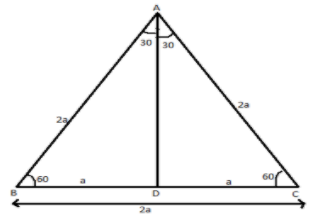
Since \[\Delta ABD = \Delta ACD\], we get\[AD\] is a common side to both the triangles.
\[\angle ADB = 90^\circ = \angle ADC\]
We know that \[\Delta ABC \cong \Delta ADC\]
Now, by using the Pythagoras theorem in \[\Delta ADB\], we will find the length of\[AD\].
\[AD = \sqrt {A{B^2} - B{D^2}} \]
\[ \Rightarrow AD = \sqrt {{{\left( {2a} \right)}^2} - {{\left( a \right)}^2}} = \sqrt {4{a^2} - {a^2}} \]
Subtracting the terms, we get
\[ \Rightarrow AD = \sqrt {3{a^2}} \]
\[ \Rightarrow AD = \sqrt 3 a\]
Now in \[\Delta ADB\], using the formula \[\tan \theta = \dfrac{{{\rm{Opposite}}}}{{{\rm{Adjacent}}}}\], we get
\[ \Rightarrow \tan 30^\circ = \dfrac{{BD}}{{AD}}\]
Now, by substituting the values, we get
\[ \Rightarrow \tan 30^\circ = \dfrac{{BD}}{{AD}}\]
\[ \Rightarrow \tan 30^\circ = \dfrac{a}{{\sqrt 3 a}}\]
\[ \Rightarrow \tan 30^\circ = \dfrac{1}{{\sqrt 3 }}\]
Therefore, the value of\[\tan 30^\circ \] is \[\dfrac{1}{{\sqrt 3 }}\].
Note:
We know that an Equilateral Triangle is a triangle having all the sides of a triangle equal. Pythagoras theorem states that the square of the hypotenuse is equal to the sum of the squares of the other two sides. Trigonometric Ratios of a Particular angle are the ratios of the sides of a right angled triangle with respect to any of its acute angle. Trigonometric ratio and Pythagoras theorem is applicable only in the case of a Right Angle triangle. We should remember that an equilateral triangle should be constructed along with a Perpendicular bisector to form a Right angle triangle in an equilateral triangle.
Here, we will first construct an equilateral triangle with a Perpendicular bisector. Then by using the properties of an equilateral triangle, properties of the Perpendicular bisector and Pythagoras theorem we will find the lengths of all the sides of the triangle. We will use the trigonometric ratio to find the value of the given trigonometric ratio at an angle.
Formula Used:
Trigonometric Ratio: \[\tan \theta = \dfrac{{{\rm{Opposite}}}}{{{\rm{Adjacent}}}}\]
Complete step by step solution:
We are given a Trigonometric ratio of \[\tan 30^\circ \].
Now, we will construct an equilateral triangle ABC.
We will consider an equilateral triangle ABC with the sides \[AB = BC = CA = 2a\]
Now, we will draw a perpendicular \[AD\] to \[BC\], which divides \[BC\] into two equal parts \[BD = DC\].
Therefore, we get
\[BD = \dfrac{{BC}}{2}\]
\[ \Rightarrow BD = \dfrac{{2a}}{2}\]
Dividing the terms, we get
\[ \Rightarrow BD = a\]
We know that in an equilateral triangle, each angle measures \[60^\circ \].
Since \[AD\] is a perpendicular bisector, \[\angle A\] is divided into two equal angles. i.e.
\[\angle BAD = \dfrac{{\angle A}}{2} = \angle DAC\]
\[ \Rightarrow \angle BAD = \dfrac{{60^\circ }}{2} = \angle DAC\]
Dividing the terms, we get
\[ \Rightarrow \angle BAD = 30^\circ = \angle DAC\]
Since \[\Delta ABD = \Delta ACD\], we get\[AD\] is a common side to both the triangles.
\[\angle ADB = 90^\circ = \angle ADC\]
We know that \[\Delta ABC \cong \Delta ADC\]
Now, by using the Pythagoras theorem in \[\Delta ADB\], we will find the length of\[AD\].
\[AD = \sqrt {A{B^2} - B{D^2}} \]
\[ \Rightarrow AD = \sqrt {{{\left( {2a} \right)}^2} - {{\left( a \right)}^2}} = \sqrt {4{a^2} - {a^2}} \]
Subtracting the terms, we get
\[ \Rightarrow AD = \sqrt {3{a^2}} \]
\[ \Rightarrow AD = \sqrt 3 a\]
Now in \[\Delta ADB\], using the formula \[\tan \theta = \dfrac{{{\rm{Opposite}}}}{{{\rm{Adjacent}}}}\], we get
\[ \Rightarrow \tan 30^\circ = \dfrac{{BD}}{{AD}}\]
Now, by substituting the values, we get
\[ \Rightarrow \tan 30^\circ = \dfrac{{BD}}{{AD}}\]
\[ \Rightarrow \tan 30^\circ = \dfrac{a}{{\sqrt 3 a}}\]
\[ \Rightarrow \tan 30^\circ = \dfrac{1}{{\sqrt 3 }}\]
Therefore, the value of\[\tan 30^\circ \] is \[\dfrac{1}{{\sqrt 3 }}\].
Note:
We know that an Equilateral Triangle is a triangle having all the sides of a triangle equal. Pythagoras theorem states that the square of the hypotenuse is equal to the sum of the squares of the other two sides. Trigonometric Ratios of a Particular angle are the ratios of the sides of a right angled triangle with respect to any of its acute angle. Trigonometric ratio and Pythagoras theorem is applicable only in the case of a Right Angle triangle. We should remember that an equilateral triangle should be constructed along with a Perpendicular bisector to form a Right angle triangle in an equilateral triangle.
Recently Updated Pages
Basicity of sulphurous acid and sulphuric acid are

Master Class 12 Economics: Engaging Questions & Answers for Success
Master Class 12 Biology: Engaging Questions & Answers for Success
Master Class 11 English: Engaging Questions & Answers for Success
Master Class 11 Physics: Engaging Questions & Answers for Success
Master Class 11 Computer Science: Engaging Questions & Answers for Success
Trending doubts
Name 10 Living and Non living things class 9 biology CBSE
On an outline map of India show its neighbouring c class 9 social science CBSE
How do you solve for x in the equation xy x + y class 9 maths CBSE
The voting age has been reduced from 21 to 18 by the class 9 social science CBSE
Differentiate between parenchyma collenchyma and sclerenchyma class 9 biology CBSE
Write the 6 fundamental rights of India and explain in detail