




How do you find the value of \[{\sin ^{ - 1}}(\dfrac{3}{5})\]?
Answer
 Verified
544.5k+ views
Hint: We will use the trigonometric identity \[{\cos ^2} + {\sin ^2} = 1\]. We will use the Pythagoras theorem here, i.e. \[\sin \theta = \dfrac{P}{H}\] and \[\cos \theta = \dfrac{B}{H}\] where $P$ means perpendicular, B is base and H means hypotenuse. The inverse of sin function is denoted by Arcsine or \[{\sin ^{ - 1}}\]
Complete step by step answer:
Let, \[{\sin ^{ - 1}}(\dfrac{3}{5}) = \theta \]
\[ \Rightarrow \sin \theta = \dfrac{3}{5}\]
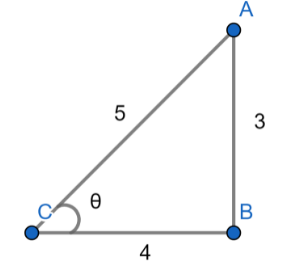
So the value of \[\theta \]will be \[\dfrac{{ - \pi }}{2} \leqslant \theta \leqslant \dfrac{\pi }{2}\]
Since, we know that, \[\cos \theta = \dfrac{B}{H}\]
where $B$ is the base and H is the hypotenuse.
From the above diagram, the value of cos will be,
\[\cos \theta = \dfrac{4}{5}\]
Another method to solve this is by using trigonometry identity.
\[\sin \theta = \dfrac{3}{5}\]
So, apply the trigonometry identity here i.e.
\[{\cos ^2}\theta = 1 - {\sin ^2}\theta \]
Taking square root on both the sides, we get,
\[ \Rightarrow \cos \theta = \sqrt {1 - {{\sin }^2}\theta } \]
Substituting the value, we get,
\[ \Rightarrow \cos \theta = \sqrt {1 - {{(\dfrac{3}{5})}^2}} \]
Removing the brackets, we get,
\[ \Rightarrow \cos \theta = \sqrt {1 - \dfrac{9}{{25}}} \]
Simplify the above equation, we get,
\[ \Rightarrow \cos \theta = \sqrt {\dfrac{{25 - 9}}{{25}}} \]
\[ \Rightarrow \cos \theta = \sqrt {\dfrac{{16}}{{25}}} \]
\[ \Rightarrow \cos \theta = \sqrt {{{(\dfrac{4}{5})}^2}} \]
\[ \therefore \cos \theta = \dfrac{4}{5}\]
Note: The expression \[{\sin ^{ - 1}}(x)\]is not the same as \[\dfrac{1}{{\sin (x)}}\]. In other words, \[ - 1\] is not an exponent. Instead, it simply means inverse function. The trigonometric functions sinx, cosx and tanx can be used to find an unknown side length of a right triangle, if one side length and an angle measure are known. The inverse trigonometric functions \[{\sin ^{ - 1}}x,{\cos ^{^{ - 1}}}x,{\tan ^{ - 1}}x\], are used to find the unknown measure of an angle of a right triangle when two side lengths are known. Pythagoras’ Theorem describes the mathematical relationship between three sides of a right-angled triangle. Trigonometry is a field of study in mathematics which observes the relationships of the sides and angles of triangles. The symbol \[\theta \] is used to describe an unknown angle. These functions are defined as the ratios of the different sides of a triangle.
Complete step by step answer:
Let, \[{\sin ^{ - 1}}(\dfrac{3}{5}) = \theta \]
\[ \Rightarrow \sin \theta = \dfrac{3}{5}\]
So the value of \[\theta \]will be \[\dfrac{{ - \pi }}{2} \leqslant \theta \leqslant \dfrac{\pi }{2}\]
Since, we know that, \[\cos \theta = \dfrac{B}{H}\]
where $B$ is the base and H is the hypotenuse.
From the above diagram, the value of cos will be,
\[\cos \theta = \dfrac{4}{5}\]
Another method to solve this is by using trigonometry identity.
\[\sin \theta = \dfrac{3}{5}\]
So, apply the trigonometry identity here i.e.
\[{\cos ^2}\theta = 1 - {\sin ^2}\theta \]
Taking square root on both the sides, we get,
\[ \Rightarrow \cos \theta = \sqrt {1 - {{\sin }^2}\theta } \]
Substituting the value, we get,
\[ \Rightarrow \cos \theta = \sqrt {1 - {{(\dfrac{3}{5})}^2}} \]
Removing the brackets, we get,
\[ \Rightarrow \cos \theta = \sqrt {1 - \dfrac{9}{{25}}} \]
Simplify the above equation, we get,
\[ \Rightarrow \cos \theta = \sqrt {\dfrac{{25 - 9}}{{25}}} \]
\[ \Rightarrow \cos \theta = \sqrt {\dfrac{{16}}{{25}}} \]
\[ \Rightarrow \cos \theta = \sqrt {{{(\dfrac{4}{5})}^2}} \]
\[ \therefore \cos \theta = \dfrac{4}{5}\]
Note: The expression \[{\sin ^{ - 1}}(x)\]is not the same as \[\dfrac{1}{{\sin (x)}}\]. In other words, \[ - 1\] is not an exponent. Instead, it simply means inverse function. The trigonometric functions sinx, cosx and tanx can be used to find an unknown side length of a right triangle, if one side length and an angle measure are known. The inverse trigonometric functions \[{\sin ^{ - 1}}x,{\cos ^{^{ - 1}}}x,{\tan ^{ - 1}}x\], are used to find the unknown measure of an angle of a right triangle when two side lengths are known. Pythagoras’ Theorem describes the mathematical relationship between three sides of a right-angled triangle. Trigonometry is a field of study in mathematics which observes the relationships of the sides and angles of triangles. The symbol \[\theta \] is used to describe an unknown angle. These functions are defined as the ratios of the different sides of a triangle.
Recently Updated Pages
Master Class 11 English: Engaging Questions & Answers for Success

Master Class 11 Physics: Engaging Questions & Answers for Success
Master Class 11 Computer Science: Engaging Questions & Answers for Success
Master Class 11 Chemistry: Engaging Questions & Answers for Success
Master Class 11 Social Science: Engaging Questions & Answers for Success
Master Class 11 Accountancy: Engaging Questions & Answers for Success
Trending doubts
Difference Between Prokaryotic Cells and Eukaryotic Cells
Two of the body parts which do not appear in MRI are class 11 biology CBSE
One Metric ton is equal to kg A 10000 B 1000 C 100 class 11 physics CBSE
10 examples of friction in our daily life
Draw a diagram of nephron and explain its structur class 11 biology CBSE
Draw a diagram of a plant cell and label at least eight class 11 biology CBSE