



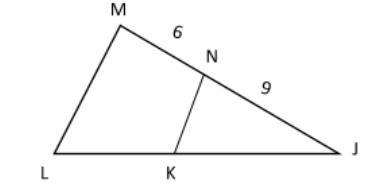
Find the value of $\dfrac{{LK}}{{KJ}}$ from the given figure.
 .
.
Answer
 Verified
587.4k+ views
Hint: To solve this and find the ratio,first we will try to find the value of MK, LK, KN, MN and the perimeter of quadrilateral MNKL.
Complete step by step solution:
Now we have given $MN = 6,NJ = 9$ and $ML\parallel NK$
Triangle Proportionality Theorem:
If a line is parallel to one side of a triangle and intersects the other two sides, then it divides the sides into segments of proportional lengths.
Use the Triangle Proportionality Theorem, we obtain
$\dfrac{{MN}}{{NJ}} = \dfrac{{LK}}{{KJ}}.......\left( i \right)$
Here,$MN = 6,NJ = 9$
Then we will substitute the value of $MN and NJ$ in equation$\left( i \right)$, we have
\[
\dfrac{{MN}}{{NJ}} = \dfrac{{LK}}{{KJ}} \\
\dfrac{6}{9} = \dfrac{{LK}}{{KJ}} \\
\Rightarrow \dfrac{{LK}}{{KJ}} = \dfrac{6}{9} \\
\]
Note: Students must keep in mind that while you use the basic Proportionality Theorem their one pair should be parallel. Then you apply the result of the basic Proportionality Theorem otherwise not use the theorem.
Complete step by step solution:
Now we have given $MN = 6,NJ = 9$ and $ML\parallel NK$
Triangle Proportionality Theorem:
If a line is parallel to one side of a triangle and intersects the other two sides, then it divides the sides into segments of proportional lengths.
Use the Triangle Proportionality Theorem, we obtain
$\dfrac{{MN}}{{NJ}} = \dfrac{{LK}}{{KJ}}.......\left( i \right)$
Here,$MN = 6,NJ = 9$
Then we will substitute the value of $MN and NJ$ in equation$\left( i \right)$, we have
\[
\dfrac{{MN}}{{NJ}} = \dfrac{{LK}}{{KJ}} \\
\dfrac{6}{9} = \dfrac{{LK}}{{KJ}} \\
\Rightarrow \dfrac{{LK}}{{KJ}} = \dfrac{6}{9} \\
\]
Note: Students must keep in mind that while you use the basic Proportionality Theorem their one pair should be parallel. Then you apply the result of the basic Proportionality Theorem otherwise not use the theorem.
Recently Updated Pages
Master Class 12 Business Studies: Engaging Questions & Answers for Success

Master Class 12 Biology: Engaging Questions & Answers for Success
Master Class 12 Chemistry: Engaging Questions & Answers for Success
Class 12 Question and Answer - Your Ultimate Solutions Guide
Complete reduction of benzene diazonium chloride with class 12 chemistry CBSE
How can you identify optical isomers class 12 chemistry CBSE
Trending doubts
Difference Between Plant Cell and Animal Cell
Fill the blanks with the suitable prepositions 1 The class 9 english CBSE
Which places in India experience sunrise first and class 9 social science CBSE
What is pollution? How many types of pollution? Define it
Name 10 Living and Non living things class 9 biology CBSE
What is the full form of pH?