




Find the value of $\cos 540^\circ = $
A) \[ - \dfrac{1}{{\sqrt 2 }}\]
B) $\dfrac{1}{{\sqrt 2 }}$
C) $\dfrac{3}{{\sqrt 2 }}$
D) $ - 1$
Answer
 Verified
583.8k+ views
Hint: Here, we are required to find the value of $\cos 540^\circ $. We will use quadrants to answer this question. We will break the given angle in two angles such that we know the value of either of the angles or that angle is present on the quadrants. After breaking the angle, we will solve them using quadrants and hence, find the required answer.
Complete step by step solution:
$\cos 540^\circ $ can be written as:
$\cos 540^\circ = \cos \left( {360^\circ + 180^\circ } \right)$
Now, we will draw the quadrants:
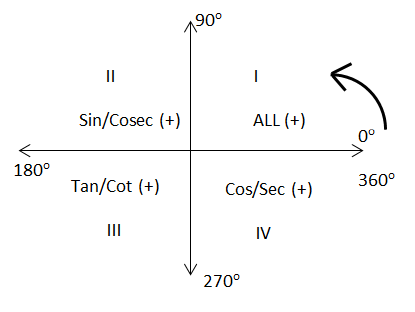
Now, $\cos 360^\circ $means one complete rotation.
Since, $\cos 360^\circ $ lies nearly on the fourth quadrant and on the fourth quadrant $\cos \theta $ is positive.
Therefore, $\cos 360^\circ $ is also positive.
Now, when we add any angle to $\cos 360^\circ $ it means that we are starting the second rotation. Hence, we usually neglect $360^\circ $ while solving the trigonometric questions.
Since,
$\cos 540^\circ = \cos \left( {360^\circ + 180^\circ } \right)$
Now, this can be written as:
$\cos 540^\circ = \cos 180^\circ $
Now, we can find the value of $\cos 180^\circ $in two ways:
$\cos 180^\circ = \cos \left( {180^\circ - 0^\circ } \right)$
Now, when we subtract any angle from $180^\circ $, then, we reach the second quadrant.
In the second quadrant, cosine is negative and due to $180^\circ $, the trigonometric function will remain the same.
$ \Rightarrow \cos \left( {180^\circ - 0^\circ } \right) = - \cos 0^\circ $
As we know, $\cos 0^\circ = 1$
Hence, $\cos 180^\circ = - \cos 0^\circ = - 1$
$\cos 180^\circ = \cos \left( {270^\circ - 90^\circ } \right)$
Now, when we subtract any angle from $270^\circ $, then, we reach the third quadrant.
In the third quadrant, cosine is negative and also, due to $270^\circ $, the trigonometric function will change, i.e. cosine will change to sine.
$ \Rightarrow \cos \left( {270^\circ - 90^\circ } \right) = - \sin 90^\circ $
As we know, $\sin 90^\circ = 1$
Hence, $\cos \left( {270^\circ - 90^\circ } \right) = - \sin 90^\circ = - 1$
Therefore, the value of $\cos 180^\circ $ is $ - 1$.
Hence, $\cos 540^\circ = \cos 180^\circ = - 1$
Therefore, the required answer is $ - 1$
And, option D is the correct answer.
Note:
We should take care while solving the quadrants because in one quadrant cosine is positive and in the other it is negative. If we use $0^\circ ,180^\circ ,360^\circ $then the trigonometric functions remain the same. But if we use $90^\circ ,270^\circ $then, we have changed them. Also, we can break the given angle in any sum possible but we should keep in mind that we have to break it in such a sum such that we know the value of one of those or how to solve the question using one of those angles.
Complete step by step solution:
$\cos 540^\circ $ can be written as:
$\cos 540^\circ = \cos \left( {360^\circ + 180^\circ } \right)$
Now, we will draw the quadrants:
Now, $\cos 360^\circ $means one complete rotation.
Since, $\cos 360^\circ $ lies nearly on the fourth quadrant and on the fourth quadrant $\cos \theta $ is positive.
Therefore, $\cos 360^\circ $ is also positive.
Now, when we add any angle to $\cos 360^\circ $ it means that we are starting the second rotation. Hence, we usually neglect $360^\circ $ while solving the trigonometric questions.
Since,
$\cos 540^\circ = \cos \left( {360^\circ + 180^\circ } \right)$
Now, this can be written as:
$\cos 540^\circ = \cos 180^\circ $
Now, we can find the value of $\cos 180^\circ $in two ways:
$\cos 180^\circ = \cos \left( {180^\circ - 0^\circ } \right)$
Now, when we subtract any angle from $180^\circ $, then, we reach the second quadrant.
In the second quadrant, cosine is negative and due to $180^\circ $, the trigonometric function will remain the same.
$ \Rightarrow \cos \left( {180^\circ - 0^\circ } \right) = - \cos 0^\circ $
As we know, $\cos 0^\circ = 1$
Hence, $\cos 180^\circ = - \cos 0^\circ = - 1$
$\cos 180^\circ = \cos \left( {270^\circ - 90^\circ } \right)$
Now, when we subtract any angle from $270^\circ $, then, we reach the third quadrant.
In the third quadrant, cosine is negative and also, due to $270^\circ $, the trigonometric function will change, i.e. cosine will change to sine.
$ \Rightarrow \cos \left( {270^\circ - 90^\circ } \right) = - \sin 90^\circ $
As we know, $\sin 90^\circ = 1$
Hence, $\cos \left( {270^\circ - 90^\circ } \right) = - \sin 90^\circ = - 1$
Therefore, the value of $\cos 180^\circ $ is $ - 1$.
Hence, $\cos 540^\circ = \cos 180^\circ = - 1$
Therefore, the required answer is $ - 1$
And, option D is the correct answer.
Note:
We should take care while solving the quadrants because in one quadrant cosine is positive and in the other it is negative. If we use $0^\circ ,180^\circ ,360^\circ $then the trigonometric functions remain the same. But if we use $90^\circ ,270^\circ $then, we have changed them. Also, we can break the given angle in any sum possible but we should keep in mind that we have to break it in such a sum such that we know the value of one of those or how to solve the question using one of those angles.
Recently Updated Pages
Master Class 10 Social Science: Engaging Questions & Answers for Success

Master Class 10 Science: Engaging Questions & Answers for Success
Master Class 10 Maths: Engaging Questions & Answers for Success
Master Class 10 General Knowledge: Engaging Questions & Answers for Success
Master Class 10 Computer Science: Engaging Questions & Answers for Success
Class 10 Question and Answer - Your Ultimate Solutions Guide
Trending doubts
What is the full form of PNG A Petrol Natural Gas B class 10 chemistry CBSE
Explain the Treaty of Vienna of 1815 class 10 social science CBSE
In cricket, how many legal balls are there in a standard over?
Why is there a time difference of about 5 hours between class 10 social science CBSE
Who Won 36 Oscar Awards? Record Holder Revealed
What is the median of the first 10 natural numbers class 10 maths CBSE