




Find the value of \[(A \cap B) \cap C\]
Answer
 Verified
585.9k+ views
Hint: Associative Law states that the grouping of set operations does not change the result of next grouping of sets. It is one of the important concepts of set theory. If we have three sets A, B and C, then,
Associative Law for the Intersection of Three Sets):
If A, B, and C are sets, then \[(A \cap B) \cap C = A \cap (B \cap C).\]
Complete step-by-step answer:
Given three sets A, B and C, the intersection is the set that contains elements or objects that belong to A, to B and to C at the same time.
First Law:
First law states that the intersection of a set to the intersection of two other sets is the same.
\[(A \cap B) \cap C = A \cap (B \cap C).\]
Proof :
In the first law \[(A \cap B) \cap C = A \cap (B \cap C).\]
Step 1:
Let us take the L.H.S, \[\left( {A{\text{ }} \cap {\text{ }}B} \right){\text{ }} \cap {\text{ }}C\]
Let\[x \in (A \cap B) \cap C\]. If \[x \in (A \cap B) \cap C\]then \[x \in \left( {A{\text{ }}and{\text{ }}B} \right)\] and \[x \in C\]
\[x \in \left( {A{\text{ }} and {\text{ }}B} \right)\] and \[x \in C\]
\[x \in \left( {A{\text{ }} and {\text{ }}B} \right)\] implies \[x \in A\] and \[x \in B\]
So, we have
\[x \in A\], \[x \in B\] and \[x \in C\]
\[x \in A\] and \[x \in \left( {B{\text{ }} and {\text{ }}C} \right)\]
\[x \in A\]\[\; \cap (B \cap C)\]
\[
x \in (A \cap B) \cap C{\text{ }} = > {\text{ }}x \in A \cap (B \cap C) \\
\left( {A{\text{ }} \cap {\text{ }}B} \right){\text{ }} \cap {\text{ }}C \subset A \cap (B \cap C) - - - {\text{ }}1 \\
\]
Step 2:
Let us take the R.H.S, \[\left( {B{\text{ }} \cap {\text{ }}C} \right){\text{ }} \cap {\text{ }}A\]
\[\begin{array}{*{20}{l}}
Let{\text{ }}x \in A \cap (B \cap C).{\text{ }} \\
If{\text{ }}x \in A \cap (B \cap C){\text{ }}then{\text{ }}x \in A{\text{ }} and {\text{ }}x \in \left( {B{\text{ }}and{\text{ }}C} \right) \\
{x \in A{\text{ }}and{\text{ }}x \in \left( {B{\text{ }}and{\text{ }}C} \right)} \\
{x \in \left( {B{\text{ }}and{\text{ }}C} \right){\text{ }}implies{\text{ }}x \in B{\text{ }}and{\text{ }}x \in C}
\end{array}\]
So, we have
x ∈ A, x ∈ B and x ∈ C
x ∈ (A and B) and x ∈ C
x ∈ (A and B) and C
x ∈ (A ∩ B) ∩ C
x ∈ A ∩ (B ∩ C) => x ∈ (A ∩ B) ∩ C
A ∩ (B ∩ C) ⊂ (A ∩ B) ∩ C-- 2
From equation 1 and 2
\[\left( {A{\text{ }} \cap {\text{ }}B} \right){\text{ }} \cap {\text{ }}C{\text{ }} = {\text{ }}A{\text{ }} \cap {\text{ }}\left( {B{\text{ }} \cap {\text{ }}C} \right)\]
Hence, the associative law of sets for intersection has been proved.
We write \[(A \cap B) \cap C\]
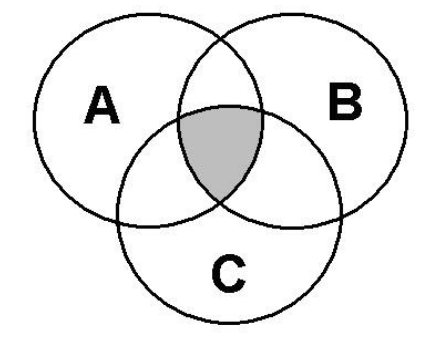
Basically, we find \[(A \cap B) \cap C\] by looking for all the elements A, B and C have in common.
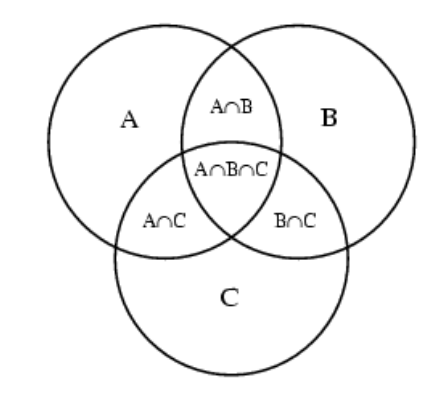
So, hence intersection of sets A, B and C has all the elements which are common to set A, Set B and Set C.
Note: To create an intersecting Venn diagram, draw three circles that overlap in the middle. You’ll be able to show which attributes are unique to each circle, which overlap between two, and which are common characteristics of all three groups.
Associative Law for the Intersection of Three Sets):
If A, B, and C are sets, then \[(A \cap B) \cap C = A \cap (B \cap C).\]
Complete step-by-step answer:
Given three sets A, B and C, the intersection is the set that contains elements or objects that belong to A, to B and to C at the same time.
First Law:
First law states that the intersection of a set to the intersection of two other sets is the same.
\[(A \cap B) \cap C = A \cap (B \cap C).\]
Proof :
In the first law \[(A \cap B) \cap C = A \cap (B \cap C).\]
Step 1:
Let us take the L.H.S, \[\left( {A{\text{ }} \cap {\text{ }}B} \right){\text{ }} \cap {\text{ }}C\]
Let\[x \in (A \cap B) \cap C\]. If \[x \in (A \cap B) \cap C\]then \[x \in \left( {A{\text{ }}and{\text{ }}B} \right)\] and \[x \in C\]
\[x \in \left( {A{\text{ }} and {\text{ }}B} \right)\] and \[x \in C\]
\[x \in \left( {A{\text{ }} and {\text{ }}B} \right)\] implies \[x \in A\] and \[x \in B\]
So, we have
\[x \in A\], \[x \in B\] and \[x \in C\]
\[x \in A\] and \[x \in \left( {B{\text{ }} and {\text{ }}C} \right)\]
\[x \in A\]\[\; \cap (B \cap C)\]
\[
x \in (A \cap B) \cap C{\text{ }} = > {\text{ }}x \in A \cap (B \cap C) \\
\left( {A{\text{ }} \cap {\text{ }}B} \right){\text{ }} \cap {\text{ }}C \subset A \cap (B \cap C) - - - {\text{ }}1 \\
\]
Step 2:
Let us take the R.H.S, \[\left( {B{\text{ }} \cap {\text{ }}C} \right){\text{ }} \cap {\text{ }}A\]
\[\begin{array}{*{20}{l}}
Let{\text{ }}x \in A \cap (B \cap C).{\text{ }} \\
If{\text{ }}x \in A \cap (B \cap C){\text{ }}then{\text{ }}x \in A{\text{ }} and {\text{ }}x \in \left( {B{\text{ }}and{\text{ }}C} \right) \\
{x \in A{\text{ }}and{\text{ }}x \in \left( {B{\text{ }}and{\text{ }}C} \right)} \\
{x \in \left( {B{\text{ }}and{\text{ }}C} \right){\text{ }}implies{\text{ }}x \in B{\text{ }}and{\text{ }}x \in C}
\end{array}\]
So, we have
x ∈ A, x ∈ B and x ∈ C
x ∈ (A and B) and x ∈ C
x ∈ (A and B) and C
x ∈ (A ∩ B) ∩ C
x ∈ A ∩ (B ∩ C) => x ∈ (A ∩ B) ∩ C
A ∩ (B ∩ C) ⊂ (A ∩ B) ∩ C-- 2
From equation 1 and 2
\[\left( {A{\text{ }} \cap {\text{ }}B} \right){\text{ }} \cap {\text{ }}C{\text{ }} = {\text{ }}A{\text{ }} \cap {\text{ }}\left( {B{\text{ }} \cap {\text{ }}C} \right)\]
Hence, the associative law of sets for intersection has been proved.
We write \[(A \cap B) \cap C\]
Basically, we find \[(A \cap B) \cap C\] by looking for all the elements A, B and C have in common.
So, hence intersection of sets A, B and C has all the elements which are common to set A, Set B and Set C.
Note: To create an intersecting Venn diagram, draw three circles that overlap in the middle. You’ll be able to show which attributes are unique to each circle, which overlap between two, and which are common characteristics of all three groups.
Recently Updated Pages
Master Class 11 Computer Science: Engaging Questions & Answers for Success

Master Class 11 Business Studies: Engaging Questions & Answers for Success
Master Class 11 Economics: Engaging Questions & Answers for Success
Master Class 11 English: Engaging Questions & Answers for Success
Master Class 11 Maths: Engaging Questions & Answers for Success
Master Class 11 Biology: Engaging Questions & Answers for Success
Trending doubts
One Metric ton is equal to kg A 10000 B 1000 C 100 class 11 physics CBSE
There are 720 permutations of the digits 1 2 3 4 5 class 11 maths CBSE
Discuss the various forms of bacteria class 11 biology CBSE
Draw a diagram of a plant cell and label at least eight class 11 biology CBSE
State the laws of reflection of light
Explain zero factorial class 11 maths CBSE