




Find the value of $1-\sin {{10}^{\circ }}\sin {{50}^{\circ }}\sin {{70}^{\circ }}$. \[\]
Answer
 Verified
601.8k+ views
Hint: We use the reduction formula for complementary angles $\theta ,{{90}^{\circ }}-\theta $ that is $\cos \theta =\sin \left( 90-\theta \right)$ for $\theta ={{40}^{\circ }},{{20}^{\circ }}$ to convert the sines into cosines. We use the sine double angle formula $\sin 2\theta =2\sin \theta \cos \theta $ by multiplying and dividing $2\cos {{10}^{\circ }}$ with the second term and simplify until we get only term in the numerator in sine where we use $\cos \theta =\sin \left( 90-\theta \right)$ to get the answer. \[\]
Complete step by step answer:
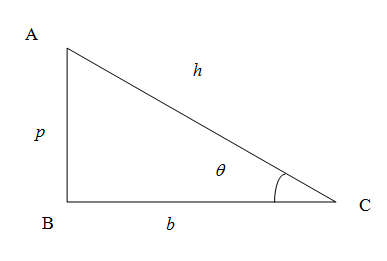
We know that in a right-angled triangle the side opposite to the right-angled triangle is called hypotenuse denoted as $h$, the vertical side is called perpendicular denoted as $p$ and the horizontal side is called the base denoted as $b$.\[\]
We know from the trigonometric ratios in a right-angled triangle the sine of any angle is given by the ratio of the side opposite to the angle to the hypotenuse. In the figure, the sine of the angle $\theta $ is given by
\[\sin \theta =\dfrac{p}{h}\]
We are asked to find the value of $1-\sin {{10}^{\circ }}\sin {{50}^{\circ }}\sin {{70}^{\circ }}$ in the question. Let use the reduction formula for complementary angles $\theta ,{{90}^{\circ }}-\theta $ that is $\cos \theta =\sin \left( 90-\theta \right)$ for $\theta ={{40}^{\circ }},{{20}^{\circ }}$ to have;
\[\begin{align}
& \Rightarrow 1-\sin {{10}^{\circ }}\sin {{50}^{\circ }}\sin {{70}^{\circ }} \\
& \Rightarrow 1-\sin {{10}^{\circ }}\sin \left( {{90}^{\circ }}-{{40}^{\circ }} \right)\sin \left( {{90}^{\circ }}-{{20}^{\circ }} \right) \\
& \Rightarrow 1-\sin {{10}^{\circ }}\cos {{40}^{\circ }}\cos {{20}^{\circ }} \\
\end{align}\]
We multiply and divide $2\cos {{10}^{\circ }}$ with the second term in the above step to have;
\[\begin{align}
& \Rightarrow 1-\dfrac{2\sin {{10}^{\circ }}\cos {{10}^{\circ }}\cos {{40}^{\circ }}\cos {{20}^{\circ }}}{2\cos {{10}^{\circ }}} \\
& \Rightarrow 1-\dfrac{\left( 2\sin {{10}^{\circ }}\cos {{10}^{\circ }} \right)\cos {{20}^{\circ }}\cos {{40}^{\circ }}\cos {{20}^{\circ }}}{2\cos {{10}^{\circ }}} \\
\end{align}\]
We use the sine double angle formula $\sin 2\theta =2\sin \theta \cos \theta $ for $\theta ={{10}^{\circ }}$ in the above step to have ;
\[\begin{align}
& \Rightarrow 1-\dfrac{\sin {{\left( 2\times 10 \right)}^{\circ }}\cos {{20}^{\circ }}\cos {{40}^{\circ }}}{2\cos {{10}^{\circ }}} \\
& \Rightarrow 1-\dfrac{\sin {{20}^{\circ }}\cos {{20}^{\circ }}\cos {{40}^{\circ }}}{2\cos {{10}^{\circ }}} \\
\end{align}\]
We multiply 2 in the numerator and denominator of the second term in the above step to have;
\[\begin{align}
& \Rightarrow 1-\dfrac{2\sin {{20}^{\circ }}\cos {{40}^{\circ }}\cos {{20}^{\circ }}}{2\times 2\cos {{10}^{\circ }}} \\
& \Rightarrow 1-\dfrac{\left( 2\sin {{20}^{\circ }}\cos {{40}^{\circ }} \right)\cos {{20}^{\circ }}}{4\cos {{10}^{\circ }}} \\
\end{align}\]
We use the sine double angle formula $\sin 2\theta =2\sin \theta \cos \theta $ for $\theta ={{20}^{\circ }}$ in the above step to have;
\[\begin{align}
& \Rightarrow 1-\dfrac{2\sin {{20}^{\circ }}\cos {{40}^{\circ }}\cos {{20}^{\circ }}}{2\times 2\cos {{10}^{\circ }}} \\
& \Rightarrow 1-\dfrac{\sin \left( 2\times {{20}^{\circ }} \right)\cos {{40}^{\circ }}}{4\cos {{10}^{\circ }}} \\
& \Rightarrow 1-\dfrac{\sin {{40}^{\circ }}\cos {{40}^{\circ }}}{4\cos {{10}^{\circ }}} \\
\end{align}\]
We multiply 2 in the numerator and denominator of the second term in the above step to have;
\[\begin{align}
& \Rightarrow 1-\dfrac{2\sin {{40}^{\circ }}\cos {{40}^{\circ }}}{2\times 4\cos {{10}^{\circ }}} \\
& \Rightarrow 1-\dfrac{2\sin {{40}^{\circ }}\cos {{40}^{\circ }}}{8\cos {{10}^{\circ }}} \\
\end{align}\]
We use the sine double angle formula $\sin 2\theta =2\sin \theta \cos \theta $ for $\theta ={{40}^{\circ }}$ in the above step to have;
\[\begin{align}
& \Rightarrow 1-\dfrac{\sin {{\left( 2\times 40 \right)}^{\circ }}}{2\times 4\cos {{10}^{\circ }}} \\
& \Rightarrow 1-\dfrac{\sin {{80}^{\circ }}}{8\cos {{10}^{\circ }}} \\
\end{align}\]
We use the reduction formula of complimentary angles $\cos \theta =\sin \left( 90{}^{\circ }-\theta \right)$ for $\theta ={{10}^{\circ }}$in the above step to have
\[\begin{align}
& \Rightarrow 1-\dfrac{\sin \left( {{90}^{\circ }}-{{10}^{\circ }} \right)}{8\cos {{10}^{\circ }}} \\
& \Rightarrow 1-\dfrac{\cos {{10}^{\circ }}}{8\cos {{10}^{\circ }}} \\
& \Rightarrow 1-\dfrac{1}{8}=\dfrac{8-1}{8}=\dfrac{7}{8} \\
\end{align}\]
So the obtained value of $1-\sin {{10}^{\circ }}\sin {{50}^{\circ }}\sin {{70}^{\circ }}$ is $\dfrac{7}{8}$. \[\]
Note:
We can alternatively solve using product of sines formula in terms cosine difference and sum of angles as $\sin A\sin B=\dfrac{1}{2}\left[ \cos \left( A-B \right)-\cos \left( A+B \right) \right]$ and then proceed to use again product of sine and cosine$\sin A\cos B=\dfrac{1}{2}\left[ \sin \left( A+B \right)-\sin \left( A-B \right) \right]$. We can also quickly find the answer if we know the formula $\sin A\sin \left( {{60}^{\circ }}-A \right)\sin \left( {{60}^{\circ }}+A \right)=\dfrac{1}{4}\sin 3A$ and use it for $A={{10}^{\circ }}$.
Complete step by step answer:
We know that in a right-angled triangle the side opposite to the right-angled triangle is called hypotenuse denoted as $h$, the vertical side is called perpendicular denoted as $p$ and the horizontal side is called the base denoted as $b$.\[\]
We know from the trigonometric ratios in a right-angled triangle the sine of any angle is given by the ratio of the side opposite to the angle to the hypotenuse. In the figure, the sine of the angle $\theta $ is given by
\[\sin \theta =\dfrac{p}{h}\]
We are asked to find the value of $1-\sin {{10}^{\circ }}\sin {{50}^{\circ }}\sin {{70}^{\circ }}$ in the question. Let use the reduction formula for complementary angles $\theta ,{{90}^{\circ }}-\theta $ that is $\cos \theta =\sin \left( 90-\theta \right)$ for $\theta ={{40}^{\circ }},{{20}^{\circ }}$ to have;
\[\begin{align}
& \Rightarrow 1-\sin {{10}^{\circ }}\sin {{50}^{\circ }}\sin {{70}^{\circ }} \\
& \Rightarrow 1-\sin {{10}^{\circ }}\sin \left( {{90}^{\circ }}-{{40}^{\circ }} \right)\sin \left( {{90}^{\circ }}-{{20}^{\circ }} \right) \\
& \Rightarrow 1-\sin {{10}^{\circ }}\cos {{40}^{\circ }}\cos {{20}^{\circ }} \\
\end{align}\]
We multiply and divide $2\cos {{10}^{\circ }}$ with the second term in the above step to have;
\[\begin{align}
& \Rightarrow 1-\dfrac{2\sin {{10}^{\circ }}\cos {{10}^{\circ }}\cos {{40}^{\circ }}\cos {{20}^{\circ }}}{2\cos {{10}^{\circ }}} \\
& \Rightarrow 1-\dfrac{\left( 2\sin {{10}^{\circ }}\cos {{10}^{\circ }} \right)\cos {{20}^{\circ }}\cos {{40}^{\circ }}\cos {{20}^{\circ }}}{2\cos {{10}^{\circ }}} \\
\end{align}\]
We use the sine double angle formula $\sin 2\theta =2\sin \theta \cos \theta $ for $\theta ={{10}^{\circ }}$ in the above step to have ;
\[\begin{align}
& \Rightarrow 1-\dfrac{\sin {{\left( 2\times 10 \right)}^{\circ }}\cos {{20}^{\circ }}\cos {{40}^{\circ }}}{2\cos {{10}^{\circ }}} \\
& \Rightarrow 1-\dfrac{\sin {{20}^{\circ }}\cos {{20}^{\circ }}\cos {{40}^{\circ }}}{2\cos {{10}^{\circ }}} \\
\end{align}\]
We multiply 2 in the numerator and denominator of the second term in the above step to have;
\[\begin{align}
& \Rightarrow 1-\dfrac{2\sin {{20}^{\circ }}\cos {{40}^{\circ }}\cos {{20}^{\circ }}}{2\times 2\cos {{10}^{\circ }}} \\
& \Rightarrow 1-\dfrac{\left( 2\sin {{20}^{\circ }}\cos {{40}^{\circ }} \right)\cos {{20}^{\circ }}}{4\cos {{10}^{\circ }}} \\
\end{align}\]
We use the sine double angle formula $\sin 2\theta =2\sin \theta \cos \theta $ for $\theta ={{20}^{\circ }}$ in the above step to have;
\[\begin{align}
& \Rightarrow 1-\dfrac{2\sin {{20}^{\circ }}\cos {{40}^{\circ }}\cos {{20}^{\circ }}}{2\times 2\cos {{10}^{\circ }}} \\
& \Rightarrow 1-\dfrac{\sin \left( 2\times {{20}^{\circ }} \right)\cos {{40}^{\circ }}}{4\cos {{10}^{\circ }}} \\
& \Rightarrow 1-\dfrac{\sin {{40}^{\circ }}\cos {{40}^{\circ }}}{4\cos {{10}^{\circ }}} \\
\end{align}\]
We multiply 2 in the numerator and denominator of the second term in the above step to have;
\[\begin{align}
& \Rightarrow 1-\dfrac{2\sin {{40}^{\circ }}\cos {{40}^{\circ }}}{2\times 4\cos {{10}^{\circ }}} \\
& \Rightarrow 1-\dfrac{2\sin {{40}^{\circ }}\cos {{40}^{\circ }}}{8\cos {{10}^{\circ }}} \\
\end{align}\]
We use the sine double angle formula $\sin 2\theta =2\sin \theta \cos \theta $ for $\theta ={{40}^{\circ }}$ in the above step to have;
\[\begin{align}
& \Rightarrow 1-\dfrac{\sin {{\left( 2\times 40 \right)}^{\circ }}}{2\times 4\cos {{10}^{\circ }}} \\
& \Rightarrow 1-\dfrac{\sin {{80}^{\circ }}}{8\cos {{10}^{\circ }}} \\
\end{align}\]
We use the reduction formula of complimentary angles $\cos \theta =\sin \left( 90{}^{\circ }-\theta \right)$ for $\theta ={{10}^{\circ }}$in the above step to have
\[\begin{align}
& \Rightarrow 1-\dfrac{\sin \left( {{90}^{\circ }}-{{10}^{\circ }} \right)}{8\cos {{10}^{\circ }}} \\
& \Rightarrow 1-\dfrac{\cos {{10}^{\circ }}}{8\cos {{10}^{\circ }}} \\
& \Rightarrow 1-\dfrac{1}{8}=\dfrac{8-1}{8}=\dfrac{7}{8} \\
\end{align}\]
So the obtained value of $1-\sin {{10}^{\circ }}\sin {{50}^{\circ }}\sin {{70}^{\circ }}$ is $\dfrac{7}{8}$. \[\]
Note:
We can alternatively solve using product of sines formula in terms cosine difference and sum of angles as $\sin A\sin B=\dfrac{1}{2}\left[ \cos \left( A-B \right)-\cos \left( A+B \right) \right]$ and then proceed to use again product of sine and cosine$\sin A\cos B=\dfrac{1}{2}\left[ \sin \left( A+B \right)-\sin \left( A-B \right) \right]$. We can also quickly find the answer if we know the formula $\sin A\sin \left( {{60}^{\circ }}-A \right)\sin \left( {{60}^{\circ }}+A \right)=\dfrac{1}{4}\sin 3A$ and use it for $A={{10}^{\circ }}$.
Recently Updated Pages
Master Class 12 Economics: Engaging Questions & Answers for Success

Master Class 12 English: Engaging Questions & Answers for Success
Master Class 12 Social Science: Engaging Questions & Answers for Success
Master Class 12 Maths: Engaging Questions & Answers for Success
Master Class 12 Physics: Engaging Questions & Answers for Success
Master Class 10 English: Engaging Questions & Answers for Success
Trending doubts
Explain the Treaty of Vienna of 1815 class 10 social science CBSE
Why is it 530 pm in india when it is 1200 afternoon class 10 social science CBSE
What is the full form of POSCO class 10 social science CBSE
Define Potential, Developed, Stock and Reserved resources
The speaker of the Lok Sabha is elected by the APresident class 10 social science CBSE
Complete the sentence with the most appropriate word class 10 english CBSE