




How do you find the terminal point $ p\left( {x,y} \right) $ on the unit circle determined by the giving value of $ t = \dfrac{{ - 3\pi }}{4} $ ?
Answer
 Verified
529.2k+ views
Hint: In order to find the terminal point $ p\left( {x,y} \right) $ on the unit circle, start with $ \left( {1,0} \right) $ which is $ \left( {\cos {0^ \circ },\sin {0^ \circ }} \right) $ at $ {0^ \circ } $ , as we know that the general terminal point for a circle is $ p\left( {\cos x,\sin x} \right) $ . We are given with the angle of $ t = \dfrac{{ - 3\pi }}{4} $ . So just put the value of $ t $ in the place of $ x $ in $ p\left( {\cos x,\sin x} \right) $ solve and get the value in the form of $ p\left( {x,y} \right) $ , where $ p\left( {x = \cos x,y = \sin x} \right) $ .
Complete step by step solution:
We are given with the angle $ t = \dfrac{{ - 3\pi }}{4} $ .
Since, we know that the general terminal point of a unit circle is: $ p\left( {\cos x,\sin x} \right) $ .
Representing it in diagram we get:
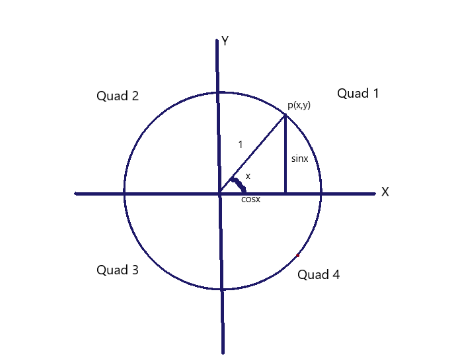
Put the value of $ t = \dfrac{{ - 3\pi }}{4} $ , in the place of $ x $ and we get:
$ p\left( {x = \cos x,y = \sin x} \right) = p\left( {\cos \left( {\dfrac{{ - 3\pi }}{4}} \right),\sin \left( {\dfrac{{ - 3\pi }}{4}} \right)} \right) $
Solving each part of sine and cosine separately:
As we know that $ \cos \left( { - x} \right) $ is written as $ \cos x $ , with this for cosine we can write:
$ \cos \left( {\dfrac{{ - 3\pi }}{4}} \right) = \cos \left( {\dfrac{{3\pi }}{4}} \right) $
Solving it for simplest form, to know the value we write:
\[\cos \left( {\dfrac{{3\pi }}{4}} \right) = \cos \left( {\pi - \dfrac{\pi }{4}} \right)\]
As this would give the value of cosine in 2nd Quadrant which is not the home of cosine so the value will be negative and we also know that \[\cos \left( {\dfrac{\pi }{4}} \right) = \dfrac{1}{{\sqrt 2 }}\].Putting it in the value and we get: \[\cos \left( {\pi - \dfrac{\pi }{4}} \right) = - \cos \left( {\dfrac{\pi }{4}} \right) = - \dfrac{1}{{\sqrt 2 }}\]
Similarly solving for sine, we get:
$ \sin \left( {\dfrac{{ - 3\pi }}{4}} \right) = - \sin \left( {\dfrac{{3\pi }}{4}} \right) $
Solving it for simplest form, to know the value we write:
\[ - \sin \left( {\dfrac{{3\pi }}{4}} \right) = - \sin \left( {\pi - \dfrac{\pi }{4}} \right)\]
As this would give the value of sine in 2nd Quadrant which is the home of sine so the value will be positive and we also know that \[\sin \left( {\dfrac{\pi }{4}} \right) = \dfrac{1}{{\sqrt 2 }}\].Putting it in the value and we get: \[ - \sin \left( {\pi - \dfrac{\pi }{4}} \right) = - \sin \left( {\dfrac{\pi }{4}} \right) = - \dfrac{1}{{\sqrt 2 }}\]
Hence, $ p\left( {\cos x,\sin x} \right) $ becomes $ p\left( {\cos \left( {\dfrac{{ - 3\pi }}{4}} \right),\sin \left( {\dfrac{{ - 3\pi }}{4}} \right)} \right) = p\left( { - \dfrac{1}{{\sqrt 2 }}, - \dfrac{1}{{\sqrt 2 }}} \right) $
Therefore, the terminal point $ p\left( {x,y} \right) $ on the unit circle determined by the giving value of $ t = \dfrac{{ - 3\pi }}{4} $ is: $ p\left( {\cos \left( {\dfrac{{ - 3\pi }}{4}} \right),\sin \left( {\dfrac{{ - 3\pi }}{4}} \right)} \right) = p\left( { - \dfrac{1}{{\sqrt 2 }}, - \dfrac{1}{{\sqrt 2 }}} \right) $ where $ x = \cos \left( { - \dfrac{{3\pi }}{4}} \right) = - \dfrac{1}{{\sqrt 2 }} $ and $ y = \sin \left( { - \dfrac{{3\pi }}{4}} \right) = - \dfrac{1}{{\sqrt 2 }} $ .
So, the correct answer is “$p\left( { - \dfrac{1}{{\sqrt 2 }}, - \dfrac{1}{{\sqrt 2 }}} \right) $ ”.
Note: Always check for the Quadrants for the sign of the values.
If the angle is positive then move counter clockwise also called anti-clockwise, and if angle is negative then move clockwise.
Complete step by step solution:
We are given with the angle $ t = \dfrac{{ - 3\pi }}{4} $ .
Since, we know that the general terminal point of a unit circle is: $ p\left( {\cos x,\sin x} \right) $ .
Representing it in diagram we get:
Put the value of $ t = \dfrac{{ - 3\pi }}{4} $ , in the place of $ x $ and we get:
$ p\left( {x = \cos x,y = \sin x} \right) = p\left( {\cos \left( {\dfrac{{ - 3\pi }}{4}} \right),\sin \left( {\dfrac{{ - 3\pi }}{4}} \right)} \right) $
Solving each part of sine and cosine separately:
As we know that $ \cos \left( { - x} \right) $ is written as $ \cos x $ , with this for cosine we can write:
$ \cos \left( {\dfrac{{ - 3\pi }}{4}} \right) = \cos \left( {\dfrac{{3\pi }}{4}} \right) $
Solving it for simplest form, to know the value we write:
\[\cos \left( {\dfrac{{3\pi }}{4}} \right) = \cos \left( {\pi - \dfrac{\pi }{4}} \right)\]
As this would give the value of cosine in 2nd Quadrant which is not the home of cosine so the value will be negative and we also know that \[\cos \left( {\dfrac{\pi }{4}} \right) = \dfrac{1}{{\sqrt 2 }}\].Putting it in the value and we get: \[\cos \left( {\pi - \dfrac{\pi }{4}} \right) = - \cos \left( {\dfrac{\pi }{4}} \right) = - \dfrac{1}{{\sqrt 2 }}\]
Similarly solving for sine, we get:
$ \sin \left( {\dfrac{{ - 3\pi }}{4}} \right) = - \sin \left( {\dfrac{{3\pi }}{4}} \right) $
Solving it for simplest form, to know the value we write:
\[ - \sin \left( {\dfrac{{3\pi }}{4}} \right) = - \sin \left( {\pi - \dfrac{\pi }{4}} \right)\]
As this would give the value of sine in 2nd Quadrant which is the home of sine so the value will be positive and we also know that \[\sin \left( {\dfrac{\pi }{4}} \right) = \dfrac{1}{{\sqrt 2 }}\].Putting it in the value and we get: \[ - \sin \left( {\pi - \dfrac{\pi }{4}} \right) = - \sin \left( {\dfrac{\pi }{4}} \right) = - \dfrac{1}{{\sqrt 2 }}\]
Hence, $ p\left( {\cos x,\sin x} \right) $ becomes $ p\left( {\cos \left( {\dfrac{{ - 3\pi }}{4}} \right),\sin \left( {\dfrac{{ - 3\pi }}{4}} \right)} \right) = p\left( { - \dfrac{1}{{\sqrt 2 }}, - \dfrac{1}{{\sqrt 2 }}} \right) $
Therefore, the terminal point $ p\left( {x,y} \right) $ on the unit circle determined by the giving value of $ t = \dfrac{{ - 3\pi }}{4} $ is: $ p\left( {\cos \left( {\dfrac{{ - 3\pi }}{4}} \right),\sin \left( {\dfrac{{ - 3\pi }}{4}} \right)} \right) = p\left( { - \dfrac{1}{{\sqrt 2 }}, - \dfrac{1}{{\sqrt 2 }}} \right) $ where $ x = \cos \left( { - \dfrac{{3\pi }}{4}} \right) = - \dfrac{1}{{\sqrt 2 }} $ and $ y = \sin \left( { - \dfrac{{3\pi }}{4}} \right) = - \dfrac{1}{{\sqrt 2 }} $ .
So, the correct answer is “$p\left( { - \dfrac{1}{{\sqrt 2 }}, - \dfrac{1}{{\sqrt 2 }}} \right) $ ”.
Note: Always check for the Quadrants for the sign of the values.
If the angle is positive then move counter clockwise also called anti-clockwise, and if angle is negative then move clockwise.
Recently Updated Pages
Master Class 11 Computer Science: Engaging Questions & Answers for Success

Master Class 11 Business Studies: Engaging Questions & Answers for Success
Master Class 11 Economics: Engaging Questions & Answers for Success
Master Class 11 English: Engaging Questions & Answers for Success
Master Class 11 Maths: Engaging Questions & Answers for Success
Master Class 11 Biology: Engaging Questions & Answers for Success
Trending doubts
There are 720 permutations of the digits 1 2 3 4 5 class 11 maths CBSE
Discuss the various forms of bacteria class 11 biology CBSE
Explain zero factorial class 11 maths CBSE
What organs are located on the left side of your body class 11 biology CBSE
Draw a diagram of nephron and explain its structur class 11 biology CBSE
How do I convert ms to kmh Give an example class 11 physics CBSE