




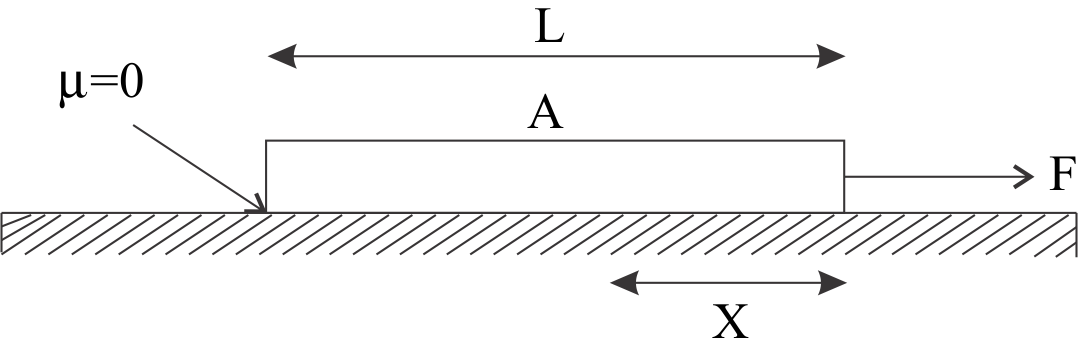
Find the tension in rope at section A, at distance x from a right end.
Answer
 Verified
572.4k+ views
Hint: In this type of situation, force applied on the body is uniformly distributed all over the length of the rope and all over the mass of the rope. So, we can use this result to find the tension or the total force, acting on the remaining part (part of rope that is in the left of point $A$ ) of the rope.
Complete step by step solution:
Since, the force is uniformly distributed over the mass of the rope. So the tension action at point $A$ will be the total force acting on the left part of the rope from point $A$ because this point will be pulling it’s left part.
So, Let the total mass of the rope be $M$
And length of rope is $L$
So mass per unit length, $\lambda = \dfrac{M}{L}$
Now, let mass of left part of rope from point $A$ be $m$ and it’s length is $L - x$ , so,
$m = \lambda \left( {L - x} \right)$
This is equivalent to,
$m = \dfrac{M}{L}\left( {L - x} \right)$
On simplifying this, we get,
$m = M\left( {1 - \dfrac{x}{L}} \right)$ ----------(1)
Now, acceleration of the rope $a$ will be the acceleration of all points of rope which is equal to,
$a = \dfrac{F}{M}$ (because ${\text{force = mass }} \times {\text{ acceleration}}$ )
So, tension $T$ at point $A$ will be the force acting on left part of the rope from point $A$ , so,
$T = ma$
Where $m = M\left( {1 - \dfrac{x}{L}} \right)$ from equation one and $a = \dfrac{F}{M}$ ,
Using these values in expression of tension, we get,
$T = M\left( {1 - \dfrac{x}{L}} \right)\dfrac{F}{M}$
On simplifying this, we get,
$T = F\left( {1 - \dfrac{x}{L}} \right)$
So tension $T$ at point $A$ is $T = F\left( {1 - \dfrac{x}{L}} \right)$.
Note: We could say that force is uniformly distributed over the mass and length and we got equation $a = \dfrac{F}{M}$ because there was no friction. If friction would present, then it’s force would also have some contribution in the expression of acceleration and the answer would be different.
Complete step by step solution:
Since, the force is uniformly distributed over the mass of the rope. So the tension action at point $A$ will be the total force acting on the left part of the rope from point $A$ because this point will be pulling it’s left part.
So, Let the total mass of the rope be $M$
And length of rope is $L$
So mass per unit length, $\lambda = \dfrac{M}{L}$
Now, let mass of left part of rope from point $A$ be $m$ and it’s length is $L - x$ , so,
$m = \lambda \left( {L - x} \right)$
This is equivalent to,
$m = \dfrac{M}{L}\left( {L - x} \right)$
On simplifying this, we get,
$m = M\left( {1 - \dfrac{x}{L}} \right)$ ----------(1)
Now, acceleration of the rope $a$ will be the acceleration of all points of rope which is equal to,
$a = \dfrac{F}{M}$ (because ${\text{force = mass }} \times {\text{ acceleration}}$ )
So, tension $T$ at point $A$ will be the force acting on left part of the rope from point $A$ , so,
$T = ma$
Where $m = M\left( {1 - \dfrac{x}{L}} \right)$ from equation one and $a = \dfrac{F}{M}$ ,
Using these values in expression of tension, we get,
$T = M\left( {1 - \dfrac{x}{L}} \right)\dfrac{F}{M}$
On simplifying this, we get,
$T = F\left( {1 - \dfrac{x}{L}} \right)$
So tension $T$ at point $A$ is $T = F\left( {1 - \dfrac{x}{L}} \right)$.
Note: We could say that force is uniformly distributed over the mass and length and we got equation $a = \dfrac{F}{M}$ because there was no friction. If friction would present, then it’s force would also have some contribution in the expression of acceleration and the answer would be different.
Recently Updated Pages
Master Class 11 Computer Science: Engaging Questions & Answers for Success

Master Class 11 Business Studies: Engaging Questions & Answers for Success
Master Class 11 Economics: Engaging Questions & Answers for Success
Master Class 11 English: Engaging Questions & Answers for Success
Master Class 11 Maths: Engaging Questions & Answers for Success
Master Class 11 Biology: Engaging Questions & Answers for Success
Trending doubts
One Metric ton is equal to kg A 10000 B 1000 C 100 class 11 physics CBSE
There are 720 permutations of the digits 1 2 3 4 5 class 11 maths CBSE
Discuss the various forms of bacteria class 11 biology CBSE
Draw a diagram of a plant cell and label at least eight class 11 biology CBSE
State the laws of reflection of light
Explain zero factorial class 11 maths CBSE