




How do you find the standard form of the equation of the ellipse given the properties foci \[\left( {0,\, \pm 5} \right)\], vertices \[\left( {0,\, \pm 8} \right)\] ?
Answer
 Verified
567.3k+ views
Hint: Since, the x-coordinates of both vertices and foci are given, this is an indication that these are the points of a vertical ellipse with centre at origin. We know that standard form of vertical ellipse with centre at origin is
\[\dfrac{{{x^2}}}{{{a^2}}} + \dfrac{{{y^2}}}{{{b^2}}} = 1\]
By using this standard equation we will get the equation of the ellipse.
Complete step-by-step solution:
The foci are on the x-axis, so the major axis is the x-axis. Thus the equation will have the form:
\[\dfrac{{{x^2}}}{{{a^2}}} + \dfrac{{{y^2}}}{{{b^2}}} = 1\]
The vertices are\[\left( {0,\, \pm 8} \right)\], so \[a = 8\] and \[{a^2} = 64\]
The foci are\[\left( {0,\, \pm 5} \right)\], so \[c = 5\] and\[{c^2} = 25\].
We know that the vertices and foci are related by the equation \[{c^2} = {a^2} - {b^2}\] solving for \[{b^2}\] we have
\[25 = 64 - {b^2}\]
(Substitute for \[{c^2}\] and\[{a^2}\].)
\[{b^2} = 39\]
Now we need only substitute \[{a^2} = 64\] and \[{b^2} = 39\] into the standard form of the equation. The equation of the ellipse is
\[\dfrac{{{x^2}}}{{64}} + \dfrac{{{y^2}}}{{39}} = 1\]
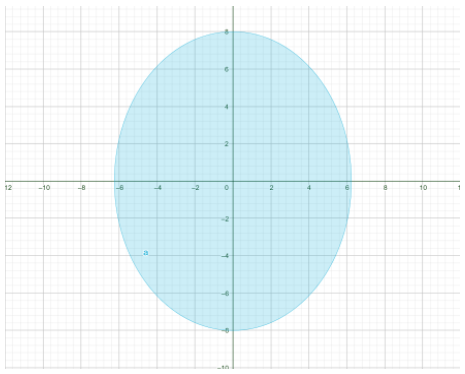
Note: Every ellipse has two axes of symmetry. The longer axis is called the major axis, and the shorter axis is called the minor axis.
Each endpoint of the major axis is the vertex of the ellipse (plural: vertices), and each endpoint of the minor axis is a co-vertex of the ellipse.
The center of an ellipse is the midpoint of both the major and minor axes. The axes are perpendicular at the center.
The foci always lie on the major axis, and the sum of the distances from the foci to any point on the ellipse (the constant sum) is greater than the distance between the foci.
STANDARD FORMS OF THE EQUATION OF AN ELLIPSE WITH CENTER \[(0,0)(0,0)\]
The standard form of the equation of an ellipse with center \[(0,0)(0,0)\] and major axis parallel to the x-axis is
\[\dfrac{{{x^2}}}{{{a^2}}} + \dfrac{{{y^2}}}{{{b^2}}} = 1\]
By using this standard equation we will get the equation of the ellipse.
Complete step-by-step solution:
The foci are on the x-axis, so the major axis is the x-axis. Thus the equation will have the form:
\[\dfrac{{{x^2}}}{{{a^2}}} + \dfrac{{{y^2}}}{{{b^2}}} = 1\]
The vertices are\[\left( {0,\, \pm 8} \right)\], so \[a = 8\] and \[{a^2} = 64\]
The foci are\[\left( {0,\, \pm 5} \right)\], so \[c = 5\] and\[{c^2} = 25\].
We know that the vertices and foci are related by the equation \[{c^2} = {a^2} - {b^2}\] solving for \[{b^2}\] we have
\[25 = 64 - {b^2}\]
(Substitute for \[{c^2}\] and\[{a^2}\].)
\[{b^2} = 39\]
Now we need only substitute \[{a^2} = 64\] and \[{b^2} = 39\] into the standard form of the equation. The equation of the ellipse is
\[\dfrac{{{x^2}}}{{64}} + \dfrac{{{y^2}}}{{39}} = 1\]
Note: Every ellipse has two axes of symmetry. The longer axis is called the major axis, and the shorter axis is called the minor axis.
Each endpoint of the major axis is the vertex of the ellipse (plural: vertices), and each endpoint of the minor axis is a co-vertex of the ellipse.
The center of an ellipse is the midpoint of both the major and minor axes. The axes are perpendicular at the center.
The foci always lie on the major axis, and the sum of the distances from the foci to any point on the ellipse (the constant sum) is greater than the distance between the foci.
STANDARD FORMS OF THE EQUATION OF AN ELLIPSE WITH CENTER \[(0,0)(0,0)\]
The standard form of the equation of an ellipse with center \[(0,0)(0,0)\] and major axis parallel to the x-axis is
Recently Updated Pages
Basicity of sulphurous acid and sulphuric acid are

Master Class 11 Business Studies: Engaging Questions & Answers for Success
Master Class 11 Computer Science: Engaging Questions & Answers for Success
Master Class 11 Economics: Engaging Questions & Answers for Success
Master Class 11 Social Science: Engaging Questions & Answers for Success
Master Class 11 English: Engaging Questions & Answers for Success
Trending doubts
One Metric ton is equal to kg A 10000 B 1000 C 100 class 11 physics CBSE
The largest wind power cluster is located in the state class 11 social science CBSE
Explain zero factorial class 11 maths CBSE
State and prove Bernoullis theorem class 11 physics CBSE
Which among the following are examples of coming together class 11 social science CBSE
Can anyone list 10 advantages and disadvantages of friction