



Find the square root of the following decimal numbers:
Find the square root of the following decimal numbers:
A.2.56
B.7.29
C.51.84
D.42.25
E.31.36
Answer
 Verified
646.2k+ views
Hint: Mark the period in both integral and decimal parts in a pair. After that find the square root by long division method and put the decimal point on the square root.
Complete step-by-step answer:
Let us take the first decimal number 2.56. Let us divide it with 1.
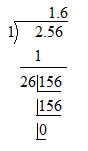
We know, \[24\times 4=96\]
\[\begin{align}
& 25\times 5=125 \\
& 26\times 6=156 \\
\end{align}\]
The square root of 2.56 = 1.6
So step 1 is to make the number of decimal places even by affixing a zero on the extreme right of the decimal part if it’s not even. As step 2, in the integral part, mark the period, \[\left( 2.\overline{56} \right)\]. In the decimal part, mark the periods on every pair of digits beginning with \[{{1}^{st}}\] decimal place. Now find the square root by long division method and put the decimal point in the square root.
Now let us find the square root of 7.29
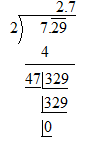
We know, \[45\times 5=225\]
\[\begin{align}
& 46\times 6=276 \\
& 47\times 7=329 \\
\end{align}\]
Square root of 51.84
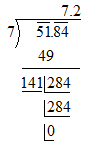
\[\left\{ \begin{align}
& 141\times 1=141 \\
& 142\times 2=284 \\
\end{align} \right.\]
\[\therefore \] We got square root of 51.84 = 7.2
Now let’s get the square root of 42.25
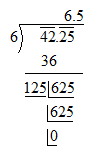
\[\left\{ \begin{align}
& 123\times 3=369 \\
& 124\times 4=496 \\
& 125\times 5=625 \\
\end{align} \right.\]
Thus square root of 42.25 = 6.5
Square root of 31.36
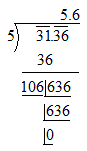
\[\left\{ \begin{align}
& 104\times 4=416 \\
& 105\times 5=525 \\
& 106\times 6=636 \\
\end{align} \right.\]
Thus we got the square root of the following decimal numbers as,
2.56 = 1.6
7.29 = 2.7
51.84 = 7.2
42.25 = 6.5
31.36 = 5.6
Note: Remember that the division of the integral part must be by a perfect square i.e. (2 \[\times \] 2), (3 \[\times \] 3), (4 \[\times \]4), (5 \[\times \] 5) etc which we have used here. Also mark the periods in both integral and decimal parts on every pair of digits.
Complete step-by-step answer:
Let us take the first decimal number 2.56. Let us divide it with 1.
We know, \[24\times 4=96\]
\[\begin{align}
& 25\times 5=125 \\
& 26\times 6=156 \\
\end{align}\]
The square root of 2.56 = 1.6
So step 1 is to make the number of decimal places even by affixing a zero on the extreme right of the decimal part if it’s not even. As step 2, in the integral part, mark the period, \[\left( 2.\overline{56} \right)\]. In the decimal part, mark the periods on every pair of digits beginning with \[{{1}^{st}}\] decimal place. Now find the square root by long division method and put the decimal point in the square root.
Now let us find the square root of 7.29
We know, \[45\times 5=225\]
\[\begin{align}
& 46\times 6=276 \\
& 47\times 7=329 \\
\end{align}\]
Square root of 51.84
\[\left\{ \begin{align}
& 141\times 1=141 \\
& 142\times 2=284 \\
\end{align} \right.\]
\[\therefore \] We got square root of 51.84 = 7.2
Now let’s get the square root of 42.25
\[\left\{ \begin{align}
& 123\times 3=369 \\
& 124\times 4=496 \\
& 125\times 5=625 \\
\end{align} \right.\]
Thus square root of 42.25 = 6.5
Square root of 31.36
\[\left\{ \begin{align}
& 104\times 4=416 \\
& 105\times 5=525 \\
& 106\times 6=636 \\
\end{align} \right.\]
Thus we got the square root of the following decimal numbers as,
2.56 = 1.6
7.29 = 2.7
51.84 = 7.2
42.25 = 6.5
31.36 = 5.6
Note: Remember that the division of the integral part must be by a perfect square i.e. (2 \[\times \] 2), (3 \[\times \] 3), (4 \[\times \]4), (5 \[\times \] 5) etc which we have used here. Also mark the periods in both integral and decimal parts on every pair of digits.
Recently Updated Pages
Master Class 11 English: Engaging Questions & Answers for Success

Master Class 11 Social Science: Engaging Questions & Answers for Success
Master Class 11 Maths: Engaging Questions & Answers for Success
Master Class 11 Biology: Engaging Questions & Answers for Success
Master Class 11 Physics: Engaging Questions & Answers for Success
Master Class 11 Chemistry: Engaging Questions & Answers for Success
Trending doubts
What is the Full Form of ICSE / ISC ?
The president of the constituent assembly was A Dr class 9 social science CBSE
What comes after 10 crore in Indian system class 9 maths CBSE
What is the Full Form of ICSE, CBSE and SSC
On the given outline map of India Mark and Label the class 9 social science CBSE
Give 5 examples of refraction of light in daily life