




How do you find the solution to \[\dfrac{\sin \left( 120 \right)\cos \left( \dfrac{2\pi }{3} \right)}{\tan \left( 315 \right)}\] ?
Answer
 Verified
534k+ views
Hint: We explain the process of finding values for associated angles. We find the rotation and the position of the angle for ${{120}^{\circ }},{{315}^{\circ }},\dfrac{2\pi }{3}$. We explain the changes that are required for that angle. Depending on those things we find the solution.
Complete step by step solution:
We need to find the ratio value for \[\sin \left( 120 \right),\cos \left( \dfrac{2\pi }{3} \right),\tan \left( 315 \right)\] .
For general form of ratios, we need to convert the value of x into the closest multiple of $\dfrac{\pi }{2}$ and add or subtract a certain value $\alpha $ from that multiple of $\dfrac{\pi }{2}$ to make it equal to x.
Let’s assume $x=k\times \dfrac{\pi }{2}+\alpha $, $k\in \mathbb{Z}$. Here we took the addition of $\alpha $. We also need to remember that $\left| \alpha \right|\le \dfrac{\pi }{2}$.
Now we take the value of k. If it’s even then keep the ratio as it is and if it’s odd then the ratio changes to cos, sin, cot ratio from sin, cos, tan respectively.
Then we find the position of the given angle as quadrant value measured in counter clockwise movement from the origin and the positive side of X-axis.
The sign of the trigonometric ratio is positive for the excess angle in their respective quadrants according to the below image.
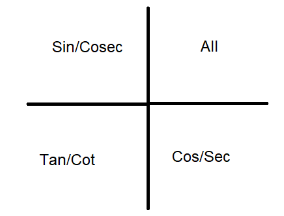
Depending on the sign and ratio change the final angle becomes $\alpha $ from x.
Now we find the values for \[\sin \left( 120 \right),\cos \left( \dfrac{2\pi }{3} \right),\tan \left( 315 \right)\] .
\[\sin \left( 120 \right)=\sin \left( 1\times \dfrac{\pi }{2}+30 \right)=\cos \left( 30 \right)=\dfrac{\sqrt{3}}{2}\]
\[\cos \left( \dfrac{2\pi }{3} \right)=\cos \left( 1\times \dfrac{\pi }{2}+30 \right)=-\sin \left( 30 \right)=-\dfrac{1}{2}\]
\[\tan \left( 315 \right)=\tan \left( 3\times \dfrac{\pi }{2}+45 \right)=-\cot \left( 45 \right)=-1\]
Therefore, the final solution of \[\dfrac{\sin \left( 120 \right)\cos \left( \dfrac{2\pi }{3} \right)}{\tan \left( 315 \right)}\] is \[\dfrac{\sin \left( 120 \right)\cos \left( \dfrac{2\pi }{3} \right)}{\tan \left( 315 \right)}=\dfrac{\dfrac{\sqrt{3}}{2}\times \left( -\dfrac{1}{2} \right)}{-1}=\dfrac{\sqrt{3}}{4}\] .
So, the correct answer is “$\dfrac{\sqrt{3}}{4}$”.
Note: We need to remember that the easiest way to avoid the change of ratio thing is to form the multiple of $\pi $ instead of $\dfrac{\pi }{2}$. It makes the multiplied number always even. In that case we don’t have to change the ratio. If $x=k\times \pi +\alpha =2k\times \dfrac{\pi }{2}+\alpha $. Value of $2k$ is always even.
Complete step by step solution:
We need to find the ratio value for \[\sin \left( 120 \right),\cos \left( \dfrac{2\pi }{3} \right),\tan \left( 315 \right)\] .
For general form of ratios, we need to convert the value of x into the closest multiple of $\dfrac{\pi }{2}$ and add or subtract a certain value $\alpha $ from that multiple of $\dfrac{\pi }{2}$ to make it equal to x.
Let’s assume $x=k\times \dfrac{\pi }{2}+\alpha $, $k\in \mathbb{Z}$. Here we took the addition of $\alpha $. We also need to remember that $\left| \alpha \right|\le \dfrac{\pi }{2}$.
Now we take the value of k. If it’s even then keep the ratio as it is and if it’s odd then the ratio changes to cos, sin, cot ratio from sin, cos, tan respectively.
Then we find the position of the given angle as quadrant value measured in counter clockwise movement from the origin and the positive side of X-axis.
The sign of the trigonometric ratio is positive for the excess angle in their respective quadrants according to the below image.
Depending on the sign and ratio change the final angle becomes $\alpha $ from x.
Now we find the values for \[\sin \left( 120 \right),\cos \left( \dfrac{2\pi }{3} \right),\tan \left( 315 \right)\] .
\[\sin \left( 120 \right)=\sin \left( 1\times \dfrac{\pi }{2}+30 \right)=\cos \left( 30 \right)=\dfrac{\sqrt{3}}{2}\]
\[\cos \left( \dfrac{2\pi }{3} \right)=\cos \left( 1\times \dfrac{\pi }{2}+30 \right)=-\sin \left( 30 \right)=-\dfrac{1}{2}\]
\[\tan \left( 315 \right)=\tan \left( 3\times \dfrac{\pi }{2}+45 \right)=-\cot \left( 45 \right)=-1\]
Therefore, the final solution of \[\dfrac{\sin \left( 120 \right)\cos \left( \dfrac{2\pi }{3} \right)}{\tan \left( 315 \right)}\] is \[\dfrac{\sin \left( 120 \right)\cos \left( \dfrac{2\pi }{3} \right)}{\tan \left( 315 \right)}=\dfrac{\dfrac{\sqrt{3}}{2}\times \left( -\dfrac{1}{2} \right)}{-1}=\dfrac{\sqrt{3}}{4}\] .
So, the correct answer is “$\dfrac{\sqrt{3}}{4}$”.
Note: We need to remember that the easiest way to avoid the change of ratio thing is to form the multiple of $\pi $ instead of $\dfrac{\pi }{2}$. It makes the multiplied number always even. In that case we don’t have to change the ratio. If $x=k\times \pi +\alpha =2k\times \dfrac{\pi }{2}+\alpha $. Value of $2k$ is always even.
Recently Updated Pages
Master Class 11 Computer Science: Engaging Questions & Answers for Success

Master Class 11 Business Studies: Engaging Questions & Answers for Success
Master Class 11 Economics: Engaging Questions & Answers for Success
Master Class 11 English: Engaging Questions & Answers for Success
Master Class 11 Maths: Engaging Questions & Answers for Success
Master Class 11 Biology: Engaging Questions & Answers for Success
Trending doubts
One Metric ton is equal to kg A 10000 B 1000 C 100 class 11 physics CBSE
There are 720 permutations of the digits 1 2 3 4 5 class 11 maths CBSE
Discuss the various forms of bacteria class 11 biology CBSE
Draw a diagram of a plant cell and label at least eight class 11 biology CBSE
State the laws of reflection of light
Explain zero factorial class 11 maths CBSE