




How do you find the smallest angle in a right-angled triangle whose side lengths are $6$ cm, $13$ cm and $14$ cm?
Answer
 Verified
576.9k+ views
Hint: In the given question, we have been asked to find the smallest angle in a right-angled triangle whose side lengths are $6$ cm, $13$ cm and $14$ cm , we just have to use the cosine formula that is ${a^2} = {b^2} + {c^2} - bc\cos A$ here we have to find the value of ‘A’ and it is given that $a = 6,b = 13,c = 14$ . To solve this question, we need to get ‘A’ on one side of the “equals” sign, and all the other numbers on the other side. To solve this equation for a given variable ‘A’, we have to undo the mathematical operations such as addition, subtraction, multiplication, and division that has been done to the variables.
Complete step by step solution:
Since we already know that the smallest angle is always present opposite the shortest side that is $6$cm , we have to solve for the value of angle A using the Law of Cosine,
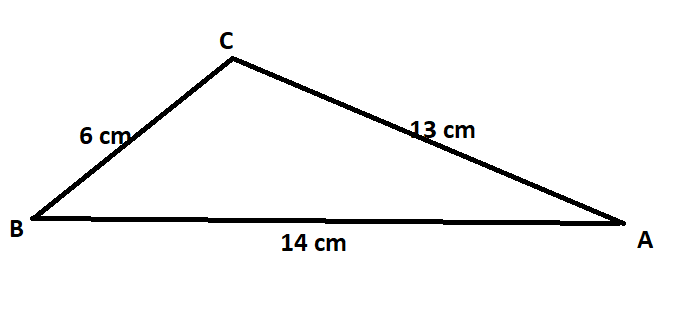
${a^2} = {b^2} + {c^2} - bc\cos A$
Where ,
$
a = 6 \\
b = 13 \\
c = 14 \\
$
Substitutes these values into the cosine formula , we will get ,
${6^2} = {13^2} + {14^2} - 2(13)(14)\cos A$
Simplify the above equation ,
$36 = 169 + 196 - 2(13)(14)\cos A$
Adding like terms , we will get ,
$36 = 365 - 364\cos A$
0r
$365 - 364\cos A = 36$
Subtract by $365$ to both the side of the equation , we will get ,
$ - 364\cos A = 36 - 365$
$ - 364\cos A = - 329$
Simplifying ,
$\cos A = \dfrac{{ - 329}}{{ - 364}}$
$\cos A = 0.9038$
$A = {\cos ^{ - 1}}(0.9038)$
$A = {25.34^ \circ }$
And hence, we get the required result.
Note: The important thing to recollect about any equation is that the ‘equals’ sign represents a balance. What the sign says is that what’s on the left-hand side is strictly an equal to what’s on the right-hand side. It is the type of question mathematical operations such as addition, subtraction, multiplication and division are used.
Complete step by step solution:
Since we already know that the smallest angle is always present opposite the shortest side that is $6$cm , we have to solve for the value of angle A using the Law of Cosine,
${a^2} = {b^2} + {c^2} - bc\cos A$
Where ,
$
a = 6 \\
b = 13 \\
c = 14 \\
$
Substitutes these values into the cosine formula , we will get ,
${6^2} = {13^2} + {14^2} - 2(13)(14)\cos A$
Simplify the above equation ,
$36 = 169 + 196 - 2(13)(14)\cos A$
Adding like terms , we will get ,
$36 = 365 - 364\cos A$
0r
$365 - 364\cos A = 36$
Subtract by $365$ to both the side of the equation , we will get ,
$ - 364\cos A = 36 - 365$
$ - 364\cos A = - 329$
Simplifying ,
$\cos A = \dfrac{{ - 329}}{{ - 364}}$
$\cos A = 0.9038$
$A = {\cos ^{ - 1}}(0.9038)$
$A = {25.34^ \circ }$
And hence, we get the required result.
Note: The important thing to recollect about any equation is that the ‘equals’ sign represents a balance. What the sign says is that what’s on the left-hand side is strictly an equal to what’s on the right-hand side. It is the type of question mathematical operations such as addition, subtraction, multiplication and division are used.
Recently Updated Pages
Master Class 11 English: Engaging Questions & Answers for Success

Master Class 11 Social Science: Engaging Questions & Answers for Success
Master Class 11 Maths: Engaging Questions & Answers for Success
Master Class 11 Biology: Engaging Questions & Answers for Success
Master Class 11 Physics: Engaging Questions & Answers for Success
Master Class 11 Chemistry: Engaging Questions & Answers for Success
Trending doubts
One Metric ton is equal to kg A 10000 B 1000 C 100 class 11 physics CBSE
Difference Between Prokaryotic Cells and Eukaryotic Cells
Find the value of the expression given below sin 30circ class 11 maths CBSE
Difference between physical and chemical change class 11 chemistry CBSE
Two of the body parts which do not appear in MRI are class 11 biology CBSE
Draw a diagram of a plant cell and label at least eight class 11 biology CBSE