




Find the slope of the line passing through the points:
(i) (-2, 3) and (8, -5)
(ii) (4, -3) and (6, -3)
(iii) (3, 2) and (3, -1)
Answer
 Verified
632.1k+ views
Hint: We know that the slope of a line joining the two points \[\left( {{x}_{1}},{{y}_{1}} \right)\] and \[\left( {{x}_{2}},{{y}_{2}} \right)\] is equal to the tangent of the angle made by the line with x-axis in anticlockwise direction by as follows:
\[slope=\tan \theta =\dfrac{{{y}_{2}}-{{y}_{1}}}{{{x}_{2}}-{{x}_{1}}}\]
Complete step-by-step answer:
We will find the slope of a line passing through the following points as below:
(i) (-2, 3) and (8, -5)
We know that the slope of a line passing through the two points \[\left( {{x}_{1}},{{y}_{1}} \right)\] and \[\left( {{x}_{2}},{{y}_{2}} \right)\] is given by,
\[slope=\dfrac{{{y}_{2}}-{{y}_{1}}}{{{x}_{2}}-{{x}_{1}}}\]
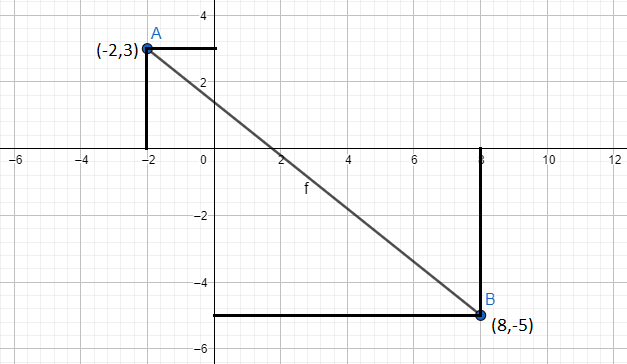
So we have \[{{x}_{1}}=-2,{{y}_{1}}=3,{{x}_{2}}=8,{{y}_{2}}=-5\]
\[\Rightarrow slope=\dfrac{-5-3}{8-(-2)}=\dfrac{-8}{8+2}=\dfrac{-8}{10}=\dfrac{-4}{5}\]
Hence the slope is equal to \[\left( \dfrac{-4}{5} \right)\].
(ii) (4, -3) and (6, -3)
We know that slope of a line passing through the points \[\left( {{x}_{1}},{{y}_{1}} \right)\] and \[\left( {{x}_{2}},{{y}_{2}} \right)\] is given by,
\[slope=\dfrac{{{y}_{2}}-{{y}_{1}}}{{{x}_{2}}-{{x}_{1}}}\]
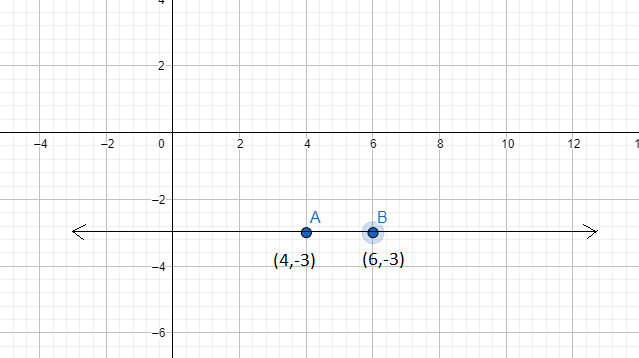
So we have \[{{x}_{1}}=4,{{y}_{1}}= -3,{{x}_{2}}=6,{{y}_{2}}=-3\]
\[\Rightarrow slope=\dfrac{-3-(-3)}{6-4}=\dfrac{0}{2}=0\]
Since we know that if the slope of a line is equal to 0 means the line is parallel to x-axis.
Hence, slope is equal to zero.
(iii) (3, 2) and (3, -1)
We know that the slope of a line passing through the points \[\left( {{x}_{1}},{{y}_{1}} \right)\] and \[\left( {{x}_{2}},{{y}_{2}} \right)\] is given by,
\[slope=\dfrac{{{y}_{2}}-{{y}_{1}}}{{{x}_{2}}-{{x}_{1}}}\]
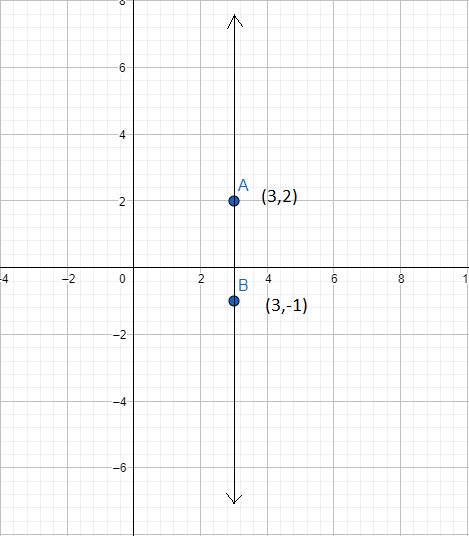
\[\Rightarrow slope=\dfrac{-1-2}{3-3}=\dfrac{-3}{0}=\infty (infinity)\]
Hence the slope is equal to infinity means the line is perpendicular to the x-axis.
Note: Substitute the value of \[{{x}_{1}},{{y}_{1}},{{x}_{2}},{{y}_{2}}\] in the formula very carefully because if you misplace it order then you will get the incorrect answer. Also, remember that the slope of a line is also equal to the tangent value of the angle by the line and the x-axis in anticlockwise direction with respect to x-axis.
\[slope=\tan \theta =\dfrac{{{y}_{2}}-{{y}_{1}}}{{{x}_{2}}-{{x}_{1}}}\]
Complete step-by-step answer:
We will find the slope of a line passing through the following points as below:
(i) (-2, 3) and (8, -5)
We know that the slope of a line passing through the two points \[\left( {{x}_{1}},{{y}_{1}} \right)\] and \[\left( {{x}_{2}},{{y}_{2}} \right)\] is given by,
\[slope=\dfrac{{{y}_{2}}-{{y}_{1}}}{{{x}_{2}}-{{x}_{1}}}\]
So we have \[{{x}_{1}}=-2,{{y}_{1}}=3,{{x}_{2}}=8,{{y}_{2}}=-5\]
\[\Rightarrow slope=\dfrac{-5-3}{8-(-2)}=\dfrac{-8}{8+2}=\dfrac{-8}{10}=\dfrac{-4}{5}\]
Hence the slope is equal to \[\left( \dfrac{-4}{5} \right)\].
(ii) (4, -3) and (6, -3)
We know that slope of a line passing through the points \[\left( {{x}_{1}},{{y}_{1}} \right)\] and \[\left( {{x}_{2}},{{y}_{2}} \right)\] is given by,
\[slope=\dfrac{{{y}_{2}}-{{y}_{1}}}{{{x}_{2}}-{{x}_{1}}}\]
So we have \[{{x}_{1}}=4,{{y}_{1}}= -3,{{x}_{2}}=6,{{y}_{2}}=-3\]
\[\Rightarrow slope=\dfrac{-3-(-3)}{6-4}=\dfrac{0}{2}=0\]
Since we know that if the slope of a line is equal to 0 means the line is parallel to x-axis.
Hence, slope is equal to zero.
(iii) (3, 2) and (3, -1)
We know that the slope of a line passing through the points \[\left( {{x}_{1}},{{y}_{1}} \right)\] and \[\left( {{x}_{2}},{{y}_{2}} \right)\] is given by,
\[slope=\dfrac{{{y}_{2}}-{{y}_{1}}}{{{x}_{2}}-{{x}_{1}}}\]
\[\Rightarrow slope=\dfrac{-1-2}{3-3}=\dfrac{-3}{0}=\infty (infinity)\]
Hence the slope is equal to infinity means the line is perpendicular to the x-axis.
Note: Substitute the value of \[{{x}_{1}},{{y}_{1}},{{x}_{2}},{{y}_{2}}\] in the formula very carefully because if you misplace it order then you will get the incorrect answer. Also, remember that the slope of a line is also equal to the tangent value of the angle by the line and the x-axis in anticlockwise direction with respect to x-axis.
Recently Updated Pages
Master Class 11 Social Science: Engaging Questions & Answers for Success

Master Class 11 English: Engaging Questions & Answers for Success
Master Class 11 Maths: Engaging Questions & Answers for Success
Master Class 11 Chemistry: Engaging Questions & Answers for Success
Master Class 11 Biology: Engaging Questions & Answers for Success
Master Class 11 Physics: Engaging Questions & Answers for Success
Trending doubts
Differentiate between an exothermic and an endothermic class 11 chemistry CBSE
One Metric ton is equal to kg A 10000 B 1000 C 100 class 11 physics CBSE
Difference Between Prokaryotic Cells and Eukaryotic Cells
There are 720 permutations of the digits 1 2 3 4 5 class 11 maths CBSE
Draw a diagram of a plant cell and label at least eight class 11 biology CBSE
Two of the body parts which do not appear in MRI are class 11 biology CBSE