




How do you find the slope and intercept to graph $x + y = - 5$?
Answer
 Verified
586.2k+ views
Hint: Slope is the change in the value of $y$ with respect to $x$ in the equation. We can find the slope of the line by using the slope-intercept formula wherein we write the given equation in the form $y = mx + c$, where $m$ is the slope of the line and $c$ is the y-intercept.
The intercepts are the points at which the line of an equation cuts the x-axis and y-axis. At the $x$ intercept on x-axis, $y = 0$. Similarly at the y-intercept on y-axis, $x = 0$.
Complete step by step solution:
We have to find the slope of the line given by the equation $x + y = - 5$.
We will use the slope-intercept formula to find the slope of the line.
The slope-intercept formula is given by $y = mx + c$.
On rearranging the equation, we get:
$
x + y = - 5 \\
\Rightarrow y = - x - 5 \\
$
On comparing the equation $y = - x - 5$ with the standard form of the slope-intercept formula, we see that
$m = - 1$ and $c = - 5$
Thus, the slope of the given line is $ - 1$
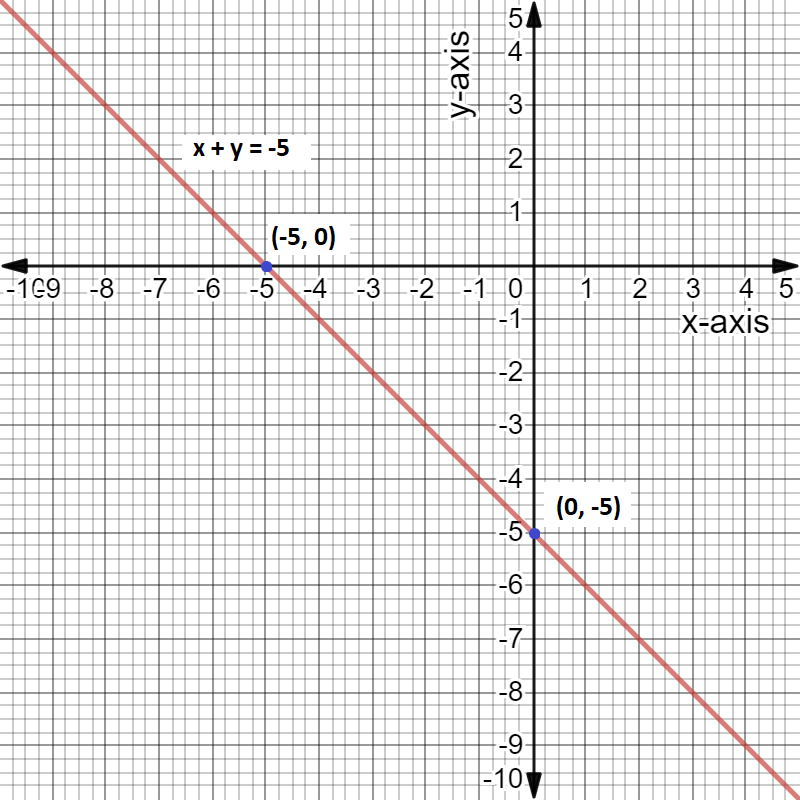
Also, $c = - 5$. So, the point at which line will cut y-axis is $(0,{\kern 1pt} {\kern 1pt} - 5)$
Now, we find the x-intercept by assuming $y = 0$ in the equation and evaluate the corresponding value of $x$. We assume here $y = 0$ because that the line will touch x-axis at that point.
$
x + y = - 5 \\
\Rightarrow x + 0 = - 5 \\
\Rightarrow x = - 5 \\
$
Thus, we get the point as $\left( { - 5,0} \right)$. This is the x-intercept of the graph of the given equation.
Hence, the slope of the given line is $3$, the x-intercept is $\left( { - 5,0} \right)$ and y-intercept is $(0,{\kern 1pt} {\kern 1pt} - 5)$
This can be shown by way of the graph of $x + y = - 5$.
Note: For a straight line, if two points $A({x_1},{\kern 1pt} {\kern 1pt} {\kern 1pt} {y_1})$ and $B({x_2},{\kern 1pt} {\kern 1pt} {\kern 1pt} {y_2})$ are situated on the line, then by slope formula we can calculate the slope (m) as, $m = \dfrac{{{y_2} - {y_1}}}{{{x_2} - {x_1}}}$.
For a linear equation, we can also find the intercepts by writing the equation in the form of $\dfrac{x}{a} + \dfrac{y}{b} = 1$, where $a$ will be the $x$ intercept and $b$ will be the $y$ intercept. For a linear equation in two variables we get at most one $x$ intercept and at most one $y$ intercept.
The intercepts are the points at which the line of an equation cuts the x-axis and y-axis. At the $x$ intercept on x-axis, $y = 0$. Similarly at the y-intercept on y-axis, $x = 0$.
Complete step by step solution:
We have to find the slope of the line given by the equation $x + y = - 5$.
We will use the slope-intercept formula to find the slope of the line.
The slope-intercept formula is given by $y = mx + c$.
On rearranging the equation, we get:
$
x + y = - 5 \\
\Rightarrow y = - x - 5 \\
$
On comparing the equation $y = - x - 5$ with the standard form of the slope-intercept formula, we see that
$m = - 1$ and $c = - 5$
Thus, the slope of the given line is $ - 1$
Also, $c = - 5$. So, the point at which line will cut y-axis is $(0,{\kern 1pt} {\kern 1pt} - 5)$
Now, we find the x-intercept by assuming $y = 0$ in the equation and evaluate the corresponding value of $x$. We assume here $y = 0$ because that the line will touch x-axis at that point.
$
x + y = - 5 \\
\Rightarrow x + 0 = - 5 \\
\Rightarrow x = - 5 \\
$
Thus, we get the point as $\left( { - 5,0} \right)$. This is the x-intercept of the graph of the given equation.
Hence, the slope of the given line is $3$, the x-intercept is $\left( { - 5,0} \right)$ and y-intercept is $(0,{\kern 1pt} {\kern 1pt} - 5)$
This can be shown by way of the graph of $x + y = - 5$.
Note: For a straight line, if two points $A({x_1},{\kern 1pt} {\kern 1pt} {\kern 1pt} {y_1})$ and $B({x_2},{\kern 1pt} {\kern 1pt} {\kern 1pt} {y_2})$ are situated on the line, then by slope formula we can calculate the slope (m) as, $m = \dfrac{{{y_2} - {y_1}}}{{{x_2} - {x_1}}}$.
For a linear equation, we can also find the intercepts by writing the equation in the form of $\dfrac{x}{a} + \dfrac{y}{b} = 1$, where $a$ will be the $x$ intercept and $b$ will be the $y$ intercept. For a linear equation in two variables we get at most one $x$ intercept and at most one $y$ intercept.
Recently Updated Pages
Master Class 11 English: Engaging Questions & Answers for Success

Master Class 11 Social Science: Engaging Questions & Answers for Success
Master Class 11 Maths: Engaging Questions & Answers for Success
Master Class 11 Biology: Engaging Questions & Answers for Success
Master Class 11 Physics: Engaging Questions & Answers for Success
Master Class 11 Chemistry: Engaging Questions & Answers for Success
Trending doubts
One Metric ton is equal to kg A 10000 B 1000 C 100 class 11 physics CBSE
Difference Between Prokaryotic Cells and Eukaryotic Cells
Find the value of the expression given below sin 30circ class 11 maths CBSE
Difference between physical and chemical change class 11 chemistry CBSE
Two of the body parts which do not appear in MRI are class 11 biology CBSE
Draw a diagram of a plant cell and label at least eight class 11 biology CBSE