




How can you find the slope and intercept of \[3y = 7\] ?
Answer
 Verified
545.7k+ views
Hint: Since we need to find the slope and intercept so we need to convert the equation into slope-intercept form by solving \[y\] and any linear equation has the form of \[y = mx + c\] where \[m\] stands as slope which can be found by finding two distinct points and \[c\] is the \[y\] intercept where graph hits \[y\] axis.
Formula used:
Since slope \[m\] depicts how steep the line is with respect to horizontal. So if in the line two points found are \[({x_1},{y_1})\] and \[({x_2},{y_2})\] so slope comes out to be
\[m = \dfrac{{{y_2} - {y_1}}}{{{x_2} - {x_1}}}\]
The point where line crosses why \[y\] axis is the \[y\] intercept \[c\]
Complete step by step solution:
As the given equation is \[3y = 7\]
Since we know that \[y = mx + c\] is the slope intercept form of a line where \[m\] is equal to slope and \[c\] is the \[y\] intercept \[(0,c)\]
Now by dividing both the sides of the equation by \[3\] we will put the given equation in slope-intercept form.
\[
\Rightarrow \dfrac{3}{3}y = \dfrac{7}{3} \\
\Rightarrow y = \dfrac{7}{3} \\
\Rightarrow y = 0x + \dfrac{7}{3} \\
\]
So they have a \[slope = 0\] and this is a horizontal line
It means \[slope = m = 0\] and y intercept \[c = \left( {0,\dfrac{7}{3}} \right)\]
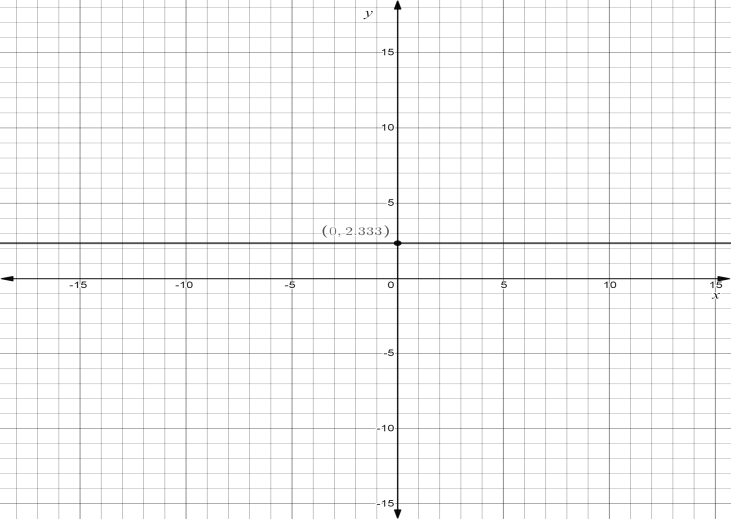
Note: While solving the above equation we need to convert the equation given in the slope intercept form and later on after finding the value of \[m\] and \[c\] then pick a point on line and check if it satisfies the equation by plugging it in. In the above equation the slope is horizontal as the value of \[m\] comes out to be \[0\]. For verification we put value of \[y\] in the equation \[3y = 7\] and we found that
\[
\Rightarrow 3 \times \dfrac{7}{3} = 7 \\
\Rightarrow 7 = 7 \\
\]
It means \[LHS = RHS\].
Formula used:
Since slope \[m\] depicts how steep the line is with respect to horizontal. So if in the line two points found are \[({x_1},{y_1})\] and \[({x_2},{y_2})\] so slope comes out to be
\[m = \dfrac{{{y_2} - {y_1}}}{{{x_2} - {x_1}}}\]
The point where line crosses why \[y\] axis is the \[y\] intercept \[c\]
Complete step by step solution:
As the given equation is \[3y = 7\]
Since we know that \[y = mx + c\] is the slope intercept form of a line where \[m\] is equal to slope and \[c\] is the \[y\] intercept \[(0,c)\]
Now by dividing both the sides of the equation by \[3\] we will put the given equation in slope-intercept form.
\[
\Rightarrow \dfrac{3}{3}y = \dfrac{7}{3} \\
\Rightarrow y = \dfrac{7}{3} \\
\Rightarrow y = 0x + \dfrac{7}{3} \\
\]
So they have a \[slope = 0\] and this is a horizontal line
It means \[slope = m = 0\] and y intercept \[c = \left( {0,\dfrac{7}{3}} \right)\]
Note: While solving the above equation we need to convert the equation given in the slope intercept form and later on after finding the value of \[m\] and \[c\] then pick a point on line and check if it satisfies the equation by plugging it in. In the above equation the slope is horizontal as the value of \[m\] comes out to be \[0\]. For verification we put value of \[y\] in the equation \[3y = 7\] and we found that
\[
\Rightarrow 3 \times \dfrac{7}{3} = 7 \\
\Rightarrow 7 = 7 \\
\]
It means \[LHS = RHS\].
Recently Updated Pages
Master Class 11 Computer Science: Engaging Questions & Answers for Success

Master Class 11 Business Studies: Engaging Questions & Answers for Success
Master Class 11 Economics: Engaging Questions & Answers for Success
Master Class 11 English: Engaging Questions & Answers for Success
Master Class 11 Maths: Engaging Questions & Answers for Success
Master Class 11 Biology: Engaging Questions & Answers for Success
Trending doubts
One Metric ton is equal to kg A 10000 B 1000 C 100 class 11 physics CBSE
There are 720 permutations of the digits 1 2 3 4 5 class 11 maths CBSE
Discuss the various forms of bacteria class 11 biology CBSE
Draw a diagram of a plant cell and label at least eight class 11 biology CBSE
State the laws of reflection of light
Explain zero factorial class 11 maths CBSE