




Find the set of values of \[k\] for which the equation \[{x^2} + 2\left( {k - 1} \right)x + k - 1 = 0\] has no real roots?
Answer
 Verified
490.5k+ views
Hint: To find the set of values of \[k\] for which the equation \[{x^2} + 2\left( {k - 1} \right)x + k - 1 = 0\] has no real roots, we will use the concept of discriminant which is denoted by \[D\]. As, we know that for an equation \[a{x^2} + bx + c = 0\] to have no real roots \[D < 0\] i.e., \[{b^2} - 4ac < 0\]. We will put the values and solve the inequality to get the possible values.
Complete step by step answer:
We have been given a quadratic equation \[{x^2} + 2\left( {k - 1} \right)x + k - 1 = 0\] and we have to find the value of \[k\] for which the given equation has no real roots.
As we know that the given equation is of the form \[a{x^2} + bx + c = 0\] and to have no real roots the value of discriminant of an equation must be less than zero i.e., \[D < 0\].
Now, we know that \[D = {b^2} - 4ac\]
The given quadratic equation is \[{x^2} + 2\left( {k - 1} \right)x + k - 1 = 0\]. Here, \[a = 1\], \[b = 2\left( {k - 1} \right)\] and \[c = k - 1\].
Putting all these values in the formula in \[D < 0\], we get
\[ \Rightarrow {b^2} - 4ac < 0\]
\[ \Rightarrow {\left[ {2(k - 1)} \right]^2} - 4 \times \left( 1 \right) \times \left( {k - 1} \right) < 0\]
On simplification, we get
\[ \Rightarrow \left[ {4({k^2} - 2k + 1)} \right] - 4(k - 1) < 0\]
Taking \[4\] common, we get
\[ \Rightarrow 4\left( {{k^2} - 2k + 1 - k + 1} \right) < 0\]
As we know, inequality remains the same when dividing both sides by a positive number.
Dividing both the sides by \[4\], we get
\[ \Rightarrow {k^2} - 2k + 1 - k + 1 < 0\]
On simplification, we get
\[ \Rightarrow {k^2} - 3k + 2 < 0\]
On splitting the middle term, we get
\[ \Rightarrow {k^2} - k - 2k + 2 < 0\]
Taking the terms common, we get
\[ \Rightarrow k\left( {k - 1} \right) - 2\left( {k - 1} \right) < 0\]
Now taking \[\left( {k - 1} \right)\] common, we get
\[ \Rightarrow \left( {k - 1} \right)\left( {k - 2} \right) < 0\]
On solving this inequality, we get
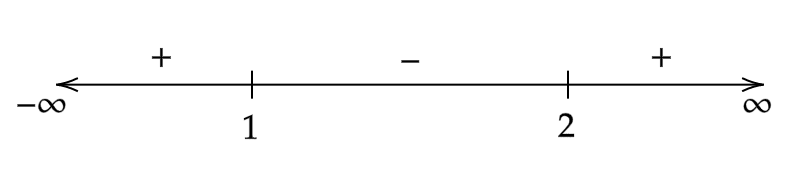
For \[k > 2\], we get \[\left( {k - 1} \right)\left( {k - 2} \right) > 0\].
For \[1 < k < 2\], we get \[\left( {k - 1} \right)\left( {k - 2} \right) < 0\].
For \[k < 1\], we get \[\left( {k - 1} \right)\left( {k - 2} \right) > 0\].
So, we get \[\left( {k - 1} \right)\left( {k - 2} \right) < 0\] for \[k \in \left( {1,2} \right)\].
Therefore, the set of values of \[k\] for which the equation \[{x^2} + 2\left( {k - 1} \right)x + k - 1 = 0\] has no real roots is \[k \in \left( {1,2} \right)\].
Note:Here, \[1\] and \[2\] are not included in the set of values of \[k\]. Here, one point to note is that square bracket \[\left[ {} \right]\] states that the end elements of the range will satisfy the given expression whereas the round bracket \[\left( {} \right)\] states that the end elements will not satisfy the given expression.
Complete step by step answer:
We have been given a quadratic equation \[{x^2} + 2\left( {k - 1} \right)x + k - 1 = 0\] and we have to find the value of \[k\] for which the given equation has no real roots.
As we know that the given equation is of the form \[a{x^2} + bx + c = 0\] and to have no real roots the value of discriminant of an equation must be less than zero i.e., \[D < 0\].
Now, we know that \[D = {b^2} - 4ac\]
The given quadratic equation is \[{x^2} + 2\left( {k - 1} \right)x + k - 1 = 0\]. Here, \[a = 1\], \[b = 2\left( {k - 1} \right)\] and \[c = k - 1\].
Putting all these values in the formula in \[D < 0\], we get
\[ \Rightarrow {b^2} - 4ac < 0\]
\[ \Rightarrow {\left[ {2(k - 1)} \right]^2} - 4 \times \left( 1 \right) \times \left( {k - 1} \right) < 0\]
On simplification, we get
\[ \Rightarrow \left[ {4({k^2} - 2k + 1)} \right] - 4(k - 1) < 0\]
Taking \[4\] common, we get
\[ \Rightarrow 4\left( {{k^2} - 2k + 1 - k + 1} \right) < 0\]
As we know, inequality remains the same when dividing both sides by a positive number.
Dividing both the sides by \[4\], we get
\[ \Rightarrow {k^2} - 2k + 1 - k + 1 < 0\]
On simplification, we get
\[ \Rightarrow {k^2} - 3k + 2 < 0\]
On splitting the middle term, we get
\[ \Rightarrow {k^2} - k - 2k + 2 < 0\]
Taking the terms common, we get
\[ \Rightarrow k\left( {k - 1} \right) - 2\left( {k - 1} \right) < 0\]
Now taking \[\left( {k - 1} \right)\] common, we get
\[ \Rightarrow \left( {k - 1} \right)\left( {k - 2} \right) < 0\]
On solving this inequality, we get
For \[k > 2\], we get \[\left( {k - 1} \right)\left( {k - 2} \right) > 0\].
For \[1 < k < 2\], we get \[\left( {k - 1} \right)\left( {k - 2} \right) < 0\].
For \[k < 1\], we get \[\left( {k - 1} \right)\left( {k - 2} \right) > 0\].
So, we get \[\left( {k - 1} \right)\left( {k - 2} \right) < 0\] for \[k \in \left( {1,2} \right)\].
Therefore, the set of values of \[k\] for which the equation \[{x^2} + 2\left( {k - 1} \right)x + k - 1 = 0\] has no real roots is \[k \in \left( {1,2} \right)\].
Note:Here, \[1\] and \[2\] are not included in the set of values of \[k\]. Here, one point to note is that square bracket \[\left[ {} \right]\] states that the end elements of the range will satisfy the given expression whereas the round bracket \[\left( {} \right)\] states that the end elements will not satisfy the given expression.
Recently Updated Pages
Master Class 11 Computer Science: Engaging Questions & Answers for Success

Master Class 11 Business Studies: Engaging Questions & Answers for Success
Master Class 11 Economics: Engaging Questions & Answers for Success
Master Class 11 English: Engaging Questions & Answers for Success
Master Class 11 Maths: Engaging Questions & Answers for Success
Master Class 11 Biology: Engaging Questions & Answers for Success
Trending doubts
One Metric ton is equal to kg A 10000 B 1000 C 100 class 11 physics CBSE
There are 720 permutations of the digits 1 2 3 4 5 class 11 maths CBSE
Discuss the various forms of bacteria class 11 biology CBSE
Draw a diagram of a plant cell and label at least eight class 11 biology CBSE
State the laws of reflection of light
Explain zero factorial class 11 maths CBSE