




How do you find the remaining sides of a \[{{45}^{\circ }}-{{45}^{\circ }}-{{90}^{\circ }}\] triangle if the shortest sides are each \[\dfrac{1}{2}\]?
Answer
 Verified
541.5k+ views
Hint: In order to find the solution to the given question that is to find the remaining sides of a \[{{45}^{\circ }}-{{45}^{\circ }}-{{90}^{\circ }}\] triangle if the shortest sides are each \[\dfrac{1}{2}\], we should apply the Pythagoras theorem for right-angled triangle which states that \[\text{Hypotenus}{{\text{e}}^{2}}~=\text{ Perpendicula}{{\text{r}}^{2}}~+\text{ Bas}{{\text{e}}^{2}}~\]where Perpendicular, Base and Hypotenuse are named as the sides of the triangle. In the question, it’s mentioned that the perpendicular side and base are equal to \[\dfrac{1}{2}\]. Here, the hypotenuse is the longest side, as it is opposite to the angle 90°, so we can find the hypotenuse by using Pythagoras theorem.
Complete step by step solution:
We have been given a \[{{45}^{\circ }}-{{45}^{\circ }}-{{90}^{\circ }}\] right triangle and the length of its shortest sides are each \[\dfrac{1}{2}\] according to the question, the angles of the triangle are \[{{45}^{\circ }},{{45}^{\circ }}\text{ }\!\!\And\!\!\text{ }{{90}^{\circ }}\] . Since two of the angles are the same and the third one is a right-angle. Therefore, it’s a right-angled triangle. The length of two sides perpendicular and Base is equal to \[\dfrac{1}{2}\] units.
Let us assume Hypotenuse to be equal to \[x\] units. Therefore, the triangle will look as follows:
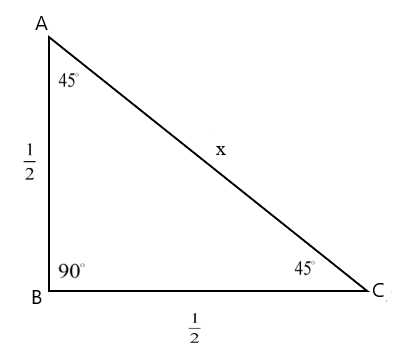
Apply the Pythagoras theorem which states that “In a right-angled triangle, the square of the hypotenuse side is equal to the sum of squares of the other two sides that is \[\text{Hypotenus}{{\text{e}}^{2}}~=\text{ Perpendicula}{{\text{r}}^{2}}~+\text{ Bas}{{\text{e}}^{2}}~\] “.
Now substitute the values from the figure in this formula we will get:
\[\Rightarrow {{x}^{2}}={{\left( \dfrac{1}{2} \right)}^{2}}+{{\left( \dfrac{1}{2} \right)}^{2}}\]
Simplifying it further we get:
\[\Rightarrow {{x}^{2}}=\left( \dfrac{1}{4} \right)+\left( \dfrac{1}{4} \right)\]
Taking LCM on the right-hand side, we get:
\[\Rightarrow {{x}^{2}}=\dfrac{1+1}{4}\]
\[\Rightarrow {{x}^{2}}=\dfrac{2}{4}\]
Take square root both the sides we get:
\[\Rightarrow x=\sqrt{\dfrac{2}{4}}\]
\[\Rightarrow x=\pm \dfrac{\sqrt{2}}{2}\]
We know that length of a side can never be negative which implies:
\[\Rightarrow x=\dfrac{\sqrt{2}}{2}\]
Therefore, the length of the remaining side of the \[{{45}^{\circ }}-{{45}^{\circ }}-{{90}^{\circ }}\] triangle is \[\dfrac{\sqrt{2}}{2}\] units.
Note: There’s alternative method to find the length of the hypotenuse:
We know that \[\sin \theta =\dfrac{\text{Perpendicular}}{\text{Hypotenuse}}\], Therefore by substitute the values from the figure in this formula we will get:
\[\Rightarrow \sin {{45}^{\circ }}=\dfrac{\dfrac{1}{2}}{\text{x}}\]
Simplifying it further we get:
\[\Rightarrow \sin {{45}^{\circ }}=\dfrac{1}{\text{2x}}\]
We know that \[\sin {{45}^{\circ }}=\dfrac{1}{\sqrt{2}}\], using it in the above equation, we get:
\[\Rightarrow \dfrac{1}{\sqrt{2}}=\dfrac{1}{\text{2x}}\]
\[\Rightarrow x=\dfrac{\sqrt{2}}{2}\]
Therefore, the length of the remaining side (Hypotenuse) of the \[{{45}^{\circ }}-{{45}^{\circ }}-{{90}^{\circ }}\] triangle is \[\dfrac{\sqrt{2}}{2}\] units.
Complete step by step solution:
We have been given a \[{{45}^{\circ }}-{{45}^{\circ }}-{{90}^{\circ }}\] right triangle and the length of its shortest sides are each \[\dfrac{1}{2}\] according to the question, the angles of the triangle are \[{{45}^{\circ }},{{45}^{\circ }}\text{ }\!\!\And\!\!\text{ }{{90}^{\circ }}\] . Since two of the angles are the same and the third one is a right-angle. Therefore, it’s a right-angled triangle. The length of two sides perpendicular and Base is equal to \[\dfrac{1}{2}\] units.
Let us assume Hypotenuse to be equal to \[x\] units. Therefore, the triangle will look as follows:
Apply the Pythagoras theorem which states that “In a right-angled triangle, the square of the hypotenuse side is equal to the sum of squares of the other two sides that is \[\text{Hypotenus}{{\text{e}}^{2}}~=\text{ Perpendicula}{{\text{r}}^{2}}~+\text{ Bas}{{\text{e}}^{2}}~\] “.
Now substitute the values from the figure in this formula we will get:
\[\Rightarrow {{x}^{2}}={{\left( \dfrac{1}{2} \right)}^{2}}+{{\left( \dfrac{1}{2} \right)}^{2}}\]
Simplifying it further we get:
\[\Rightarrow {{x}^{2}}=\left( \dfrac{1}{4} \right)+\left( \dfrac{1}{4} \right)\]
Taking LCM on the right-hand side, we get:
\[\Rightarrow {{x}^{2}}=\dfrac{1+1}{4}\]
\[\Rightarrow {{x}^{2}}=\dfrac{2}{4}\]
Take square root both the sides we get:
\[\Rightarrow x=\sqrt{\dfrac{2}{4}}\]
\[\Rightarrow x=\pm \dfrac{\sqrt{2}}{2}\]
We know that length of a side can never be negative which implies:
\[\Rightarrow x=\dfrac{\sqrt{2}}{2}\]
Therefore, the length of the remaining side of the \[{{45}^{\circ }}-{{45}^{\circ }}-{{90}^{\circ }}\] triangle is \[\dfrac{\sqrt{2}}{2}\] units.
Note: There’s alternative method to find the length of the hypotenuse:
We know that \[\sin \theta =\dfrac{\text{Perpendicular}}{\text{Hypotenuse}}\], Therefore by substitute the values from the figure in this formula we will get:
\[\Rightarrow \sin {{45}^{\circ }}=\dfrac{\dfrac{1}{2}}{\text{x}}\]
Simplifying it further we get:
\[\Rightarrow \sin {{45}^{\circ }}=\dfrac{1}{\text{2x}}\]
We know that \[\sin {{45}^{\circ }}=\dfrac{1}{\sqrt{2}}\], using it in the above equation, we get:
\[\Rightarrow \dfrac{1}{\sqrt{2}}=\dfrac{1}{\text{2x}}\]
\[\Rightarrow x=\dfrac{\sqrt{2}}{2}\]
Therefore, the length of the remaining side (Hypotenuse) of the \[{{45}^{\circ }}-{{45}^{\circ }}-{{90}^{\circ }}\] triangle is \[\dfrac{\sqrt{2}}{2}\] units.
Recently Updated Pages
Master Class 10 Computer Science: Engaging Questions & Answers for Success

Master Class 10 General Knowledge: Engaging Questions & Answers for Success
Master Class 10 English: Engaging Questions & Answers for Success
Master Class 10 Social Science: Engaging Questions & Answers for Success
Master Class 10 Maths: Engaging Questions & Answers for Success
Master Class 10 Science: Engaging Questions & Answers for Success
Trending doubts
What is the median of the first 10 natural numbers class 10 maths CBSE
Which women's tennis player has 24 Grand Slam singles titles?
Who is the Brand Ambassador of Incredible India?
Why is there a time difference of about 5 hours between class 10 social science CBSE
Write a letter to the principal requesting him to grant class 10 english CBSE
A moving boat is observed from the top of a 150 m high class 10 maths CBSE