




Find the ratio in which the y-axis divides the line segment joining the points (5,-6) and (-1,-4). Also, find the coordinates of the point of division.
Answer
 Verified
638.7k+ views
Hint: In this question, we will use the concept of section formulae of coordinate geometry. This states that the coordinate of the point which divides the line segment joining the points $({x_1},{y_1})$and $({x_2},{y_2})$ internally in the ratio m:n is given by $\left( {x = \dfrac{{m{x_2} + n{x_1}}}{{m + n}},y = \dfrac{{m{y_2} + n{y_1}}}{{m + n}}} \right)$. …….(i)
Complete step-by-step answer:
Here , we have given points of the line segment , (5,-6) and (-1,-4)
Comparing this with $({x_1},{y_1})$and $({x_2},{y_2})$, we get
${x_1} = 5,{x_2} = - 1,{y_1} = - 6$ and ${y_2} = - 4$.
Let the required ratio be k:1.
Then by using the section formula,
$\left( {x = \dfrac{{m{x_2} + n{x_1}}}{{m + n}},y = \dfrac{{m{y_2} + n{y_1}}}{{m + n}}} \right)$
According to the question, the point of division is on the y-axis, hence the x- coordinate of that point is 0.
Then, the coordinates of the point of division are,
$
\Rightarrow x = \dfrac{{m{x_2} + n{x_1}}}{{m + n}} \\
\Rightarrow 0 = \dfrac{{k( - 1) + 1(5)}}{{k + 1}} \\
\Rightarrow 0 = 5 - k \\
\Rightarrow k = 5 \\
$
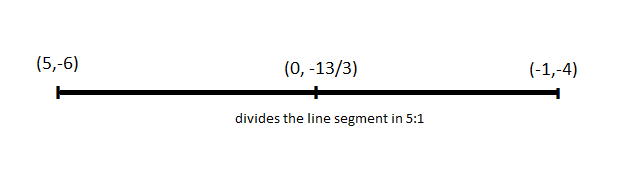
Hence, the ratio in which the y-axis divides the line segment is 5:1.
Now we have to find the coordinates of the point of division on y-axis, i.e. (0,y)
$ \Rightarrow $$y = \dfrac{{m{y_2} + n{y_1}}}{{m + n}}$
$
\Rightarrow y = \dfrac{{5( - 4) + 1( - 6)}}{{5 + 1}} \\
\Rightarrow y = \dfrac{{ - 20 - 6}}{6} = \dfrac{{ - 26}}{6} \\
\Rightarrow y = \dfrac{{ - 13}}{3} \\
$
Hence, the coordinates of the point of division is $\left( {0,\dfrac{{ - 13}}{3}} \right)$.
Note: In this type of question we have to remember the concept of the section formulae .First we have to find out the required values and then we will assume that the line segment will be divided in k:1. After that we will find out the coordinates of the point of division by putting those values in section formulae i.e. $\left( {x = \dfrac{{m{x_2} + n{x_1}}}{{m + n}},y = \dfrac{{m{y_2} + n{y_1}}}{{m + n}}} \right)$. After solving the formula step by step, we will get the required ratio of division and the coordinates of point of division.
Complete step-by-step answer:
Here , we have given points of the line segment , (5,-6) and (-1,-4)
Comparing this with $({x_1},{y_1})$and $({x_2},{y_2})$, we get
${x_1} = 5,{x_2} = - 1,{y_1} = - 6$ and ${y_2} = - 4$.
Let the required ratio be k:1.
Then by using the section formula,
$\left( {x = \dfrac{{m{x_2} + n{x_1}}}{{m + n}},y = \dfrac{{m{y_2} + n{y_1}}}{{m + n}}} \right)$
According to the question, the point of division is on the y-axis, hence the x- coordinate of that point is 0.
Then, the coordinates of the point of division are,
$
\Rightarrow x = \dfrac{{m{x_2} + n{x_1}}}{{m + n}} \\
\Rightarrow 0 = \dfrac{{k( - 1) + 1(5)}}{{k + 1}} \\
\Rightarrow 0 = 5 - k \\
\Rightarrow k = 5 \\
$
Hence, the ratio in which the y-axis divides the line segment is 5:1.
Now we have to find the coordinates of the point of division on y-axis, i.e. (0,y)
$ \Rightarrow $$y = \dfrac{{m{y_2} + n{y_1}}}{{m + n}}$
$
\Rightarrow y = \dfrac{{5( - 4) + 1( - 6)}}{{5 + 1}} \\
\Rightarrow y = \dfrac{{ - 20 - 6}}{6} = \dfrac{{ - 26}}{6} \\
\Rightarrow y = \dfrac{{ - 13}}{3} \\
$
Hence, the coordinates of the point of division is $\left( {0,\dfrac{{ - 13}}{3}} \right)$.
Note: In this type of question we have to remember the concept of the section formulae .First we have to find out the required values and then we will assume that the line segment will be divided in k:1. After that we will find out the coordinates of the point of division by putting those values in section formulae i.e. $\left( {x = \dfrac{{m{x_2} + n{x_1}}}{{m + n}},y = \dfrac{{m{y_2} + n{y_1}}}{{m + n}}} \right)$. After solving the formula step by step, we will get the required ratio of division and the coordinates of point of division.
Recently Updated Pages
Master Class 12 Economics: Engaging Questions & Answers for Success

Master Class 12 English: Engaging Questions & Answers for Success
Master Class 12 Social Science: Engaging Questions & Answers for Success
Master Class 12 Maths: Engaging Questions & Answers for Success
Master Class 12 Physics: Engaging Questions & Answers for Success
Master Class 11 Social Science: Engaging Questions & Answers for Success
Trending doubts
One Metric ton is equal to kg A 10000 B 1000 C 100 class 11 physics CBSE
Difference Between Prokaryotic Cells and Eukaryotic Cells
Two of the body parts which do not appear in MRI are class 11 biology CBSE
1 ton equals to A 100 kg B 1000 kg C 10 kg D 10000 class 11 physics CBSE
Draw a diagram of nephron and explain its structur class 11 biology CBSE
10 examples of friction in our daily life