




Find the ratio in which the point \[P\left( 3,5 \right)\] divides $\overline{AB}$ where \[A\left( 1,3 \right)\] and $B\left( 7,9 \right)$.
Answer
 Verified
602.1k+ views
Hint: We will first start defining the section formula and then we will apply the section formula for internal division that is $P\left( a,b \right)=\left( \dfrac{x{{a}_{2}}+y{{a}_{1}}}{x+y},\dfrac{x{{b}_{2}}+y{{b}_{1}}}{x+y} \right)$ to our given points and then get our ratio and hence, the answer. We have the points as $P\left( a,b \right)=P\left( 3,5 \right)$ , $A\left( {{a}_{1}},{{b}_{1}} \right)=A\left( 1,3 \right)$ and $B\left( {{a}_{2}},{{b}_{2}} \right)=B\left( 7,9 \right)$ .
Complete step by step answer:
To find the ratio in which the point \[P\left( 3,5 \right)\] divides $\overline{AB}$ where \[A\left( 1,3 \right)\] and $B\left( 7,9 \right)$ , we will use the section formula. First let’s define what a section formula is.
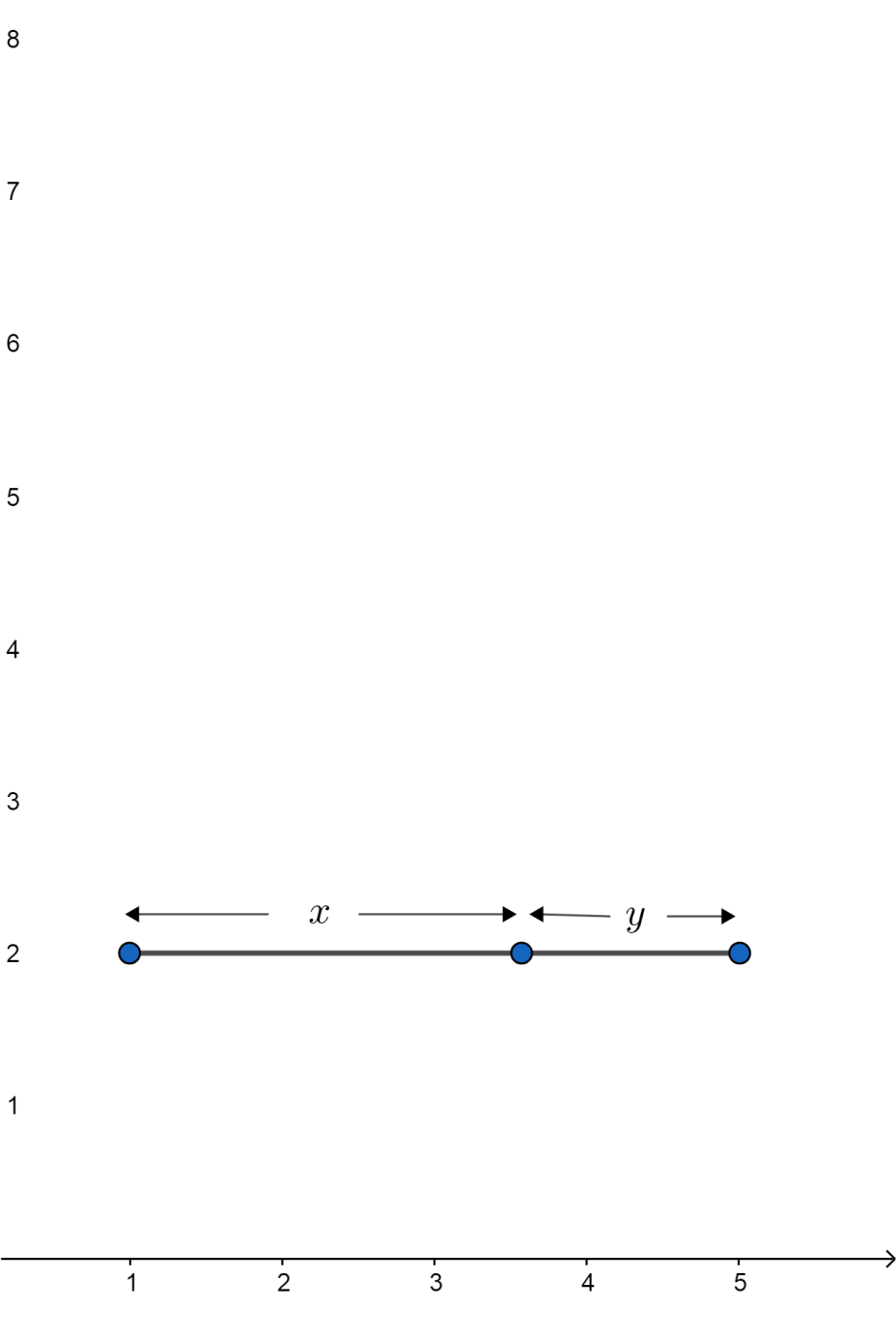
So basically, the section formula tells us the coordinates of the point which divides a given line segment into two parts such that their lengths are in the ratio $x:y$ as shown in the following figure:
Now, let’s see the formula of the internal division with section formula:
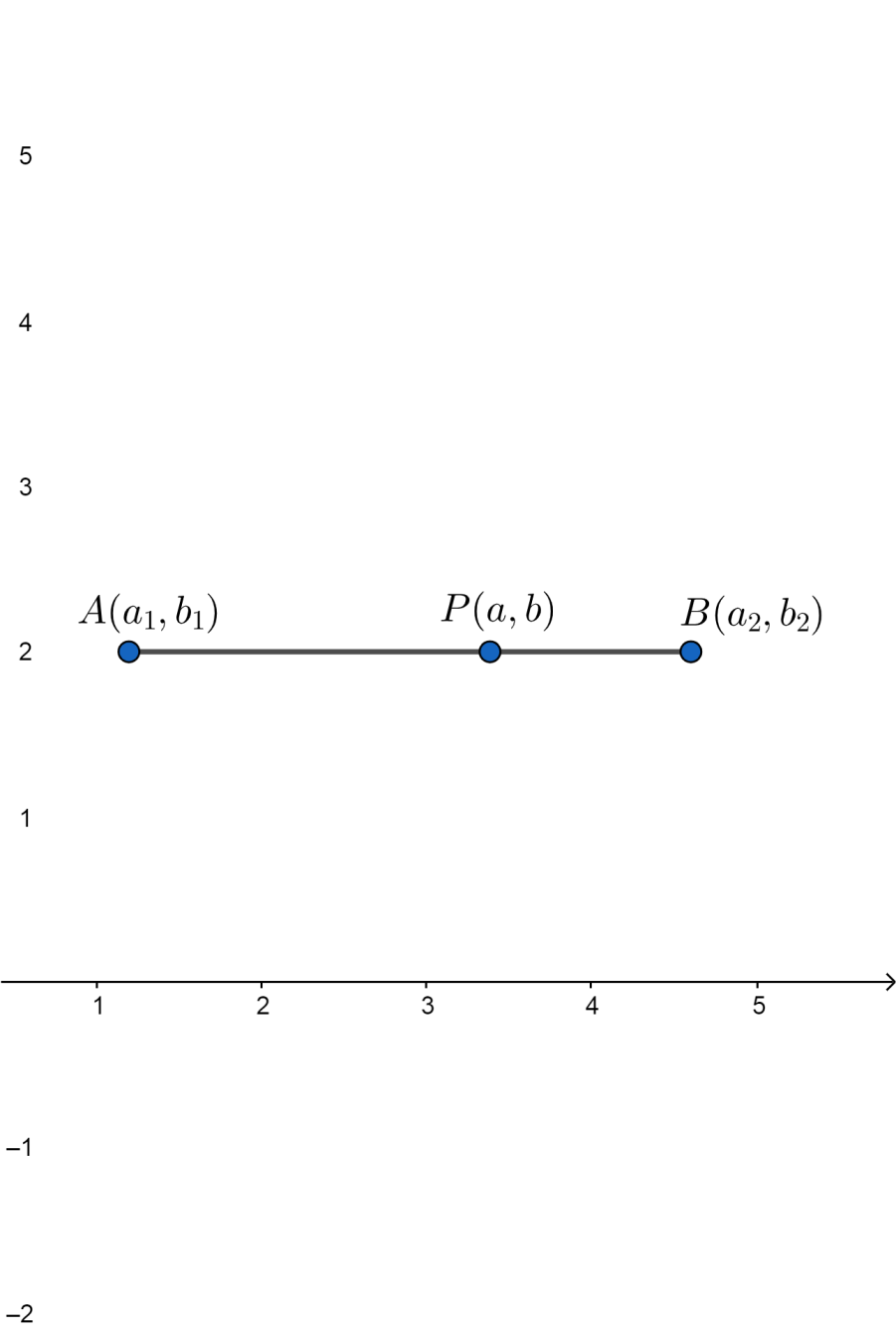
If point $P\left( a,b \right)$ lies on line segment $AB$ (between points $A$ and $B$) and satisfies \[AP:PB=x:y\] , then we say that $P$ divides \[AB\] internally in the ratio $x:y$ . The point of division has the coordinates:
$P\left( a,b \right)=\left( \dfrac{x{{a}_{2}}+y{{a}_{1}}}{x+y},\dfrac{x{{b}_{2}}+y{{b}_{1}}}{x+y} \right)$
So, let’s take the question, and see it is given that the point \[P\left( 3,5 \right)\] divides $\overline{AB}$ where \[A\left( 1,3 \right)\] and $B\left( 7,9 \right)$ :
Now, we can solve this question in normal method by assuming the ratio to be $x:y$ . But now we will take a different substitution. Let’s assume that $k=\dfrac{x}{y}$ so that $x:y=k:1$ .
Now the required ratio will be $k:1$, now the formula for internal division will become:
\[P\left( a,b \right)=\left( \dfrac{k{{a}_{2}}+{{a}_{1}}}{k+1},\dfrac{k{{b}_{2}}+{{b}_{1}}}{k+1} \right)\]
Now we have $P\left( a,b \right)=P\left( 3,5 \right)$ , $A\left( {{a}_{1}},{{b}_{1}} \right)=A\left( 1,3 \right)$ and $B\left( {{a}_{2}},{{b}_{2}} \right)=B\left( 7,9 \right)$ :
\[\begin{align}
& \Rightarrow P\left( a,b \right)=\left( \dfrac{k{{a}_{2}}+{{a}_{1}}}{k+1},\dfrac{k{{b}_{2}}+{{b}_{1}}}{k+1} \right)\Rightarrow a=\dfrac{k{{a}_{2}}+{{a}_{1}}}{k+1} \\
& \Rightarrow 3=\dfrac{\left( k\times 7 \right)+1}{k+1}\Rightarrow 3=\dfrac{7k+1}{k+1}\Rightarrow 3\left( k+1 \right)=7k+1 \\
& \Rightarrow 3k+3=7k+1\Rightarrow 3-1=7k-3k\Rightarrow 2=4k \\
& \Rightarrow k=\dfrac{1}{2} \\
\end{align}\]
Therefore, the ratio in which \[P\left( 3,5 \right)\] divides $\overline{AB}$ is $1:2$ .
Note:
We can also solve this by following method with the graph, so we have:
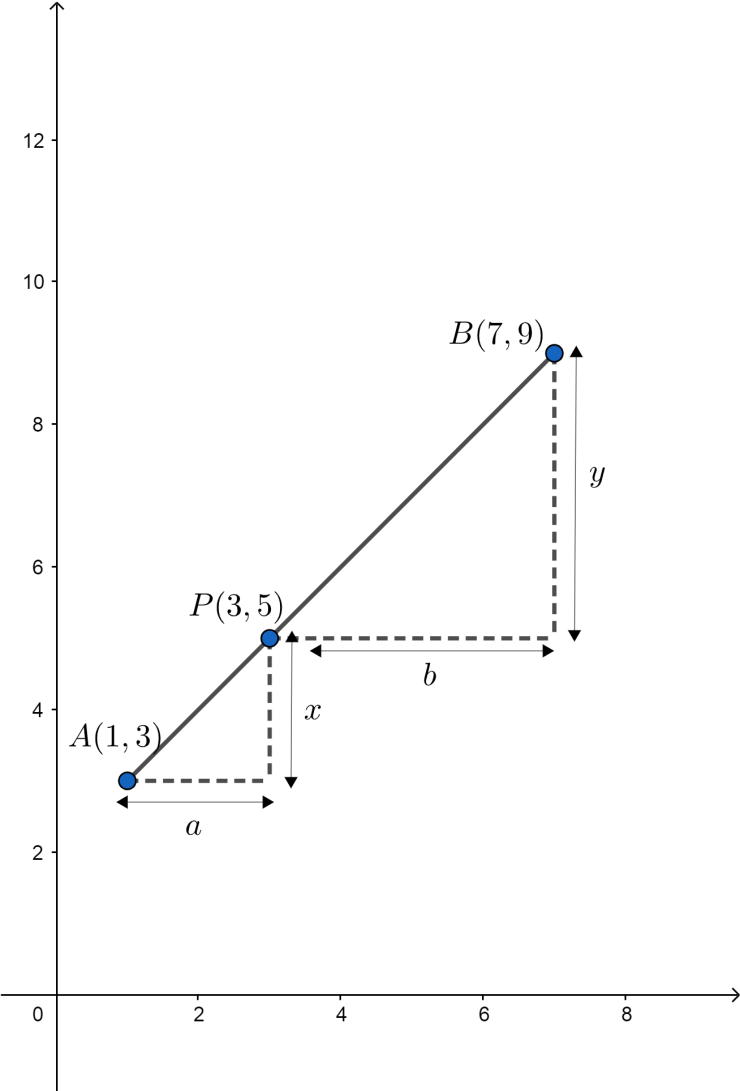
Now, from the graph we have:
$\begin{align}
& \Rightarrow x=\left( 5-3 \right)=2,y=\left( 9-5 \right)=4 \\
& \Rightarrow x:y=2:4=1:2 \\
& \Rightarrow a=\left( 3-1 \right)=2,b=\left( 7-3 \right)=4 \\
& \Rightarrow a:b=2:4=1:2 \\
\end{align}$
Therefore, the ratio is $1:2$ .
Complete step by step answer:
To find the ratio in which the point \[P\left( 3,5 \right)\] divides $\overline{AB}$ where \[A\left( 1,3 \right)\] and $B\left( 7,9 \right)$ , we will use the section formula. First let’s define what a section formula is.
So basically, the section formula tells us the coordinates of the point which divides a given line segment into two parts such that their lengths are in the ratio $x:y$ as shown in the following figure:
Now, let’s see the formula of the internal division with section formula:
If point $P\left( a,b \right)$ lies on line segment $AB$ (between points $A$ and $B$) and satisfies \[AP:PB=x:y\] , then we say that $P$ divides \[AB\] internally in the ratio $x:y$ . The point of division has the coordinates:
$P\left( a,b \right)=\left( \dfrac{x{{a}_{2}}+y{{a}_{1}}}{x+y},\dfrac{x{{b}_{2}}+y{{b}_{1}}}{x+y} \right)$
So, let’s take the question, and see it is given that the point \[P\left( 3,5 \right)\] divides $\overline{AB}$ where \[A\left( 1,3 \right)\] and $B\left( 7,9 \right)$ :
Now, we can solve this question in normal method by assuming the ratio to be $x:y$ . But now we will take a different substitution. Let’s assume that $k=\dfrac{x}{y}$ so that $x:y=k:1$ .
Now the required ratio will be $k:1$, now the formula for internal division will become:
\[P\left( a,b \right)=\left( \dfrac{k{{a}_{2}}+{{a}_{1}}}{k+1},\dfrac{k{{b}_{2}}+{{b}_{1}}}{k+1} \right)\]
Now we have $P\left( a,b \right)=P\left( 3,5 \right)$ , $A\left( {{a}_{1}},{{b}_{1}} \right)=A\left( 1,3 \right)$ and $B\left( {{a}_{2}},{{b}_{2}} \right)=B\left( 7,9 \right)$ :
\[\begin{align}
& \Rightarrow P\left( a,b \right)=\left( \dfrac{k{{a}_{2}}+{{a}_{1}}}{k+1},\dfrac{k{{b}_{2}}+{{b}_{1}}}{k+1} \right)\Rightarrow a=\dfrac{k{{a}_{2}}+{{a}_{1}}}{k+1} \\
& \Rightarrow 3=\dfrac{\left( k\times 7 \right)+1}{k+1}\Rightarrow 3=\dfrac{7k+1}{k+1}\Rightarrow 3\left( k+1 \right)=7k+1 \\
& \Rightarrow 3k+3=7k+1\Rightarrow 3-1=7k-3k\Rightarrow 2=4k \\
& \Rightarrow k=\dfrac{1}{2} \\
\end{align}\]
Therefore, the ratio in which \[P\left( 3,5 \right)\] divides $\overline{AB}$ is $1:2$ .
Note:
We can also solve this by following method with the graph, so we have:
Now, from the graph we have:
$\begin{align}
& \Rightarrow x=\left( 5-3 \right)=2,y=\left( 9-5 \right)=4 \\
& \Rightarrow x:y=2:4=1:2 \\
& \Rightarrow a=\left( 3-1 \right)=2,b=\left( 7-3 \right)=4 \\
& \Rightarrow a:b=2:4=1:2 \\
\end{align}$
Therefore, the ratio is $1:2$ .
Recently Updated Pages
Master Class 10 Social Science: Engaging Questions & Answers for Success

Master Class 10 Science: Engaging Questions & Answers for Success
Master Class 10 Maths: Engaging Questions & Answers for Success
Master Class 10 General Knowledge: Engaging Questions & Answers for Success
Master Class 10 Computer Science: Engaging Questions & Answers for Success
Class 10 Question and Answer - Your Ultimate Solutions Guide
Trending doubts
What is the full form of PNG A Petrol Natural Gas B class 10 chemistry CBSE
Explain the Treaty of Vienna of 1815 class 10 social science CBSE
In cricket, how many legal balls are there in a standard over?
Why is there a time difference of about 5 hours between class 10 social science CBSE
Who Won 36 Oscar Awards? Record Holder Revealed
What is the median of the first 10 natural numbers class 10 maths CBSE