




Find the ratio in which the line segment joining the points\[\left( { - 3,10} \right)\] and \[\left( {6, - 8} \right)\] is divided by \[\left( { - 1,6} \right)\].
Answer
 Verified
528.9k+ views
Hint:For a better understanding we will make a line segment, and label the coordinates there and the assumptions on the segment itself. After that we will assume the ratio is \[k:1\] and the values of \[{m_1}{m_2}\] respectively. and after doing all this we will put it in the section formula.
Complete step by step answer:
For a better understanding we will make a line segment and allot the points on it,
A\[\left( { - 3,10} \right)\], B\[\left( {6, - 8} \right)\], C\[\left( { - 1,6} \right)\]
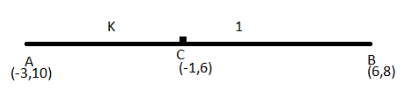
In the drawn diagram, we have to find the ratio between both the points $AC$ and $CB$. Let’s assume that the ratio is \[k:1\] so, \[{m_1} = k,{m_2} = 1\],
\[{x_1} = - 3,{x_2} = 6\]\[{y_1} = 10,{y_2} = - 8\]
Now using the section formula for further assessment, we get:
\[x = \left( {\dfrac{{{m_1}{x_2} + {m_2}{x_1}}}{{{m_1} + {m_2}}}} \right)\]
\[\Rightarrow - 1 = \left( {\dfrac{{k \times 6 + 1 \times - 3}}{{k + 1}}} \right) \\
\Rightarrow - 1 = \left( {\dfrac{{6k - 3}}{{k + 1}}} \right)\]
\[\Rightarrow - 1\left( {k + 1} \right) = 6k - 3\]
\[\Rightarrow - k - 1 = 6k - 3 \\
\Rightarrow - k - 6k = - 3 + 1 \\
\Rightarrow - 7k = - 2\]
\[\Rightarrow k = \left( {\dfrac{{ - 2}}{{ - 7}}} \right) \\
\Rightarrow k = \left( {\dfrac{2}{7}} \right)\]
Now we got the value of k and from our assumption its in ratio with 1.Hence the ratio is \[k:1\] so, now we can say that:
\[\dfrac{2}{7}:1\]
Multiplying 7 on both sides in order to equalise the ratio
\[7 \times \dfrac{2}{7}:7 \times 1 \Rightarrow 2:7\]
So, the ratio is \[2:7\].
Note:Above question can be solved easily. Generally, the students do not make diagrams and skip the labelling part which makes it quite difficult to visualise and hence one should always make a diagram for an easy solution.
Complete step by step answer:
For a better understanding we will make a line segment and allot the points on it,
A\[\left( { - 3,10} \right)\], B\[\left( {6, - 8} \right)\], C\[\left( { - 1,6} \right)\]
In the drawn diagram, we have to find the ratio between both the points $AC$ and $CB$. Let’s assume that the ratio is \[k:1\] so, \[{m_1} = k,{m_2} = 1\],
\[{x_1} = - 3,{x_2} = 6\]\[{y_1} = 10,{y_2} = - 8\]
Now using the section formula for further assessment, we get:
\[x = \left( {\dfrac{{{m_1}{x_2} + {m_2}{x_1}}}{{{m_1} + {m_2}}}} \right)\]
\[\Rightarrow - 1 = \left( {\dfrac{{k \times 6 + 1 \times - 3}}{{k + 1}}} \right) \\
\Rightarrow - 1 = \left( {\dfrac{{6k - 3}}{{k + 1}}} \right)\]
\[\Rightarrow - 1\left( {k + 1} \right) = 6k - 3\]
\[\Rightarrow - k - 1 = 6k - 3 \\
\Rightarrow - k - 6k = - 3 + 1 \\
\Rightarrow - 7k = - 2\]
\[\Rightarrow k = \left( {\dfrac{{ - 2}}{{ - 7}}} \right) \\
\Rightarrow k = \left( {\dfrac{2}{7}} \right)\]
Now we got the value of k and from our assumption its in ratio with 1.Hence the ratio is \[k:1\] so, now we can say that:
\[\dfrac{2}{7}:1\]
Multiplying 7 on both sides in order to equalise the ratio
\[7 \times \dfrac{2}{7}:7 \times 1 \Rightarrow 2:7\]
So, the ratio is \[2:7\].
Note:Above question can be solved easily. Generally, the students do not make diagrams and skip the labelling part which makes it quite difficult to visualise and hence one should always make a diagram for an easy solution.
Recently Updated Pages
Master Class 11 Social Science: Engaging Questions & Answers for Success

Master Class 11 Physics: Engaging Questions & Answers for Success
Master Class 11 Maths: Engaging Questions & Answers for Success
Master Class 11 Economics: Engaging Questions & Answers for Success
Master Class 11 Computer Science: Engaging Questions & Answers for Success
Master Class 11 Chemistry: Engaging Questions & Answers for Success
Trending doubts
One Metric ton is equal to kg A 10000 B 1000 C 100 class 11 physics CBSE
There are 720 permutations of the digits 1 2 3 4 5 class 11 maths CBSE
1 Quintal is equal to a 110 kg b 10 kg c 100kg d 1000 class 11 physics CBSE
State and prove Bernoullis theorem class 11 physics CBSE
Difference Between Prokaryotic Cells and Eukaryotic Cells
Which among the following are examples of coming together class 11 social science CBSE